Haplogroup BT

– 6 min read


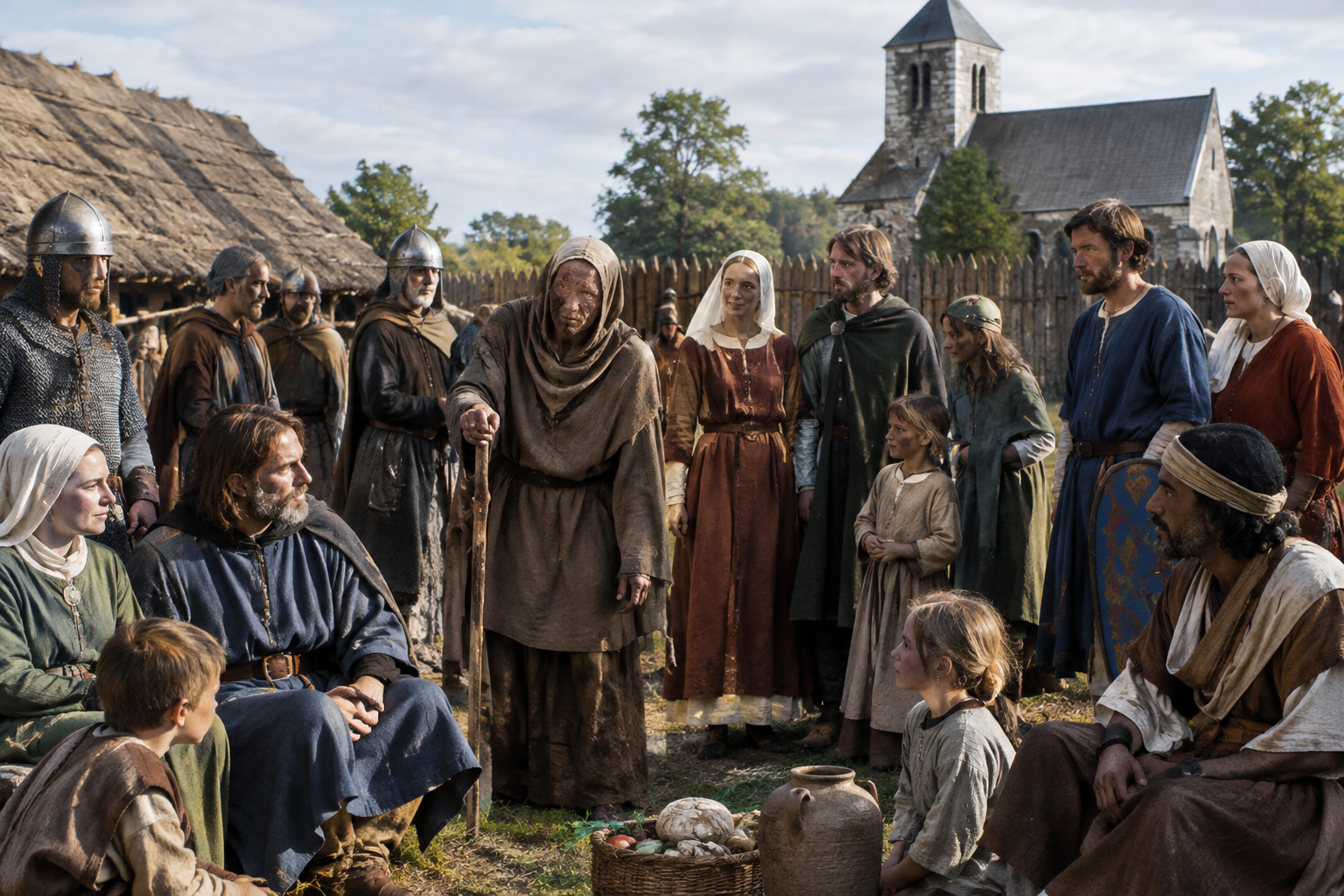
Haplogroup BT is an odd subject for a historical article, and that is exactly what makes it interesting. Most readers meet Y-DNA through more familiar labels further down the tree, the branches that turn up in discussions of Bronze Age Europe, Viking migrations, medieval dynasties, or named regional lineages. BT sits much higher up. It is one of the great ancestral trunks of the human Y-chromosome tree, ancestral to the overwhelming majority of living paternal lines outside some of the earliest-diverging African branches. In other words, when BT appears in an ancient DNA context, we are often looking not at a neat, tightly defined medieval clan marker, but at a very old paternal framework within which much later histories unfolded.
That matters because Y-DNA traces one line only: father to son to son across many generations. It does not describe a person's whole ancestry, culture, language, or identity. But as a tool for reconstructing paternal history, it is extraordinarily revealing. With BT, the story is not the tale of one kingdom or one people. It is the deep background to an enormous number of later lineages, glimpsed through burials that range from Bronze Age Alpine Europe to Iron Age Ashkelon, and then into the lived medieval worlds of England, Germany, Poland, Spain, and Denmark.
In the Y-chromosome family tree, BT is an ancient parent branch from which many later haplogroups descend. That simple fact is the key to understanding why the samples associated with BT can look so geographically and historically diverse. We should not imagine BT as the signature of one tribe marching across a map. Better to think of it as a very old paternal umbrella beneath which countless later branches emerged, spread, and differentiated.
Because BT is so broad, caution is essential. A BT classification in an archaeological context may reflect limited resolution, preservation issues, or a sample that has not been assigned further downstream in the available data. Even so, its appearance across widely separated times and places reminds us of a basic historical truth: paternal ancestry does not neatly follow the boundaries of later nations, languages, or aristocratic houses.
The earliest chronological anchor in this set is ASH008_ASH_IA2, an Ahskelon Canaanite dated to 1200 BC. That places BT in the eastern Mediterranean in the Late Bronze to early Iron Age transition, a world of port cities, imperial collapse, trade, and mobility. Another early marker, AITI_36, from the North Alpine Bronze Age dated to 1886 BC, shows the same broad paternal framework far to the northwest in prehistoric Europe. Between those two points lies the real lesson of BT: not a narrow ethnic signal, but a paternal ancestry category present in multiple ancient worlds.
Explore Ancient DNA and Archaeogenetics
The Bronze Age Alpine sample AITI_36 is especially evocative because the North Alpine zone was no backwater. It was a corridor. Goods, metalworking traditions, ideas, and people moved through it over centuries. A broad haplogroup like BT appearing there should not surprise us, but it does help place later European paternal lines in a much longer frame than medieval surnames or modern borders allow.
Then there is ASH008_ASH_IA2 in Ashkelon, a Canaanite context at 1200 BC. This was a time when the eastern Mediterranean was being remade. Here, BT appears not in a northern European setting but in the Levant, among populations tied to urban life, seaborne exchange, and the political upheavals of the age. One can see at once why over-simple claims about haplogroups and identity quickly collapse. The same broad paternal umbrella encompasses men living in very different landscapes and historical systems.
By the early medieval period, the evidence becomes much denser and much more human in scale. In what is now Germany, the Migration Period Liebenau Lower Saxony samples LBU002, LBU003, and LBU008, all dated to 550 AD, bring BT into a region long associated with post-Roman population movement and social reorganization. Nearby and slightly later, G31 and G31T from Early Medieval Merovingian Germany Lauchheim Mittelhofen dated to 700 AD place this paternal background within the Merovingian world of grave goods, emerging Christianization, and local elite formation.
These are not proof of one uninterrupted family line. They are, rather, evidence that broad paternal ancestry categories persisted across the very centuries when Roman frontiers faded and new medieval societies took shape.
Read About the German Frontier 400-700 CE
England provides some of the most vivid individual snapshots. LAK016 from Early Medieval Suffolk England Lakenheath, dated to 650 AD, sits in the period when post-Roman Britain had already become a patchwork of kingdoms. Later medieval examples include ATP_PSN_731 from Late Medieval England All Saints dated to 1150 AD, MMW_H63 from a Medieval England Leprosy Victim Winchester St Mary Magdalen dated to 1176 AD, and ATP_PSN_1262 from Late Medieval England Clopton Cambridgeshire dated to 1300 AD. Together they remind us that paternal lineages are not just the business of kings and conquerors. They also belong to parishioners, patients, townspeople, and the dead of ordinary institutions.
In Iberia, the contrast between I12029 from Visigoth Spain Pla de la Horta Catalonia Girona Sarri de Ter dated to 558 AD and I10854 from Medieval Spain Sant Juli de Ramis Catalonia Girona dated to 1072 AD is particularly useful. The same broad paternal designation appears in the same wider region across centuries that saw Visigothic rule, Islamic expansion elsewhere in Iberia, Carolingian influence in the northeast, and the development of medieval Catalonia. That does not prove direct continuity between these two men, but it does show how ancient DNA can illuminate regional persistence as well as change.
Further north, KPN010 from Post Viking Era Denmark St Clemen Zealand Denmark dated to 1100 AD and the Saxon samples DUN004 and DUN014 from Saxon Lower Saxony Germany Dunum dated to 840 AD place BT in the North Sea world of the early and central Middle Ages. This is precisely the sort of setting where archaeology, migration history, and genetics fruitfully overlap.
And then there is PCA0230 from the Piast Dynasty Greater Poland Golun Lad dated to 1100 AD. That is the sort of sample that naturally excites genealogical imagination. Yet the responsible point is not to claim too much. A dynastic burial with a BT-associated paternal classification offers important context for medieval Poland and elite lineages, but it is not a magic shortcut from a modern test result to royal descent.
Discover the Medieval Piast Rulers
Here we run into an important limit in the supplied material. No associated noble families or castles were actually provided alongside haplogroup BT in the input. That absence is worth stating plainly rather than papering over with guesswork. It would be easy, and entirely wrong, to start attaching BT to whatever famous house happened to rule in Winchester, Catalonia, Greater Poland, or Lower Saxony.
Still, the historical settings themselves point toward the kinds of fortified landscapes later readers may want to explore. The Piast realm in Greater Poland, Merovingian and Saxon territories in Germany, and the ecclesiastical and urban worlds of medieval England all belonged to societies in which lordship was increasingly anchored in strongholds, courts, churches, and eventually castles. Ancient DNA and Y-DNA do not turn those buildings into genetic evidence. What they do offer is a way of placing the men buried in and around those political landscapes into a longer paternal history than written pedigrees can usually reach.
That is particularly striking in regions like Catalonia and England, where the documentary record becomes richer in the high Middle Ages. Written history loves named families. Genetics often begins with unnamed dead. The two forms of evidence are not rivals. They answer different questions.
Explore Roman Hispania's Genetic Legacy
So what does haplogroup BT reveal? First, it reveals depth. This is not a narrow historical badge but a high-level paternal branch with roots far older than medieval surnames and noble genealogies. Second, it reveals breadth. From AITI_36 in the North Alpine Bronze Age to ASH008_ASH_IA2 in Canaanite Ashkelon, and from LBU002 in Migration Period Lower Saxony to MMW_H63 in medieval Winchester, BT appears across very different societies.
Third, it reveals why ancient DNA is so useful and so humbling. A shared broad haplogroup does not prove close kinship. It does not certify ethnicity. It does not make everyone in a region part of one paternal clan. But it does show that paternal ancestry can persist, branch, travel, and reappear in ways that complicate neat historical categories.
For MyTrueAncestry users, that is part of the fascination. Your Y-DNA result may connect you not to a single dramatic story, but to a very old and expansive paternal framework whose descendants show up in many chapters of human history. Ancient comparisons can offer context, pattern, and historical imagination, even when they do not prove direct descent from a king, a knight, or a man buried in a churchyard.
If you want to see whether your own DNA shows links to ancient individuals, historical populations, and deep paternal lineages like BT, MyTrueAncestry can help you explore those connections in a grounded and exciting way.
Comments