Gleb Svyatoslavich, Prince of Novgorod

– 5 min read


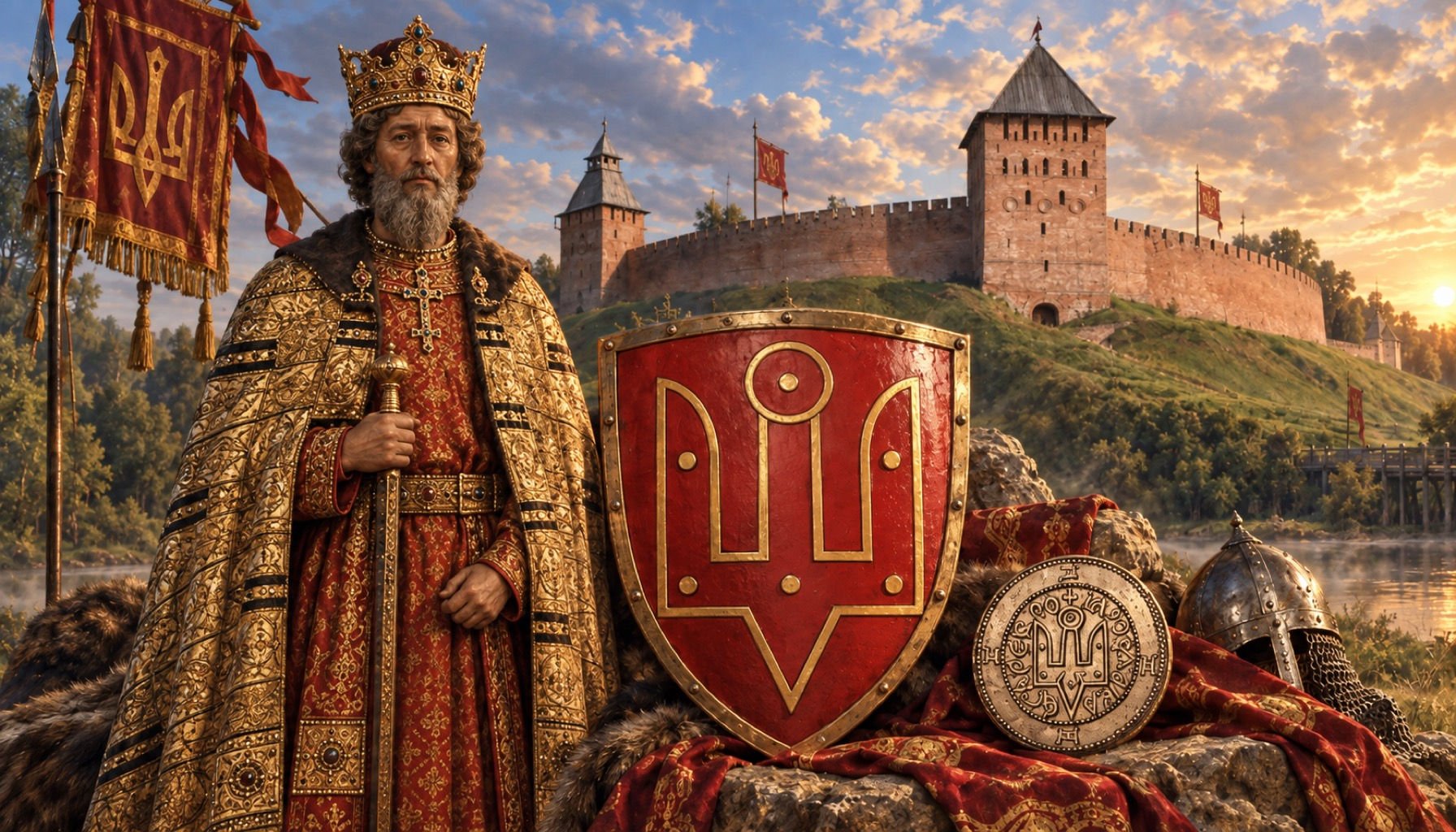
Gleb Svyatoslavich was an 11th-century Rurikid prince, a grandson of Yaroslav the Wise, and one of the young rulers drawn into the dangerous politics of Kievan Rus at its height. He belonged to a dynasty that sat astride some of the most important river routes in medieval Europe, where power flowed not only through bloodlines and armed retinues, but through trade, tribute, and the ability to hold strategic towns.
That made Novgorod no provincial posting. It was one of the great hubs of the Rus world, tied by waterways and commerce to Scandinavia, the Baltic, the Slavic lands, and Byzantium. To rule there was to stand at a crossroads of merchants, warriors, churchmen, and ambitious princely families. Gleb’s life was short, but it opens a vivid window onto this world of dynastic rivalry, frontier warfare, and early medieval state formation.
Gleb was the son of Sviatoslav Yaroslavich, who became Grand Prince of Kiev, and his career reflects the way the Rurikid realm was governed through family appointments. His father placed him over major territories including Novgorod and later Tmutarakan, both significant in their own right. Novgorod was a northern powerhouse of commerce and politics; Tmutarakan, on the other hand, connected the Rus sphere to the Black Sea world and the steppe frontier. A prince who moved between such places was not simply a local notable but part of a larger geopolitical web stretching from the Baltic to Byzantium.
The chronicles preserve one striking episode that has made Gleb memorable far beyond lists of princely succession. He is said to have confronted a sorcerer who boasted that he could foretell the future. Gleb’s answer was brutally direct: when challenged, he killed the man with an axe. Whether one reads the story as political theatre, Christian polemic against pagan or magical authority, or simply a chronicle writer’s taste for drama, it says something important about the age. Rus princes ruled in a landscape where older beliefs, new Christianity, and hard-edged public displays of authority all coexisted.
His fortunes did not last. After Sviatoslav’s death in 1076, the balance of power shifted rapidly, as it so often did within the Rurikid family. Gleb was expelled by the people of Novgorod amid the political upheaval. He was later killed in conflict with the Chudes, a Baltic-Finnic people living on the northwestern frontier of the Rus world. His end was the end of many such princes: not in serene dynastic dignity, but in a contested borderland, amid war and fracture.
Explore Early Medieval Baltic Connections
The biological sample associated with him is listed as Gleb Svyatoslavich Prince of Novgorod Rurik Dynasty, with an approximate date of 1078 AD. According to the supplied historical and archaeological description, his remains were buried near the Saviour Cathedral in Chernihiv. That burial context matters, because Chernihiv was one of the major princely centers of the Rus world and an appropriate resting place for a member of the ruling dynasty.
Archaeological analysis reportedly found that the man died at approximately 25 to 35 years of age and had sword wounds to the skull. That is a grim but valuable detail. It gives us physical evidence that matches the violent political and military world described in the chronicles. In other words, this is not merely a story about a prince who lived in dangerous times; the bones themselves seem to bear the marks of that danger.
As for identification, the material provided treats the remains as those of Gleb Svyatoslavich, but it does not spell out in detail how the attribution was established. Because of that, it is best to present the identification as historically supported by the burial tradition and archaeological interpretation, rather than to invent a level of forensic certainty that has not been described here. Ancient DNA is very good at testing biological relationships and lineage patterns, but it does not by itself magically label a skeleton with a name. Historical attribution still depends on context, excavation history, and scholarly judgment.
Read about Princess Maria Shvarnovna
The reported Y-DNA haplogroup for Gleb is I2a1a2b1a1a2, while his mitochondrial DNA haplogroup is H5a2a. These two results track different lines of ancestry. Y-DNA follows the direct paternal line, passed from father to son, while mtDNA follows the direct maternal line, passed from mother to all her children. They are useful precisely because they tell us about two very specific threads within a much larger family tapestry.
Gleb’s Y-DNA result is historically interesting because he was a Rurikid prince, and any securely associated paternal-line result from an early member of that dynasty is potentially valuable for studying dynastic biology as well as dynastic politics. But one must be careful. A Y-haplogroup does not prove ethnicity, nationality, or “what the dynasty really was.” It identifies a paternal lineage, not a cultural identity. In early medieval eastern Europe, where elite networks linked Scandinavia, Slavic-speaking regions, Finnic populations, and the Byzantine world, that distinction matters enormously.
The mtDNA haplogroup H5a2a is likewise a maternal lineage, and it should be read with the same caution. It tells us something about Gleb’s direct maternal line, not the total ancestry of his mother, still less the whole ancestry of Kievan Rus elites. Medieval princely families married across regions and political blocs, so a maternal haplogroup is one useful clue among many, not a stand-alone verdict.
A short ancient-DNA note on the paternal side: the related I2a1a2b1a1a2-linked sample specifically available here is Gleb himself, the individual labeled VK542. That means the most relevant comparison at present is not to a broad invented set of supposed relatives, but to the fact that this lineage is now directly recorded in a named Rurikid-associated medieval prince. If future work identifies other securely tested dynasty members or close kin sharing the same downstream Y-lineage, that would sharpen discussions of paternal continuity within this branch of the ruling house.
On the maternal side, the same caution applies. The H5a2a-linked sample explicitly available in the supplied material is again Gleb Svyatoslavich (VK542). That gives us a direct maternal-line marker for this individual, but without a wider tested maternal network of close relatives, it cannot by itself reconstruct the full maternal genealogy of the family. What it does provide is a fixed genetic point in an otherwise text-dominated dynastic history.
The reference study at https://www.biorxiv.org/content/10.1101/703405v1 is important here as part of the growing effort to bring paleogenomics into conversation with the history of medieval elites. The larger value of such work is not that it replaces chronicles, but that it lets skeletal remains contribute their own evidence: sex, lineage markers, age at death, trauma, and sometimes kinship.
Discover DNA of the Northern Black Sea Region
What makes Gleb’s DNA so compelling is not that it solves every question about the Rurikids, but that it anchors one well-known medieval prince in biological reality. We already knew from the chronicles that he was a grandson of Yaroslav the Wise, ruler of Novgorod, and a casualty of the brutal politics of the 1070s. Archaeology adds the wounded skull; genetics adds paternal and maternal lineage markers. Together, they make him less of a name in a succession list and more of an excavated human being from the trading, fighting, argumentative world of Kievan Rus.
At the same time, the limits matter. Haplogroups alone cannot define the ethnic identity of the Rurikids, cannot prove direct descent for modern people, and cannot summarize the full ancestry of one prince or one dynasty. What they can do is give us carefully bounded evidence about direct paternal and maternal lines, and that is already a remarkable gain when dealing with an 11th-century ruler whose life ended in frontier violence.
MyTrueAncestry lets you compare your DNA with ancient populations and archaeological samples from the worlds that shaped figures like Gleb Svyatoslavich. You may discover genetic connections to medieval eastern Europe, Baltic frontier populations, or deeper lineages that appear in ancient remains, while keeping in mind that such matches do not by themselves prove direct descent from any one historical prince.


Comments