Emperor Wu of Northern Zhou
– 5 min read


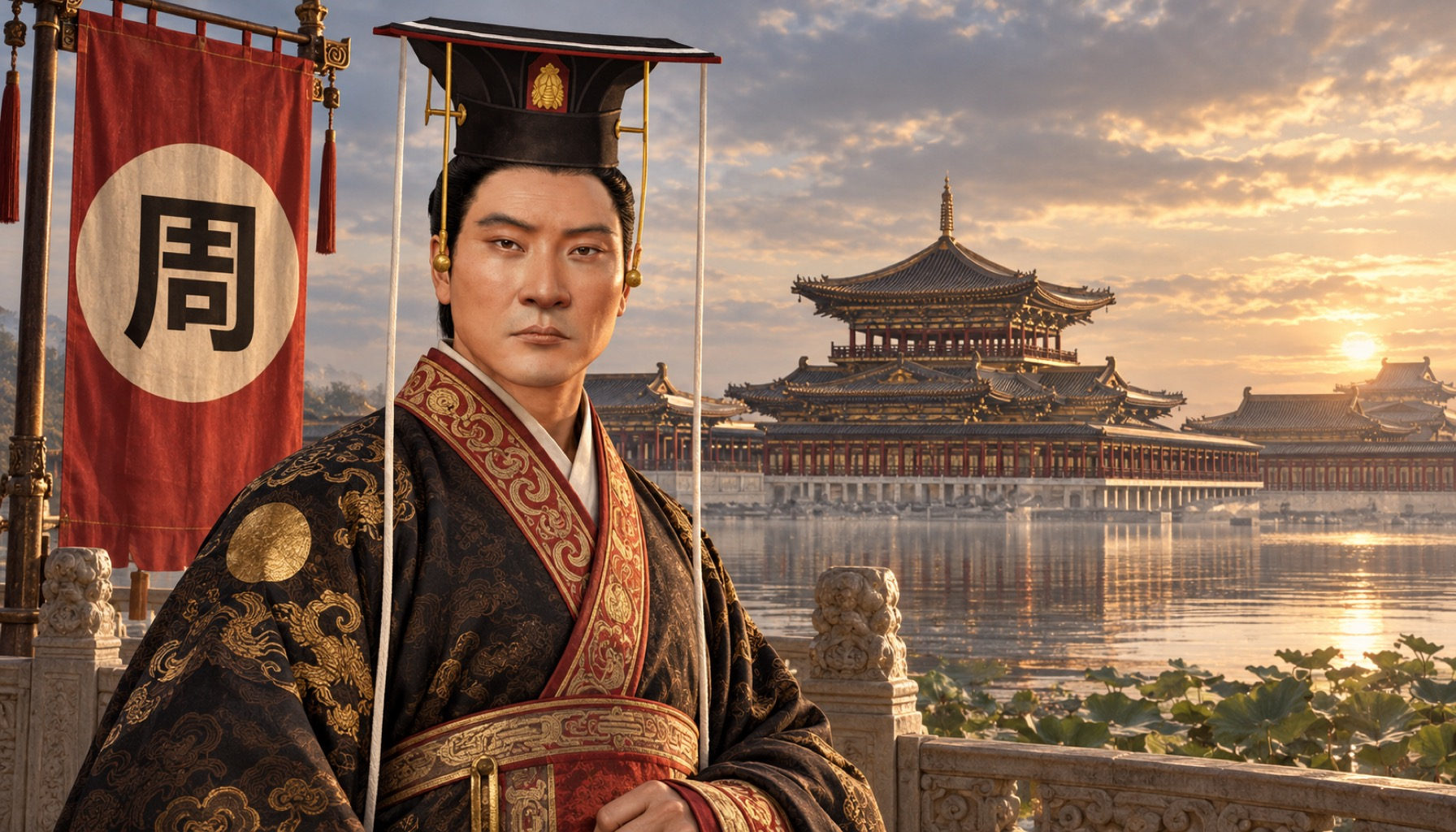
Emperor Wu of Northern Zhou, born Yuwen Yong, was one of the decisive rulers of sixth-century China. He reigned from 560 to 578 AD, in the turbulent age of the Northern and Southern Dynasties, when rival courts, frontier armies, and ambitious aristocratic families competed to control the old heartland of empire. A member of the Yuwen ruling house, whose background lay among Xianbei-associated populations of northern China, he emerged not merely as a palace figure but as a hard and capable monarch who reshaped the balance of power across the north.
His historical importance is considerable. By strengthening Northern Zhou, reorganizing its military capacity, and conquering the rival Northern Qi in 577, Emperor Wu brought most of northern China under one state. That mattered enormously. The reunification achieved soon afterward by the Sui did not appear out of nowhere; it rested in part on the political and military groundwork laid by Emperor Wu. In that sense, he belongs to the company of rulers who did not complete the final act themselves, but made it possible.
Explore ancient DNA from the China-steppe frontier
The world Emperor Wu inherited was politically fractured but culturally energetic. Northern China was ruled by dynasties with mixed court traditions, drawing on older Chinese imperial institutions as well as the military and aristocratic legacies of steppe and frontier peoples. The Yuwen family stood in that world of synthesis. When Yuwen Yong came to power, Northern Zhou was already a major state, yet still faced serious threats, above all from Northern Qi to the east. Emperor Wu consolidated authority, strengthened administration, and turned military reform into conquest. His destruction of Northern Qi in 577 was one of the great strategic achievements of the age, and it transformed the map of China. He died the following year, before he could enjoy the long-term fruits of that victory, but his reign helped clear the path toward the eventual reunification of China under the Sui. His burial at the Xiao Mausoleum near modern Xi'an and Xianyang places him, in death as in life, at the crossroads of imperial memory and frontier history.
The ancient DNA sample associated with him is listed as Emperor Wu of Northern Zhou China, with an approximate date of 560 AD. The remains are attributed to the emperor buried in the Xiao Mausoleum, and this is historically important because we are not dealing here with a vague cemetery individual later wrapped in legend, but with a named ruler whose place in the written record is already well established. The supplied material identifies this as the remains of Emperor Wu of Northern Zhou, making this a securely identified historical individual in the context of the article as presented here. At the same time, one should be careful not to invent details not provided: if the precise archaeological chain of identification, excavation history, or specific sampled bone or tooth is not described in the supplied material, it is better to say so plainly than to embroider the story.
That restraint matters. Ancient DNA is most powerful when joined to good archaeology, clear provenience, and sober historical method. In this case, the excitement lies in the rarity of having genome data from an identified Chinese emperor of the Northern Dynasties period. According to the recent research literature, including the study referenced at ScienceDirect, his remains have also been used for ancestry analysis and DNA-based phenotype reconstruction, offering an unusually direct glimpse into the biology of a ruler known from texts.
The reported Y-DNA haplogroup of Emperor Wu is C2a1a1b1a2a1. Y-DNA follows the direct paternal line, passing from father to son, so this lineage speaks only to one narrow branch of his ancestry: his father’s father’s father, and so on. It does not summarize his whole background. Broadly speaking, branches of haplogroup C2 are historically associated with northern and eastern Eurasia, including steppe and northeastern Asian contexts, which fits comfortably with the wider frontier history of Xianbei-linked ruling elites without reducing that history to a single genetic label.
His mtDNA haplogroup is C4a1a-a5. Mitochondrial DNA follows the direct maternal line, passed from mother to child, and so it illuminates a different narrow thread of ancestry: his mother’s mother’s mother, and so forth. Like the Y-line, this is just one lineage among many ancestors. It cannot by itself define ethnicity, court identity, or political allegiance. What it does provide is another anchor point in the emperor’s biological history, one that can be compared with other ancient and modern maternal lineages in a cautious way.
The more interesting point is not the haplogroup labels by themselves, but the wider genomic picture. Genetic analysis of Emperor Wu’s remains reportedly revealed both East Asian and steppe-related ancestry components. That is exactly the kind of finding that makes historical sense in northern China during this era, when elite families, military confederations, and frontier states were shaped by long-term movement, alliance, intermarriage, and incorporation. His genome therefore adds a direct line of evidence to a history long known from chronicles: the making of northern imperial power in this period involved populations with mixed regional backgrounds.
For the paternal line, the most obviously related C2a1a1b1a2a1-linked ancient sample named in the supplied material is Emperor Wu himself, listed as Emperor Wu of Northern Zhou China, sometimes abbreviated in research contexts as EmperorWu. That may sound circular, but it is still useful: in a field where many royal lineages remain genetically invisible, having even one securely attributed ancient imperial genome in this branch is valuable. It establishes a concrete data point for the Yuwen ruling house’s direct paternal lineage, while still falling well short of proving wider claims about every member of the dynasty or every Xianbei-associated group.
The same is true for the maternal side. The mtDNA lineage C4a1a-a5 is, in the supplied material, directly represented by Emperor Wu of Northern Zhou China himself. At present, the historical significance lies less in building a grand maternal clan narrative than in showing that an identified emperor’s maternal line can now be placed within the broader ancient genetic landscape of northern Eurasia and East Asia. As more ancient genomes are published, such lineages may become easier to contextualize, but caution is still the order of the day.
Read about ancient East Asian Y chromosomes
There is something wonderfully grounding about this evidence. Historians have long written about the Northern Dynasties as a world in which frontier lineages, steppe traditions, and Chinese statecraft were woven together. Emperor Wu’s genome does not replace the texts, and it certainly does not tell us everything about identity, language, or self-understanding. But it does give us a direct biological record from one of the central actors. It helps confirm that the ruling elites who transformed northern China were not abstractions; they were real families with ancestries shaped by the same movements and mixtures that the period’s politics suggest. DNA can illuminate that background, and even contribute to reconstructing aspects of appearance, but it cannot tell us whether Emperor Wu felt “more this” or “more that,” nor can haplogroups alone define a dynasty.
Compare with a Tang dynasty clan study
With MyTrueAncestry, you can compare your DNA with ancient populations and archaeological samples from the wider world that shaped rulers like Emperor Wu of Northern Zhou, including lineages and populations connected to northern China and the steppe frontier. It is a fascinating way to explore genetic connections to the deep historical background of East Asia without confusing shared ancestry with proven descent from a specific emperor.




Comments