Clan Plunkett
– 3 min read


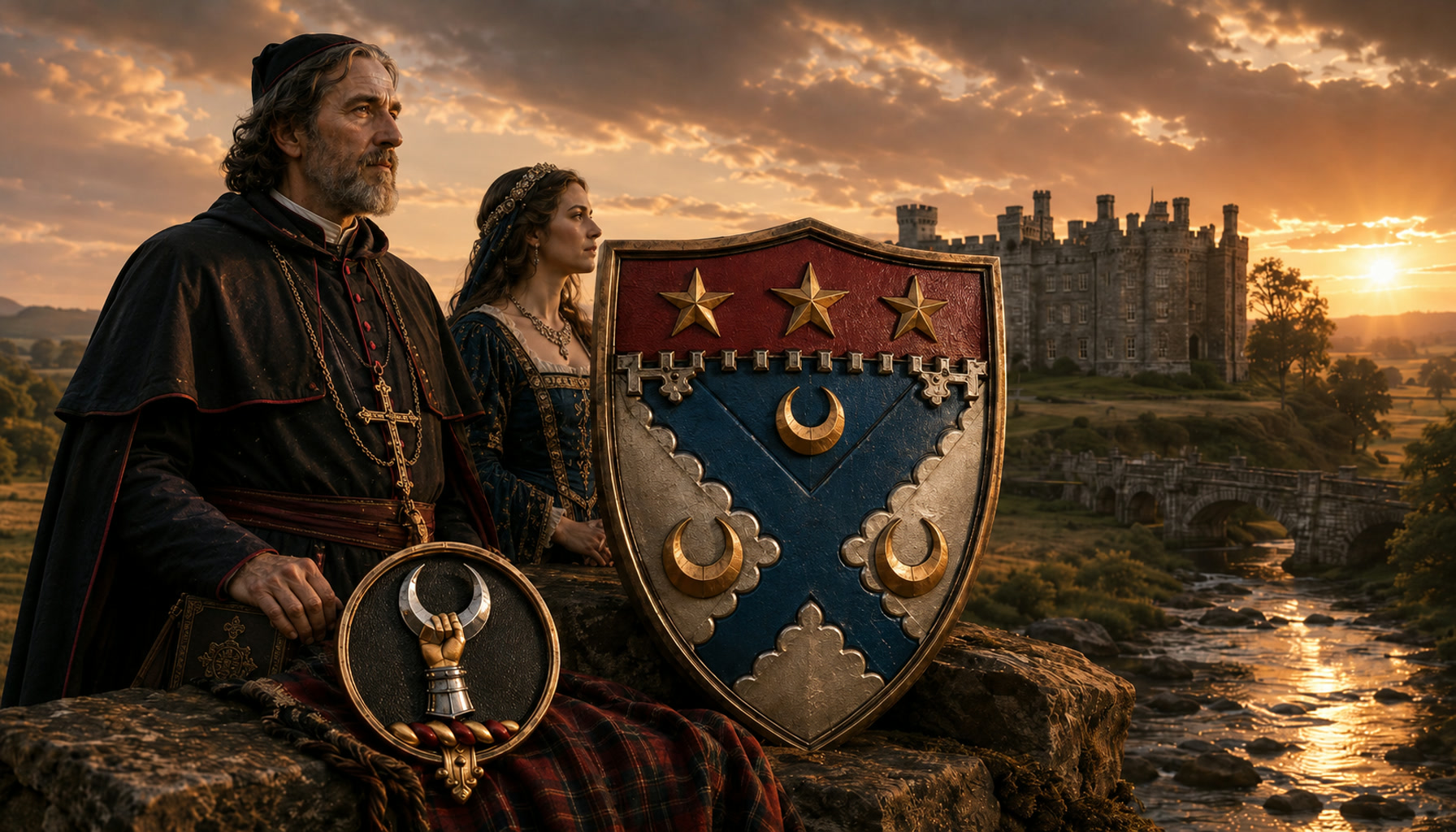
Clan Plunkett was one of the great Norman-Irish noble families: a dynasty of landholders, lawyers, churchmen, and regional power brokers who put down deep roots in medieval Ireland. Their story begins with the Anglo-Norman world that spread into Ireland after the late 12th-century invasion, when families of continental and English-Norman background established lordships especially in and around the Pale. Over generations, the Plunketts became thoroughly woven into Irish life, balancing crown service, local influence, aristocratic marriage networks, and a distinctly Irish identity. The primary haplogroup linked here is R1b1a1b1a1a2c1a2a1a1a1b1, a branch associated with many western European paternal lines.
The Plunketts are a particularly good example of how Norman families in Ireland were never simply outsiders frozen in time. They arrived within the wider feudal expansion of the High Middle Ages, but their importance came from what happened afterward: settlement, adaptation, and endurance. Their fortunes were tied to land and law in counties around Meath and Dublin, and their name appears again and again in the business of governance, ecclesiastical patronage, and noble title. Richard Plunkett (1340-1393), a notable member of the family, stands within that long medieval world in which dynastic survival depended on office, alliance, and the careful management of estates as much as on battlefield glamour.
The strongest place-anchor for the family is Killeen Castle in County Meath, near Dunsany, in the old heartland of the Pale. This was no mere country house but a long-lived seat of the Plunketts, especially the Barons of Dunsany, whose association with the estate stretched across centuries. The castle originated in the medieval period and developed over time, absorbing the scars and ambitions of successive ages. In other words, it is precisely the sort of site that tells the truth about noble history: not a single pristine moment, but layers of rebuilding, destruction, adaptation, and display. Set in a landscape that was central to Anglo-Norman settlement in Meath, Killeen speaks to the Plunketts' role in the aristocratic shaping of eastern Ireland. The site and grounds remain known today, and the castle area can still be visited in the broader sense, with the estate continuing as a notable heritage location.
From a DNA perspective, the Plunkett-linked haplogroup R1b1a1b1a1a2c1a2a1a1a1b1 belongs to a paternal landscape that reaches widely across Atlantic and western Europe. Related or linked ancient samples under this branch include a remarkable spread of individuals: Celtic Durotriges from Duropolis at Winterborne Kingston in England such as WBK12, WBK20, WBK29, WBK41, WBK05, WBK30, WBK43, WBK06, WBK08, WBK18 and WBK191; Celtic Briton East Kent England I13730; Iron Age Worlebury Somerset I11991; Iron Age Roundhouse Bu Orkney I2982; Iron Age Hillfort Battlesbury Bowl I21309; Bell Beaker and Bronze Age individuals from Wiltshire, Cambridge, Bedfordshire, South Lanarkshire and the Thames including I4950, I2417, I3256, I7576, I7577, I5473 and I5377; and Ireland Copper Age Rathlin2B. The same wider paternal cluster also appears in later contexts, including Imperial Roman Era Zadar Croatia I26776, Late Roman Conimbriga Portugal R10488, Late Roman Klosterneuburg Lower Austria R10656, Post Roman Worth Matravers Dorset I11580, Early Medieval Belgium Sint-Truiden ST2025, Medieval Belgium outsider ST1308, Merovingian Alt-Inden IND013, Viking Age Denmark VK287, and Medieval Sandoy Church in the Faroe Islands VK27. None of these should be treated as direct ancestors of the Plunketts without documentary proof, but they do show the deep time range and geographic breadth of lineages related to the same paternal branch.
If you are researching Plunkett heritage, this is where history and genetics become especially interesting. A family like the Plunketts sits at the meeting point of Norman expansion, Irish settlement, noble identity, and long-run genetic continuity across western Europe. Upload your DNA to MyTrueAncestry to see whether you match Clan Plunkett, or whether you connect with related ancient DNA samples from Iron Age Britain, Roman Europe, medieval Belgium, Viking Age Scandinavia, or prehistoric Ireland.
Comments