Clan Magennis

– 3 min read


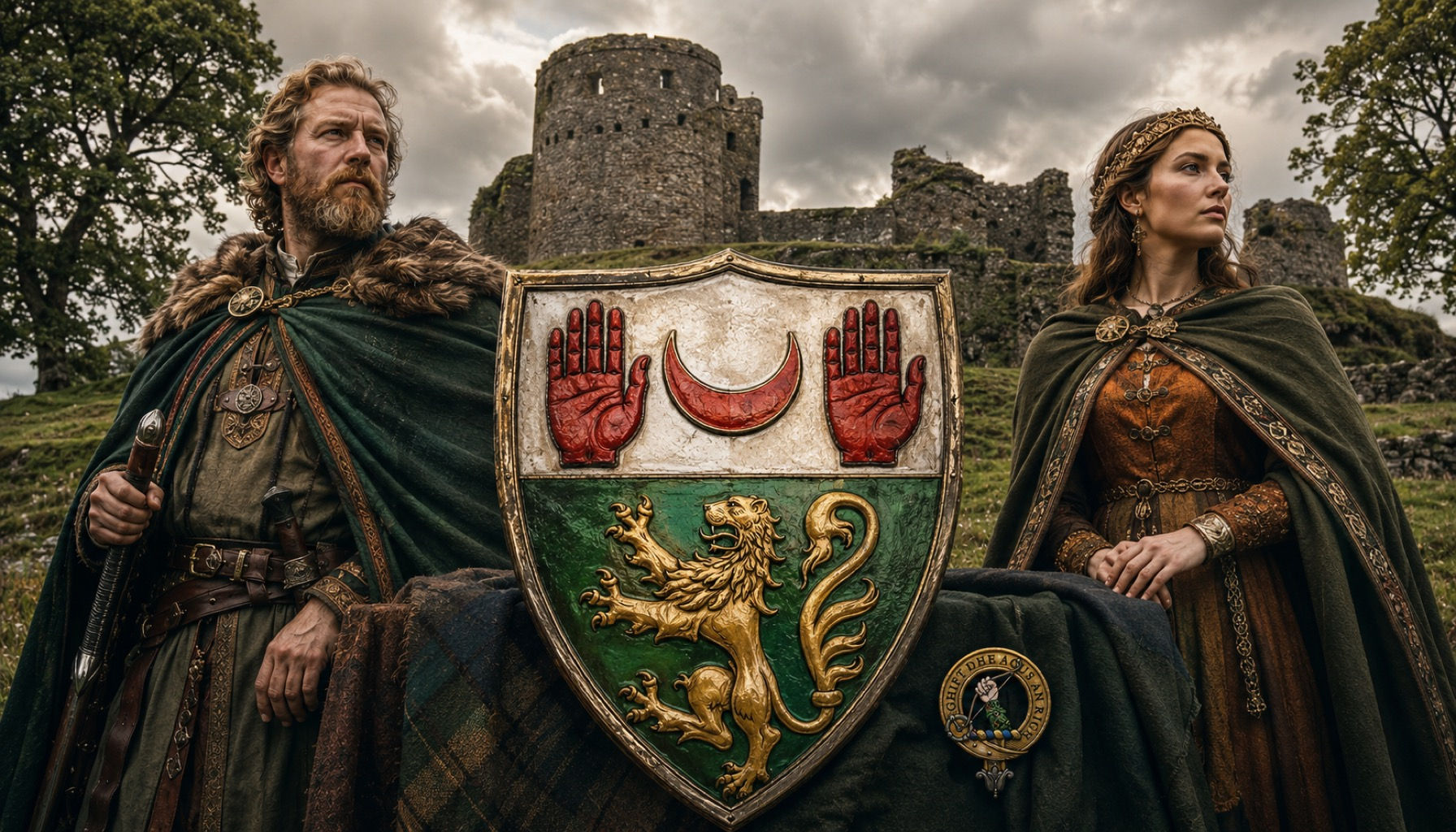
Clan Magennis, or Mag Aonghusa, was one of the great Gaelic families of Ulster, rooted above all in Iveagh in what is now County Down. They were not simply a surname but a ruling kindred: a lordship with land, followers, fighting men, client families, and the authority that came from long local memory. In that older Irish world, power meant far more than a title on parchment. It meant holding territory, leading kinsmen, negotiating alliances, defending borders, and preserving status through generations of upheaval. The primary haplogroup linked with the family is R1b1a1b1a1a2c1a2a1a1a1, part of a broader paternal line often seen across Atlantic and Celtic-speaking parts of Europe.
The Magennises emerged from the political landscape of medieval Ulster, where regional lordships were the real machinery of power. Their story belongs to that very Irish pattern of chieftainship: local kingship on a smaller scale, martial service, dynastic competition, and an identity tied closely to place. Aedh Mor Magennis, recorded in 1153, is one of the early named figures associated with the line and a useful reminder that these families enter history not as isolated individuals but as heads of enduring kindreds. Across the centuries, the Magennises weathered conquest, plantation, changing crowns, and migration, yet the family name, heraldry, and memory endured. That is often the striking thing with Irish clans: not that they escaped history, but that they survived it.
One of the strongest location anchors for Clan Magennis heritage is Rathfriland Castle in County Down. The site stands on a hill with commanding views over the surrounding countryside, exactly the sort of position that tells you at once what a castle was for: visibility, control, and the statement of lordship. The castle is associated with the Magennises of Iveagh and later became entangled in the shifting struggles of the Tudor and early Stuart periods, when Gaelic Ulster was being pressured, partitioned, and remade. The surviving remains are fragmentary rather than grand, but that in itself is part of the story. Irish power was not erased neatly; it was broken, reused, and built over. Rathfriland still offers a tangible link to the Magennis landscape, and the site can still be visited as a visible historic ruin in the town.
From a DNA point of view, the Magennis primary family haplogroup is tagged here as R1b1a1b1a1a2c1a2a1a1a1. We should be careful and sensible: ancient samples with this lineage or closely linked branches are not evidence of direct descent from Clan Magennis itself. What they do show is a wider paternal background spread across time and geography, one with strong connections to Atlantic Europe, Iron Age and later Celtic worlds, and post-Roman populations. Related or linked examples include Celtic Durotriges individuals from Duropolis at Winterborne Kingston in England such as WBK12, WBK20, WBK29, WBK41, WBK05, WBK30, WBK43, WBK06, WBK08, WBK18 and WBK191, as well as samples from Roman Zadar in Croatia, Bronze Age Orkney, Bronze Age Calabria, early medieval and medieval Sint-Truiden in Belgium, Iron Age and Roman Britain, Bell Beaker and Bronze Age southern England, the Faroe Islands, and even the Copper Age individual Rathlin2B from Ireland. Taken together, these linked samples sketch a very broad prehistoric and historic backdrop rather than a tidy family tree. That is the fascination of archaeogenetics: it gives you the long road behind a clan, not a simplistic claim about one famous surname.
Explore Neolithic Irish kinship
If you carry the Magennis name, have Iveagh or County Down roots, or simply suspect an Ulster Gaelic connection in your family, DNA can add another layer to the story. Uploading your results can help you see whether you match Clan Magennis, its broader R1b1a1b1a1a2c1a2a1a1a1 signature, or related ancient DNA samples from Ireland, Britain, and the wider Celtic world. It is a lovely way of putting family memory beside archaeology and genetics, and seeing what survives.
Comments