Clan Mac Donnchada
– 3 min read


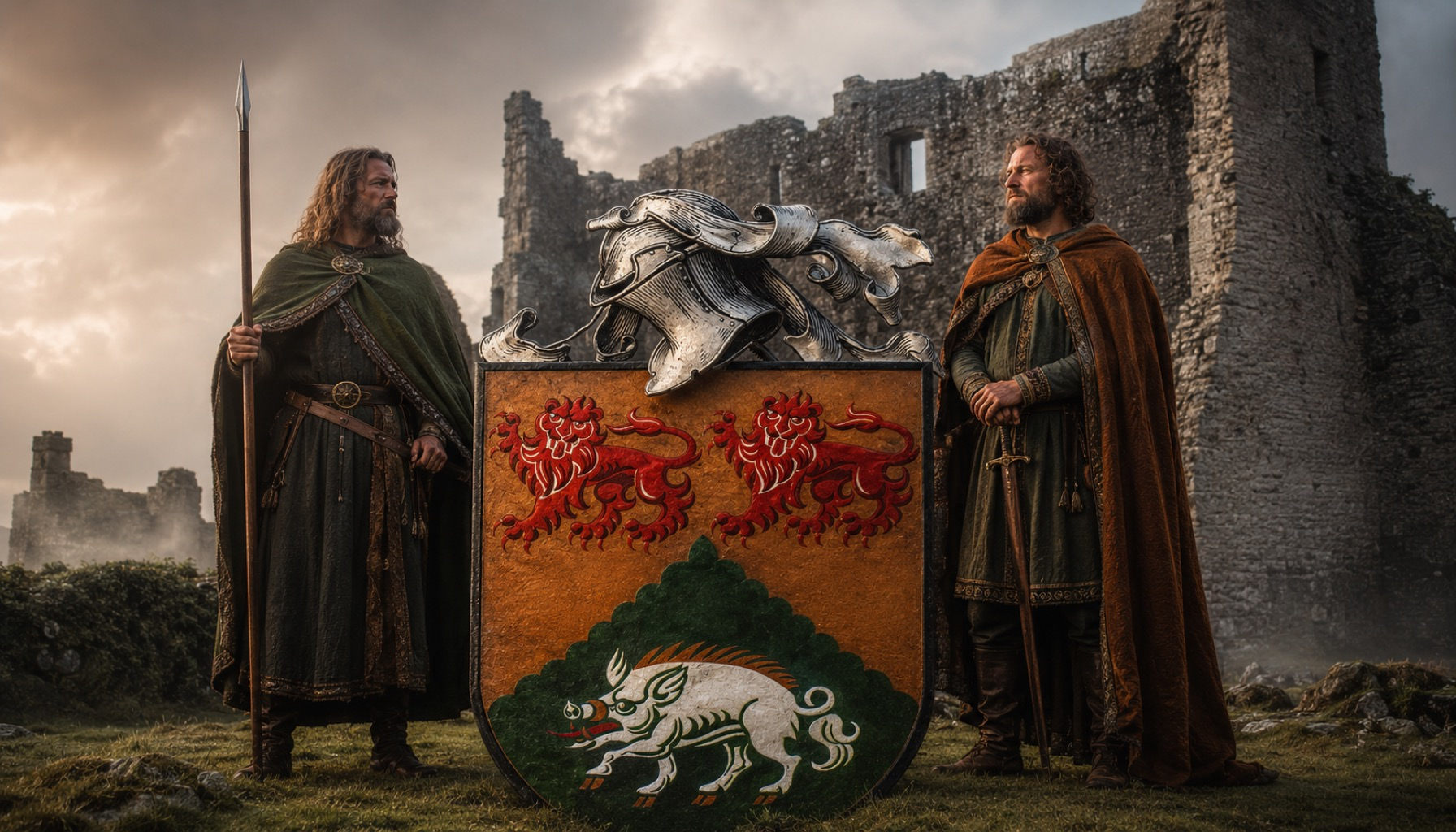
Clan Mac Donnchada was a Gaelic Irish lineage shaped by remembered descent, regional authority, and the stubborn continuity of surname and family memory. The name simply means "son of Donnchadh," but there is nothing small about that kind of naming. In the Gaelic world, a patronymic was not just a label. It was a claim to ancestry, status, obligation, and belonging. The family belongs in the broad stream of Irish kin-based society in which landholding, military service, lordship, and local reputation were all tied to the authority of kindred. For DNA readers, the primary haplogroup linked here is R1b1a1b1a1a2c1a3a2a1a2d1a, a branch associated with wider paternal lineages found across Atlantic and Celtic-facing Europe.
Historically, Mac Donnchada heritage sits in the long story of Gaelic Ireland: families anchored in territory, serving as local powers, adapting to kingdom politics, and enduring wave after wave of change. Anglicization altered names, crown power altered landholding, and migration scattered descendants across Britain, North America, and beyond. Yet the old pattern remained recognisable. Clan Mac Donnchada represents that classic Gaelic Irish model of ancestral descent, regional authority, local service, cultural resilience, and enduring surname continuity. Among the better-known figures linked to this wider dynastic memory are Donnchad Midi, High King of Ireland from 733 to 797, and Conchobar Mac Donnchada, High King of Ireland from 819 to 833, names that remind us this was not merely a local family story but one tied into the highest levels of early medieval Irish kingship.
Read more about Clan Donnachaidh
The strongest location anchor for this story lies in the heartland of Clann Cholmain in Mide, the great midlands kingdom from which several descendants of Donnchad Midi emerged. Mael Ruanaid mac Donnchada Midi, as the record preserved in Irish history makes clear, belonged to this ruling world of Uisnech, Tara, and the political centre of Ireland. This was not a remote fringe but the contested middle of the island, where kingship, church patronage, and dynastic rivalry were constantly intertwined. The landscape associated with this dynasty still survives in evocative fragments: the Hill of Uisneach in County Westmeath, long regarded as a symbolic centre of Ireland, and the Hill of Tara in County Meath, seat of high kingship, can both still be visited today. To stand on those ridges is to grasp something important about Gaelic rule: power was not abstract, it was rooted in assembly places, ritual landscapes, and remembered ancestral ground.
From the ancient DNA angle, the Mac Donnchada haplogroup tag R1b1a1b1a1a2c1a3a2a1a2d1a connects the family to a wider web of related or linked paternal signatures rather than proving direct descent from any excavated individual. That linked network includes Celtic Durotriges samples from Duropolis, Winterborne Kingston in England such as WBK12, WBK20, WBK29, WBK41, WBK05, WBK30, WBK43, WBK06, WBK08, WBK18, and WBK191, alongside later and earlier individuals from a wide geographic spread: Imperial Roman Zadar in Croatia, Bronze Age Westray Links of Noltland in Orkney, Bronze Age Calabria at Grotta della Monaca, Early Medieval and Medieval Sint-Truiden in Belgium, Gallic France at Parancot, Post-Roman Worth Matravers in Dorset, Merovingian Alt-Inden in Germany, Late Roman Klosterneuburg in Austria, Late Roman Conimbriga in Portugal, Iron Age Worlebury and Battlesbury Bowl in England, Bronze Age Trumpington Meadows, Amesbury Down, Upavon, Bedfordshire, Boatbridge Quarry in South Lanarkshire, Hinxton Iron Age, Early Bronze Age Thames, Late Bronze Age Scotland, and even Copper Age Ireland at Rathlin2B. What that tells us, in plain terms, is that this paternal line belongs to a very old Atlantic European story, visible across Bronze Age, Iron Age, Roman, and early medieval communities. It is a lineage pattern with deep roots, not a neat one-family fossil.
Explore Neolithic Irish kinship
If Clan Mac Donnchada is part of your family story, then you are looking at more than a surname. You are looking at a Gaelic inheritance of kinship, remembered forebears, political adaptation, and continuity across centuries of upheaval. Upload your DNA to MyTrueAncestry to see whether you match this family story or any of the related ancient DNA samples linked to haplogroup R1b1a1b1a1a2c1a3a2a1a2d1a.
Comments