Clan Johnstone
– 3 min read


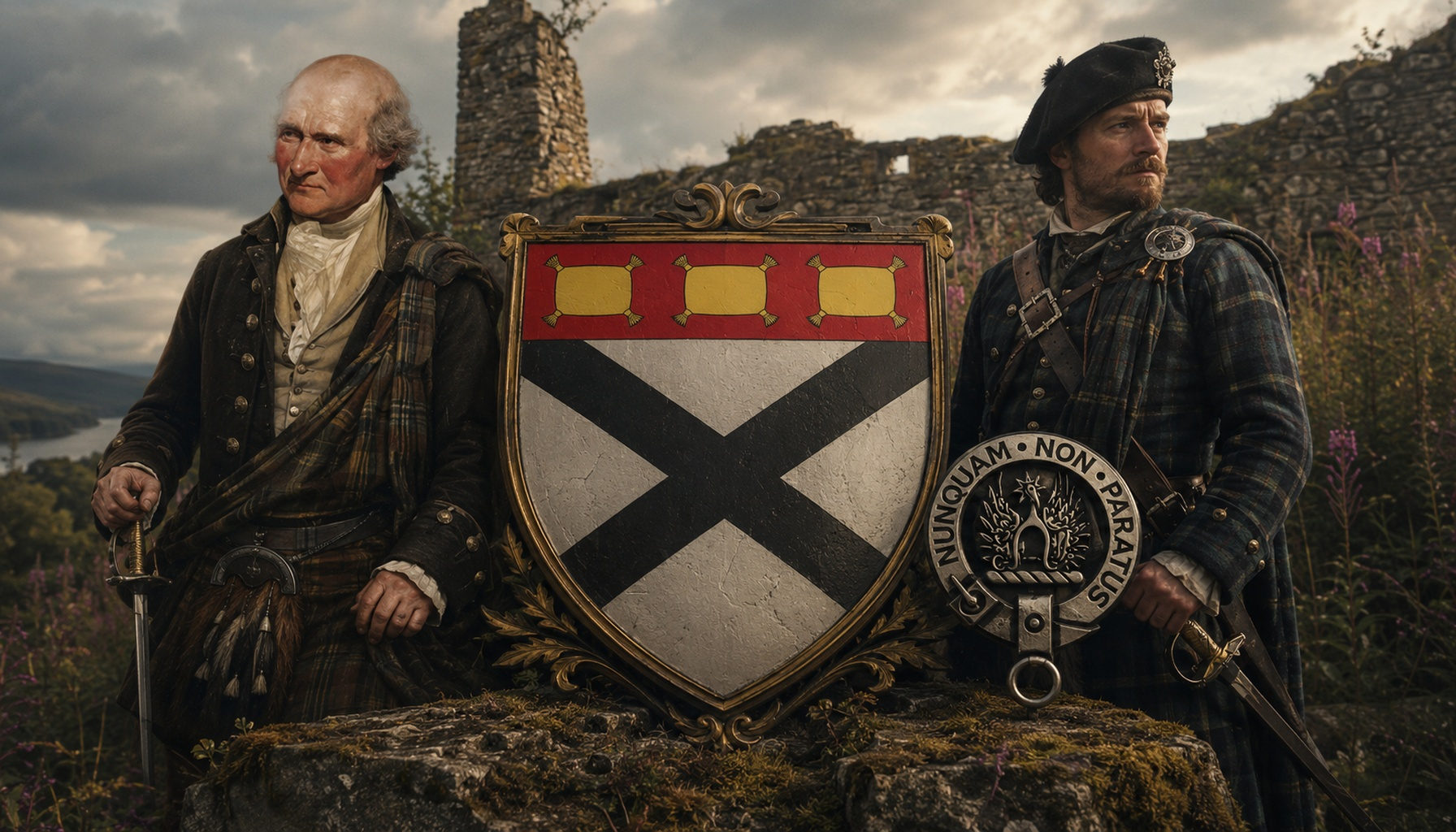
Clan Johnstone was one of the great Border families of southern Scotland, rooted above all in Annandale in Dumfriesshire, where land, kinship, and force of arms went together. Their story belongs to that harsh and fascinating frontier world between Scotland and England, where authority was often negotiated at sword point and a surname could function almost like a marching banner. The clan is commonly linked here with the haplogroup R1b1a1b1a1a2c1a3a2, the primary family haplogroup in this profile, set within the wider genetic landscape long associated with western Britain and Atlantic Europe.
The Johnstones emerge in the record in the late 12th century, with John Johnstone noted in 1194, and from there the family grew into a formidable territorial power. Their rise was not some neat march of inevitable progress. It came through chiefship, careful landholding, military service, marriage connections, regional alliances, and, of course, rivalry with neighboring Border families, especially in a society shaped by raiding, feuding, and the uncertain loyalties of the marches. In that sense the Johnstones are almost a textbook Border clan: resilient, martial, proud of their lineage, and deeply attached to ancestral ground even as politics around them shifted from local vendetta to crown authority and noble title.
That ancestral ground is best symbolized by Lochwood Tower, the historic seat of the chiefs of Clan Johnstone near Beattock in Dumfries and Galloway. Lochwood was not merely a residence but a Border stronghold, set in the landscape that gave the clan its identity and much of its power. The tower replaced an earlier castle and became the center of the Johnstones' authority in Annandale. Like many Border fortifications, it was shaped by insecurity as much as prestige: thick walls, defensible position, and the constant expectation that neighbors might arrive armed rather than invited. The old seat later declined, and the tower is now a ruin, but it remains one of the key physical anchors of Johnstone memory. The site can still be visited from the outside as a historic ruin, which is often the most moving way to encounter these places: not as polished museum pieces, but as weathered survivors in the landscape that made them.
From an ancient DNA point of view, the Johnstone-linked haplogroup R1b1a1b1a1a2c1a3a2 sits within a very old and widely distributed western European paternal story. Related or linked samples associated with this branch include a striking cluster from Celtic Durotriges burials at Duropolis, Winterborne Kingston in England, such as WBK12, WBK20, WBK29, WBK41, WBK05, WBK30, WBK43, WBK06, WBK08, WBK18, and WBK191. Other linked samples come from a broad sweep of time and place: Bronze Age Orkney at Westray Links of Noltland (KD061), Bronze Age Boatbridge Quarry in South Lanarkshire, Scotland (I5473), Scotland Late Bronze Age (I2859), Iron Age Worlebury in Somerset (I11991), Iron Age Battlesbury Bowl (I21309), Bell Beaker Upavon in Wiltshire (I4950), Bronze Age Amesbury Down (I2417), Bronze Age Trumpington Meadows (I3256), Hinxton Iron Age (HI2), Early Bronze Age Thames (I5377), Rathlin2B from Copper Age Ireland, Imperial Roman Era Zadar in Croatia (I26776), Late Roman Conimbriga in Portugal (R10488), and Early Medieval and Medieval individuals from Belgium, Germany, Austria, and France. These are not evidence of direct descent from any named Johnstone, of course, but they do show how a related paternal lineage was present across Celtic, Roman, and post-Roman Europe long before the medieval Border clans took shape.
If you have Johnstone roots, this is where family history becomes especially interesting: the records tell one story of Border lordship, feuds, and fortified homes, while DNA can sometimes place your deeper ancestry in a much older map of Britain and Europe. Upload your DNA to MyTrueAncestry and see whether you match Clan Johnstone, or any of the related ancient DNA samples connected with haplogroup R1b1a1b1a1a2c1a3a2.
Comments