Clan Hogg
– 3 min read


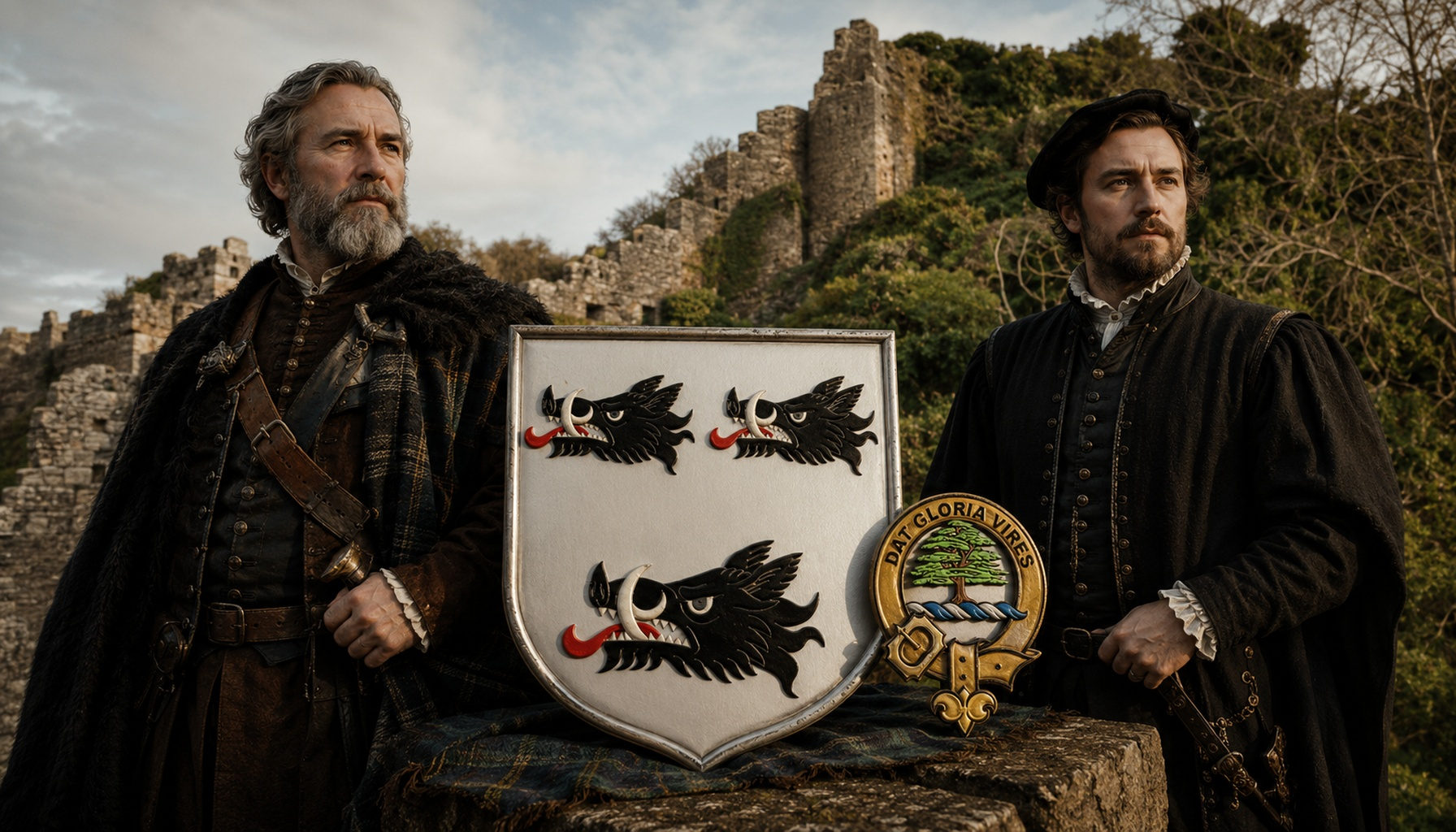
Clan Hogg was not one of the great princely houses of Scotland, and that is precisely what makes its story so recognisably Scottish. The family belongs to the Lowland and Border world, rooted in rural service, pastoral life, and the long continuity of surname identity. The name itself is usually linked to the world of livestock and herding, where an occupational description could settle into a hereditary surname over generations. In that landscape of sheep, pasture, tenants, kirks, and local loyalties, Hogg heritage grew from work, reputation, and endurance rather than royal glamour. In haplogroup terms, the primary family line here is tagged to I1a2b3a1b1a2, a branch that also appears in a wider northwestern European genetic story.
Historically, the Hoggs fit a pattern seen again and again in the Borders and Lowlands: families shaped by place, local service, and the need to survive in a frontier society where allegiance could be practical as much as noble. Early record forms remind us how fluid medieval spelling could be, and one of the named figures associated with the family is Salomon del Hoga in 1270, a wonderfully evocative name because it sounds both local and documentary at once, the sort of person who steps briefly into the written record and then vanishes back into the working countryside. That is often how families like the Hoggs appear in history: not as kings, but as people whose names endured because their communities endured.
Read more about Clan Johnstone
A strong location anchor for Hogg heritage is Berwick Castle, tied to the great border town of Berwick-upon-Tweed, one of the most fought-over places in medieval Britain. The castle stood above the River Tweed and guarded a town of huge strategic and commercial value, sitting in that contested zone where Scotland and England pressed constantly against one another. What survives today is fragmentary, because much of the medieval fortress was later damaged, dismantled, or built over, especially with the arrival of the railway in the nineteenth century. Even so, Berwick Castle still matters as a historical setting: it speaks of garrisons, administration, trade, war, and the unstable frontier conditions that shaped nearby families for centuries. For a Border-rooted surname like Hogg, this is exactly the kind of world in which local identity hardened and survived. The site can still be visited in Berwick-upon-Tweed, where visible remains and the surrounding historic landscape give a real sense of its former importance.
From an ancient DNA perspective, the primary Hogg-linked haplogroup I1a2b3a1b1a2 sits within a broad northern European paternal story rather than a single provable family line. Related or linked samples include Gallic Triboci Tribe France Goxwiller Grand Est Region Bas-Rhin Selestat (GOX287), Post-Roman England North Yorkshire Vale of Pickering (I20638), Neolithic Denmark Karlstrup (CGG106702), Early Anglo Saxon Cemetery West Heslerton Yorkshire (I20639), Early Anglo Saxon Cemetery West Heslerton Yorkshire (I20646), Early Anglo Saxon Cemetery West Heslerton Yorkshire (I20661), Early Anglo Saxon Cemetery West Heslerton Yorkshire (I20656), and Post Roman Era Worth Matravers Dorset England (I20637). These do not prove direct descent from Clan Hogg, and it is important not to pretend otherwise. What they do offer is a fascinating genetic backdrop, linking the Hogg paternal signature to ancient populations stretching from prehistoric Scandinavia to post-Roman and early medieval Britain, the very wider world from which Lowland and Border identities eventually emerged.
If you carry the Hogg surname, or suspect Border and Lowland roots in your family tree, this is the sort of heritage that rewards a closer look. It is a history of fields, flocks, records, crossings, migrations, and memory, and DNA can sometimes add an unexpected extra layer to that story. You can upload your DNA to MyTrueAncestry and see whether you match Clan Hogg connections or any related ancient DNA samples from Britain and northern Europe.
Comments