Clan Collins
– 3 min read


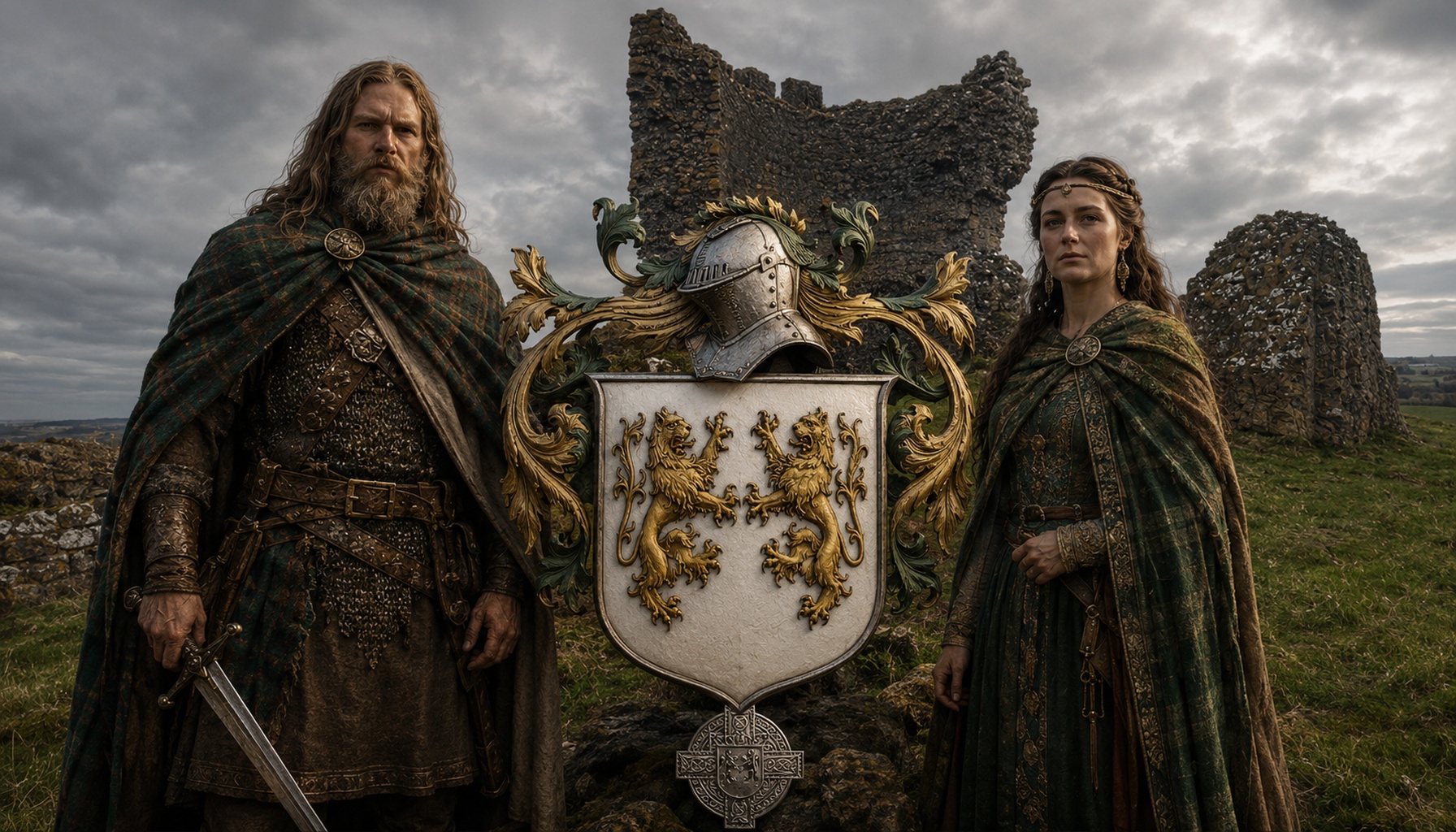
Clan Collins was a Gaelic Irish family of Munster, closely tied to the old landscape of Limerick, to Shanid, and to the long memory of local kinship in the south-west of Ireland. In Irish form the name appears as O Coileain, pointing back to an ancestor remembered as Coilean around 900, and the family belongs to that distinctly Irish pattern in which surname, territory, service, and alliance all worked together to create lasting identity. The haplogroup most closely linked here is R1b1a1b1a1a2c1a3a2a1b1a, a branch within the wider Atlantic-facing R1b world so often associated with later prehistoric and historic populations across Ireland and western Europe.
What makes the Collins story interesting is that it is not simply a matter of a surname surviving on paper. This was a lineage rooted in place, woven into the noble and clan landscape of Munster, and remembered through landholding, regional reputation, and family continuity. The O Coileain were associated with the Lords of Ui Conaill Gabhra, and their story belongs to the world of Gaelic lordship, where castles mattered, but so too did fosterage, loyalty, poetry, and the practical business of local service. That is why figures such as Coilean, the early named ancestor, and much later Sean O Coileain, the Irish poet and scribe who lived from 1754 to 1817, stand out so well: one anchors the lineage in early memory, the other shows how family identity endured into a very different Ireland, still carried in language and learning.
Shanid Castle is the great location anchor for this heritage, and it is one of those places where Irish history becomes wonderfully tangible. Set in County Limerick, Shanid was a major stronghold in medieval Munster and gave its name to the surrounding territory. The castle itself, now a ruin, was built on a commanding hill and is especially known for its prominent earthwork mound and surviving tower remains. Historically it passed through the hands of important powers, including the FitzGeralds, but its real importance is broader than any one owner: Shanid was a statement in stone about control, visibility, and lordship over the surrounding countryside. For a family like the Collins line, association with Shanid places them within a landscape where ancestry, political service, and regional belonging were constantly reinforced by the presence of fortification and land. And yes, the site can still be visited today as a ruin, which is rather marvellous, because it means this is not just a name in a pedigree but a real place you can stand in, look out from, and imagine as part of the lived world of Gaelic Munster.
From a DNA perspective, the primary family haplogroup tag here is R1b1a1b1a1a2c1a3a2a1b1a. We should be careful, of course: ancient samples are linked or related to this broader paternal line, not proof of direct descent from any specific excavated individual. Even so, the spread is fascinating. Related samples include several Celtic Durotriges burials from Duropolis at Winterborne Kingston in England, such as WBK12, WBK20, WBK29, WBK41, WBK05, WBK30, WBK43, WBK06, WBK08, WBK18, and WBK191, alongside Iron Age and Bronze Age individuals like Worlebury Somerset I11991, Battlesbury Bowl I21309, Trumpington Meadows I3256, Amesbury Down I2417, Upavon I4950, Bedfordshire I7576 and I7577, South Lanarkshire I5473, Hinxton HI2, Thames I5377, Scotland I2859, and Rathlin2B from Copper Age Ireland. The same linked branch also appears across a wider European world, from Gallic France and Roman Portugal to Croatia, Belgium, Germany, Austria, and Italy. That does not make the Collins family continental aristocrats in any simplistic sense; rather, it shows how the paternal background associated with many Gaelic Irish families sits within a deep western European story stretching from Bronze Age movements to Iron Age Celtic societies and into the historic period.
If you carry the Collins surname, have Munster roots, or simply suspect a connection to this wider Gaelic heritage, DNA can add a remarkable extra layer to the story. Uploading your results can help you see whether you match Clan Collins connections or any of these related ancient DNA samples, and place your own family history within the longer sweep of Irish and European ancestry.
Comments