Clan Bissett
– 3 min read


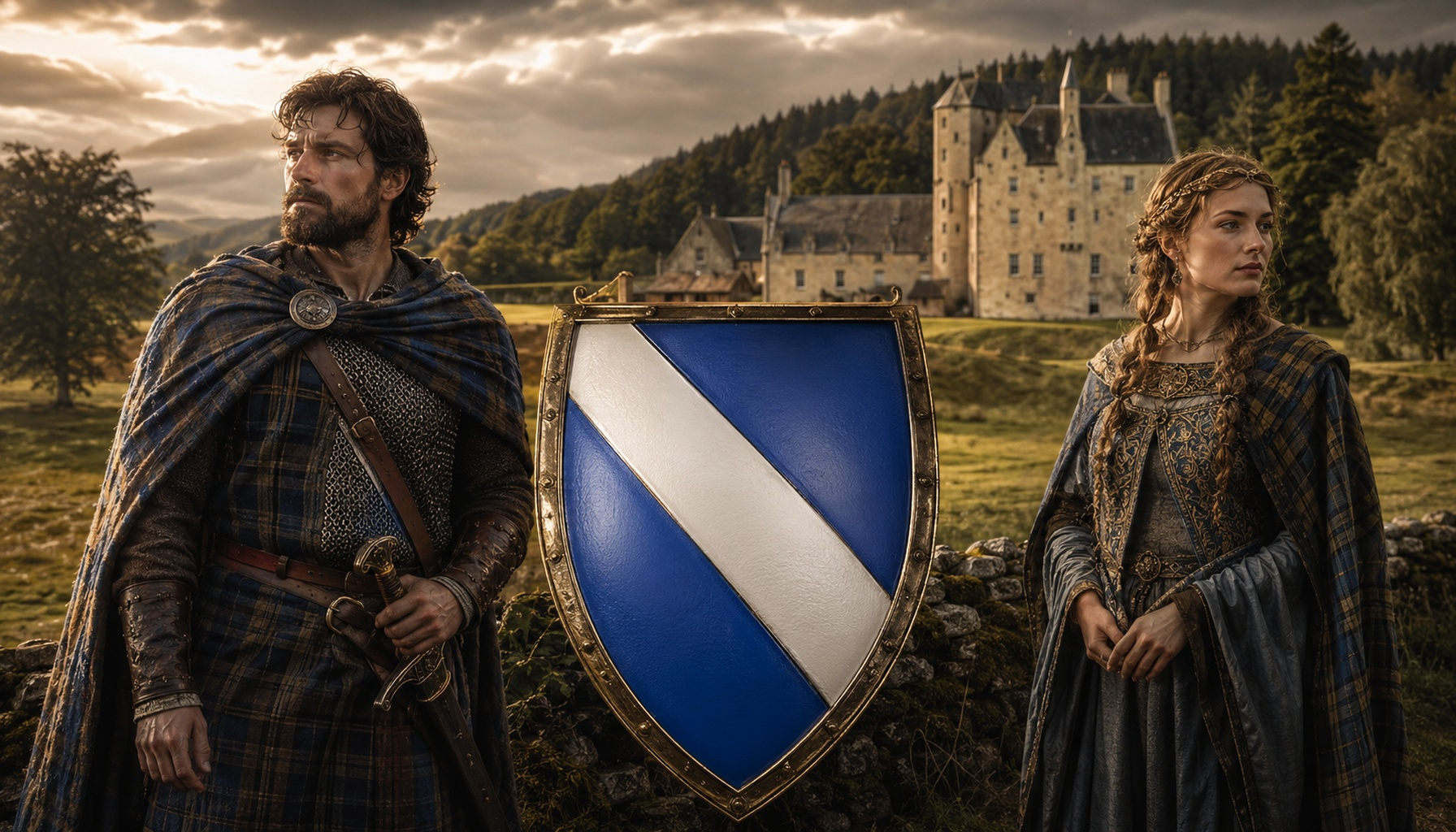
Clan Bissett was one of those Norman-origin families who crossed into the world of medieval Scotland and, in time, became thoroughly part of it. Their story begins in the wider Norman sphere, almost certainly from the continental aristocratic culture that spread out after the 11th century, when men with horses, charters, and military usefulness could make new lives in new kingdoms. In Scotland, the Bissetts entered the familiar medieval ladder of advancement: royal service, land grants, marriage, lordship, and local influence. In genetic tagging terms, the primary family haplogroup linked here is R1b1a1b1a1a2c1a2a1a, a branch within the great western European R1b story, and one that sits comfortably within the long population history of Atlantic and northwestern Europe.
The Bissetts are a good reminder that "Norman" in Scotland did not mean forever foreign. Quite the reverse. Families like this arrived as part of the feudal reshaping of the kingdom, but within generations they were woven into Scottish politics, landholding, and regional power. Their fortunes rose in the north, especially around Aboyne, and they appear in the documentary record as men of consequence rather than as vague clan legend. Walter Byset, Lord of Aboyne, is recorded in 1242 and stands as one of the named figures who anchor the family in the hard-edged politics of 13th-century Scotland. Yet, as so often with medieval nobles, position brought danger as much as privilege: royal suspicion, accusation, and political rivalry could swiftly unmake what inheritance had built. That is very much the Bissett story too.
Explore the House of de Warenne
The great location anchor for the family is Aboyne Castle in Aberdeenshire, on Deeside, a landscape where lordship was never just about a house but about control, routes, tenants, and prestige. The castle site has deep history: an earlier motte-and-bailey fortification is thought to have existed there before the later tower house and subsequent rebuilding. What survives today is largely the result of later phases, especially a 17th-century rebuilding and later alterations, but the place still carries the memory of its medieval importance. It passed through several hands over the centuries, including the Gordons, and like many Scottish castles it is less a frozen relic than a building with a long, layered biography. The setting matters too: near the River Dee, with the Cairngorm landscape not far off, it is exactly the sort of place that tells you why a noble family wanted to hold it. Aboyne Castle is not generally open as a full-time public interior attraction because it remains a private residence, but the castle and its grounds are well known from the outside and the wider Aboyne area can certainly still be visited, which makes it a very tangible point of connection for anyone tracing the Bissett story.
From a DNA perspective, the Bissett-linked haplogroup R1b1a1b1a1a2c1a2a1a belongs to a much older tapestry than any one medieval surname. We should not claim direct descent from ancient samples without specific evidence, but we can say that related or linked ancient DNA points to a broad and fascinating west European and trans-European background. Among the linked samples are several Celtic Durotriges burials from Duropolis at Winterborne Kingston in England, including WBK12, WBK20, WBK29, WBK41, WBK05, WBK30, WBK43, WBK06, WBK08, WBK18 and WBK191. There are also related samples from Imperial Roman Zadar in Croatia (I26776), Bronze Age Orkney at Links of Noltland on Westray (KD061), Bronze Age Calabria at Grotta della Monaca Sant Agata di Esaro (GMO015), Early Medieval and Medieval Belgium at Sint-Truiden (ST2025 and ST1308), Gallic France at Parancot (CGG023699), Post-Roman Dorset (I11580), Merovingian Germany (IND013), Late Roman Lower Austria (R10656), Late Roman Conimbriga in Portugal (R10488), Celtic Briton East Kent (I13730), Iron Age Somerset (I11991), Iron Age Orkney (I2982), Iron Age Battlesbury Bowl (I21309), Bronze Age Trumpington Meadows (I3256), Amesbury Down (I2417), Bell Beaker Upavon (I4950), Viking Age Denmark (VK287), Medieval Sandoy in the Faroe Islands (VK27), Bronze Age Bedfordshire (I7576 and I7577), Bronze Age South Lanarkshire (I5473), Hinxton Iron Age (HI2), Early Bronze Age Thames (I5377), and Copper Age Ireland at Rathlin (Rathlin2B). What that suggests, in plain English, is not a single straight family line, but a long continuity of related paternal signatures moving through Bell Beaker, Bronze Age, Iron Age, Roman, and medieval worlds that helped form the populations from which later families such as the Bissetts emerged.
Explore Ancient DNA in Post-Roman Britain
If you are curious about Clan Bissett, the Norman families who settled Scotland, or the deeper R1b1a1b1a1a2c1a2a1a story behind them, this is exactly where family history becomes more interesting than a list of names. Upload your DNA to MyTrueAncestry and see whether you match the Bissett family story or any of the related ancient DNA samples linked to this wider genetic landscape.






Comments