Clan Ainslie

– 2 min read


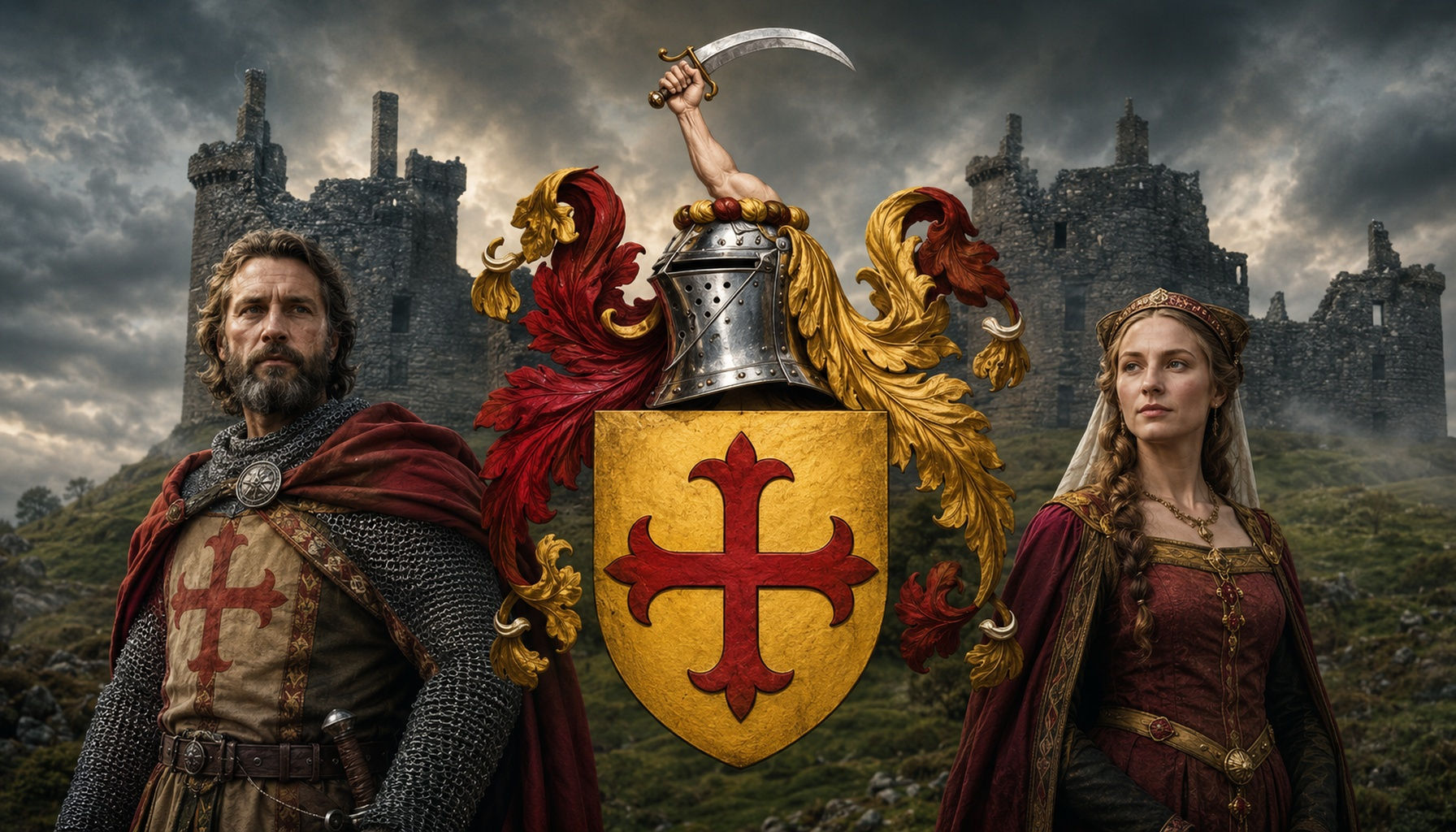
Clan Ainslie belongs to the long, sturdy tradition of Scottish Border and Lowland family history: not a princely dynasty thundering across Europe, but a surname rooted in place, service, kinship, and the stubborn continuity of remembered ancestry. The name appears in medieval records as Aneslei and related forms, and is generally tied to territorial naming, most likely connected with lands in the old borderlands where identity was often as much about where one stood as who one claimed. For this family tradition, the primary linked Y-DNA haplogroup is R1a1a1b1a1a1c1e.
That matters because surnames like Ainslie were formed in the same historical world that shaped so many Scottish families: feudal landholding, local obligation, military service, church record keeping, and the gradual hardening of a byname into a hereditary surname. One early figure is Thomas de Aneslei, recorded in 1221, whose name tells us a great deal in just a few words. The little "de" marks him as a man identified by place, which is exactly how many Scottish surnames first step onto the documentary stage. Clan Ainslie, then, is best understood not as a royal house in miniature, but as a durable Scottish name carried through generations, preserved in heraldry, memory, and local belonging.
A key location anchor for the Ainslie story is Dolphinstone Castle in East Lothian, a site that helps place the family in the wider landscape of Lowland Scotland. The castle began as a late medieval tower house and was later enlarged, reflecting a pattern seen all over Scotland: a defensible residence first, then a more comfortable lairdly home as times changed. It is associated with the Ainslies of Dolphinstone, who rose into the local landed world and tied their name to this estate. In architectural terms it developed from fortified core to an expanded residence, and in social terms it speaks of ambition, status, and continuity within regional society rather than grand national power. Like so many Scottish towers, it is not merely a picturesque ruin; it is a statement in stone about family permanence. The site and its remains can still be visited from the outside, and the castle survives as a real, physical point of connection for anyone tracing the Ainslie name through the landscape of East Lothian.
From the ancient DNA side, the primary Ainslie-linked haplogroup R1a1a1b1a1a1c1e appears in a wider web of medieval and earlier European samples rather than in any proven single "Ainslie ancestor," and it is important not to overclaim. Related or linked examples include Medieval Hungary Carolingian samples from Szekesfehervar Sarkereszturi AHPS185W and Bodajk Proletarfoldek AHPS190W and AHPS199W, Early Goth samples from Pommerania at Pruszcz Gdansk Wielbark PCA0457 and Czarnowko Wielbark PCA0550, PCA0551, and PCA0554, Medieval Denmark Tjrby Randers CGG101689, Piast-linked and Santok-associated individuals such as PCA0213, PCA0383, PCA0394, PCA0399, PCA0643, PCA0624, PCA0336, and PCA0181, along with Medieval Pommerania Legowo PCA0165, Duchy of Sandomierz region sample PDH006, Thuringii-associated Deersheim DRH009, the Napoleon Grande Armee burial from Vilnius YYY088B, and the Swedish warship Kronan sample kro002. Taken together, these linked finds place the haplogroup within a broad northern and central European historical zone shaped by migration, war bands, dynasties, frontier societies, and medieval state formation: precisely the sort of deep background from which later Scottish surname histories eventually emerge.
Explore the medieval Piast DNA story
If you carry the Ainslie surname, or have Border and Lowland Scottish ancestry in your family tree, this is where history becomes personal. Upload your DNA to MyTrueAncestry to see whether you match Clan Ainslie, or any of the related ancient DNA samples linked to haplogroup R1a1a1b1a1a1c1e, and place your own family story against the deeper archaeological map of Europe.


Comments