Christopher Corvinus
– 5 min read


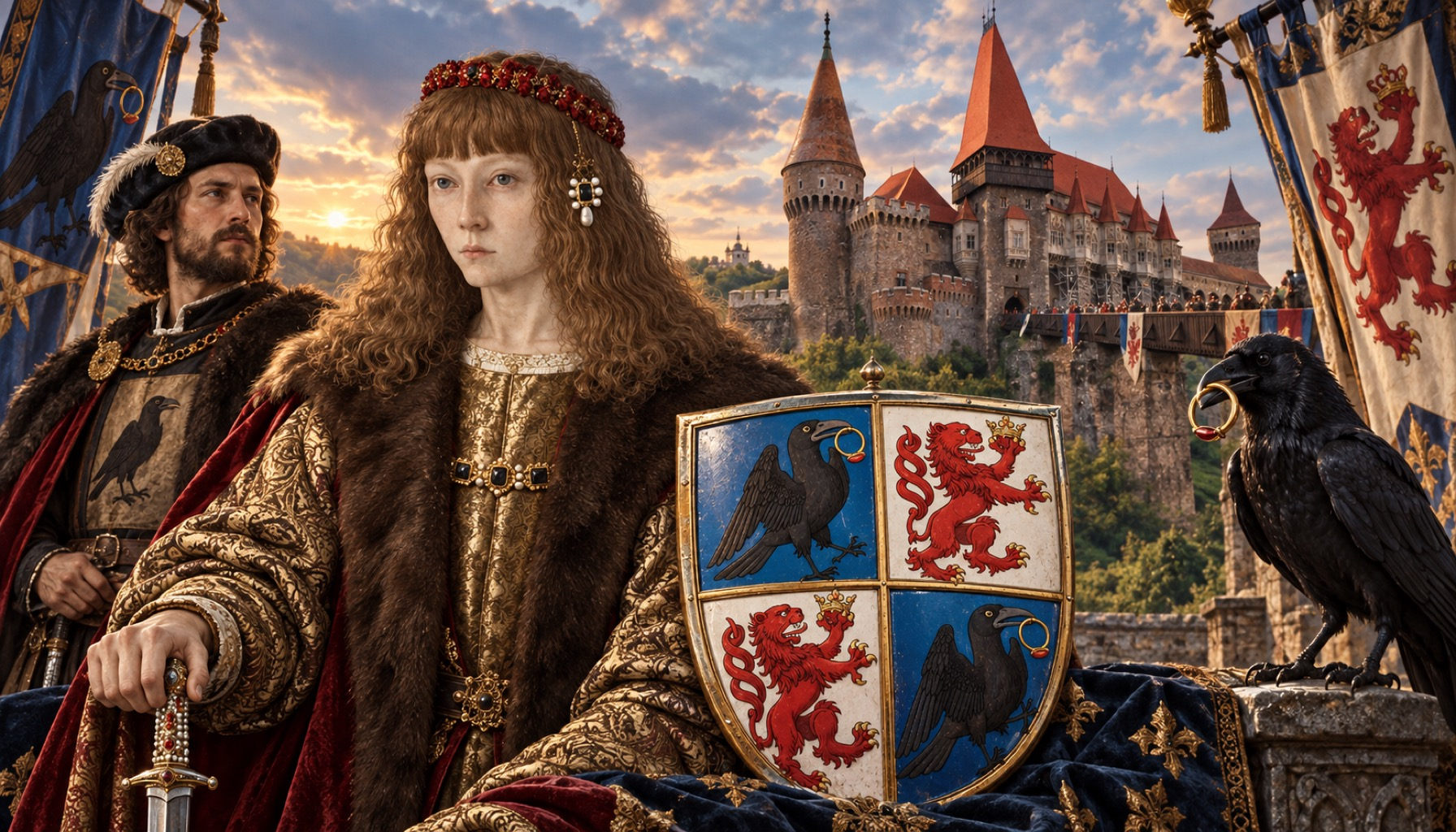
Christopher Corvinus was born in 1499 into one of the most dramatic family stories in late medieval and Renaissance Hungary. He was the son of John Corvinus and the grandson of Matthias Corvinus, the famous king whose court at Buda became a major centre of humanist culture while Hungary stood on the front line against Ottoman expansion. Through that grandfather, Christopher belonged to the Hunyadi-Corvinus family, a dynasty that had climbed with astonishing speed from military nobility to the royal throne.
Yet Christopher’s importance lies as much in his early death as in his birth. When his father died in 1504, the small boy became head of the family. He survived only a little longer, dying in 1505, and with the deaths of Christopher and his young brother Matthias the legitimate male line of the Hunyadi-Corvinus house came to an abrupt end. It is one of those bleak historical moments: a dynasty that had loomed so large in Hungarian politics simply vanished within a generation of its greatest king.
To understand Christopher, one has to begin with Matthias Corvinus. Matthias was not merely a successful ruler but a symbol of Hungarian kingship at its most self-confident: energetic in war, ambitious in diplomacy, and famously engaged with Renaissance learning and art. His father, John Hunyadi, had already become legendary for resisting the Ottomans, so by the time Christopher was born he inherited not just a name, but a heroic family memory. The trouble was that heroic memory did not guarantee political security.
After Matthias Corvinus died in 1490, the political world that had sustained Hunyadi power changed quickly. His illegitimate but acknowledged son, John Corvinus, struggled to maintain the family’s standing in a kingdom shaped by noble faction, contested succession, and pressure from powerful neighbours. Christopher’s short life unfolded in that unsettled aftermath. He was born into magnificence, but magnificence under strain. His death in childhood meant there would be no adult heir to continue the legitimate male line, no later Corvinus prince to revive the house, and no second act for one of Hungary’s most celebrated dynasties.
Explore the Royal House of Hunyadi
The biological sample associated with him is listed as Christopher Corvinus Hunyadi Dynasty, with an approximate date of 1506 AD. In practical terms, this places the sample very close to Christopher’s death in 1505 and within the funerary context of the dynasty’s final generation. The published research relevant here is the study available through the National Center for Biotechnology Information, which discusses genetic results from Hunyadi-Corvinus remains and their historical significance.
In this case, the identification should be treated as a historically attributed dynastic sample linked to Christopher Corvinus rather than as a case where every detail of the chain of identification is spelled out in the brief summary alone. That distinction matters. Ancient DNA work can strongly support dynastic relationships and burial attributions, but readers should resist the temptation to imagine that genetics by itself labels a skeleton with a name tag. What it can do, when combined with archaeology, chronology, and known family relationships, is help test whether the remains fit the historical person they are thought to represent.
For a figure like Christopher, who died as a child and left no political legacy of his own, that is especially valuable. The remains become one of the few direct windows onto the last legitimate male generation of the Corvinus line.
The reported Y-DNA haplogroup for Christopher Corvinus is E1b1b1a1b1a6a1c. Y-DNA follows the direct paternal line, passed from father to son, so this lineage is particularly interesting for a male dynastic figure whose family identity was tied so closely to descent through the male line. In plain language, it offers a genetic marker for the paternal line of the Hunyadi-Corvinus family represented by Christopher and, by extension, helps researchers compare him with close male relatives such as his father John Corvinus.
His mitochondrial DNA haplogroup is T2c1+146. mtDNA follows the direct maternal line, passed from mothers to all their children. This tells us about one narrow maternal lineage within Christopher’s ancestry, not about all of his ancestry overall. As ever with haplogroups, these are lineages, not ethnic labels. They do not prove that Christopher was “really” one people or another, nor do they sum up the full genetic background of a Renaissance Hungarian noble child.
The paternal lineage E1b1b1a1b1a6a1c is historically interesting because related ancient samples linked to this branch or its close placement appear across a strikingly broad chronological and geographic range. Among examples noted in connection with this lineage are Johannes Corvinus Hunyadi Dynasty (CJM), which is directly relevant for dynastic comparison, as well as samples from Medieval Northern Spain at Las Gobas (ldo046), Early Bronze Age Greece at Corinthia Perachora (G76a), Medieval Hungary at Bodajk Homoki dulo (AHPS206W), the Byzantine/Avar borderlands at Kiskunorozsma-Daruhalom-dulo (KDA-520), Bronze Age Austria at Pottenbrunn (PEB016), Late Bronze Age Megiddo elite graves (I10769 and I10770), ancient Himera in Sicily (I20162), Mycenaean Attica (I15582), Celtic-period Hungary (I18838), Saifi in Lebanon (SFI-43), and Neolithic Italy at Grotta Continenza (R10). That list does not mean all these people were close relatives of Christopher. Far from it. It simply shows that the deeper paternal lineage has a long and complex history across parts of Europe and the Mediterranean.
The maternal lineage T2c1+146 is more narrowly represented in the material supplied here, with Christopher Corvinus himself given as the relevant linked sample. Even so, that in itself is useful: it preserves a direct maternal-line signal for a member of a famous dynasty whose documented political story is overwhelmingly told through men, titles, and inheritance disputes.
Read about Hungary's Árpád dynasty burials
Christopher Corvinus is a good example of what ancient DNA can and cannot do. It cannot restore the lost future he never had, and it cannot by itself explain the political collapse of his family after Matthias Corvinus. But it can anchor the last legitimate male generation of the Hunyadi-Corvinus dynasty in biological evidence. In combination with the related Hunyadi samples discussed in the research, it helps scholars explore kinship, burial authenticity, and the paternal continuity of a line that ended in tragedy almost as soon as Christopher inherited its name.
There is something rather moving about that. History usually remembers the triumphant grandfather, Matthias the king. Genetics lets us look instead at the child at the end of the story: not a conqueror, not a ruler in his own right, but the last small bearer of a great dynastic inheritance.
Discover medieval Hungary's elite genomes
With MyTrueAncestry, you can compare your DNA with ancient populations and archaeological samples from the worlds that shaped figures like Christopher Corvinus, from medieval Hungary to deeper European and Mediterranean lineages. It is a way to explore genetic connections to the past without confusing shared ancestry signals with proven descent from a specific historical individual.



Comments