Amesbury Archer
– 5 min read


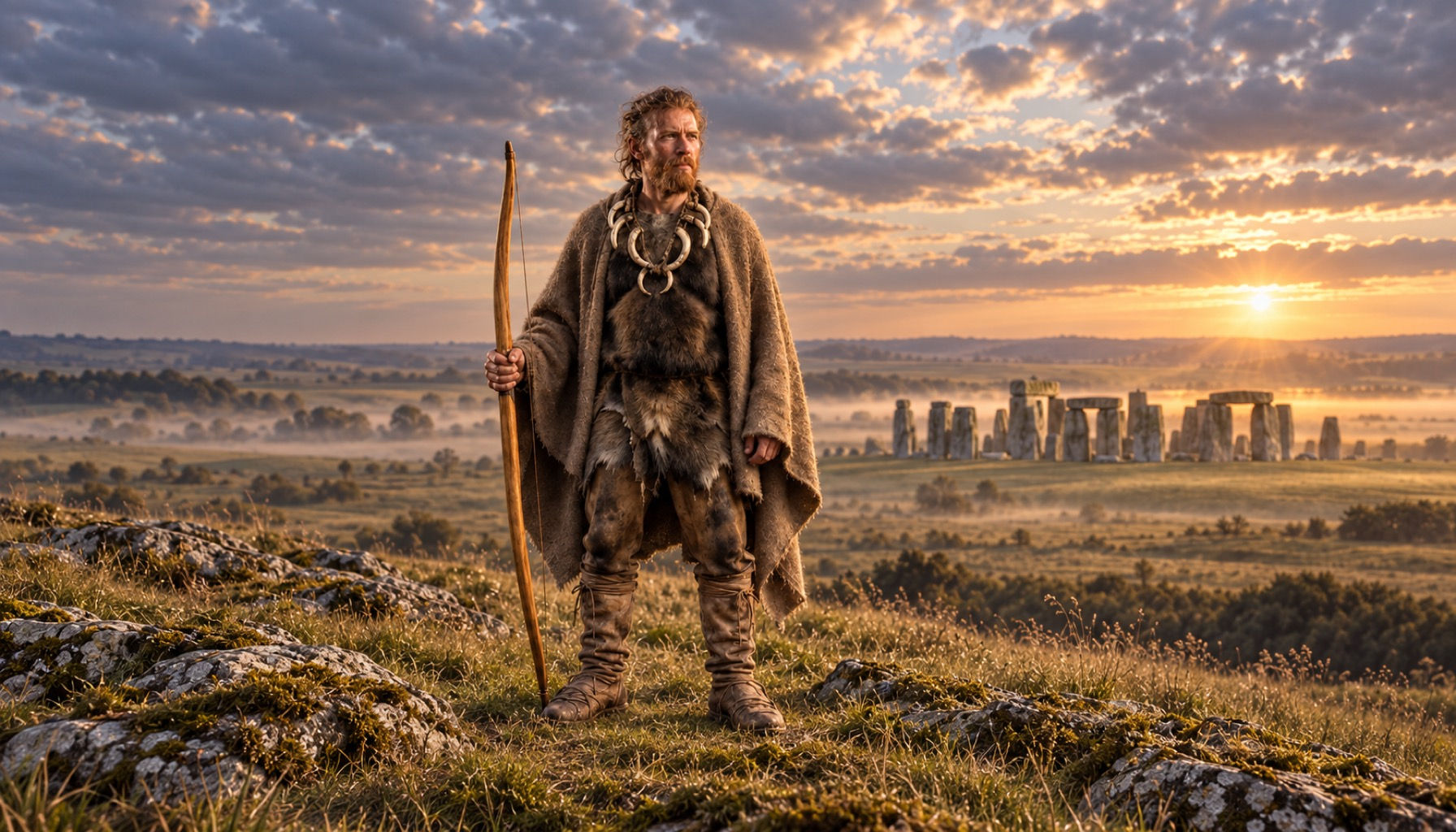
The Amesbury Archer was a man of the Early Bronze Age, buried near Stonehenge around 2300 BC in what is still one of the richest prehistoric graves ever found in Britain. He is important not because we know his personal name, tribe, or office—we do not—but because his burial brings together several of the great themes of later prehistory in one striking human story: wealth, migration, metallurgy, and the making of connections across Europe.
His grave goods were extraordinary: Beaker pottery, flint arrowheads, copper knives, stone wristguards, gold hair ornaments, and other carefully chosen objects that signal status, skill, and access to far-reaching networks. It is this lavish burial that earned him the modern nickname “the King of Stonehenge,” though that title is popular rather than historical. What matters more is that he lived at a moment when Stonehenge and its surrounding ceremonial landscape were still being shaped, and when Britain was becoming more deeply entangled with the wider Beaker world of continental Europe.
Explore Bronze Age burial worlds in Britain
The Archer belonged to a period when old monuments still mattered, but new people, new customs, and new technologies were altering Britain very quickly. The Beaker phenomenon was not a single kingdom or tribe marching under one banner. It was a broad cultural world, recognisable through pottery styles, burial practices, metalworking, and long-distance exchange. The Amesbury Archer stands right in the middle of that transformation. His grave suggests a man who was not ordinary: perhaps a craft specialist, perhaps a warrior, perhaps someone whose standing came from knowledge, travel, or command of valuable materials. Archaeology cannot simply read a job title off a skeleton, but it can show us that he was treated in death as a person of consequence.
One of the most compelling details is his mobility. Isotope analysis of his teeth suggested that he had spent his childhood far from southern Britain, quite possibly in a region of continental Europe. That matters enormously. It reminds us that prehistoric people were not rooted immovably to one village for life. Some travelled great distances, carrying skills, contacts, and family histories with them. In the age of the Amesbury Archer, Stonehenge was not just a local monument on Salisbury Plain; it stood in a landscape connected to wider movements of people and ideas across the Channel and beyond.
The biological sample associated with this individual is listed as Amesbury Archer Bronze Age England, dated to about 2300 BC. This is not a speculative literary identification but a securely defined archaeological individual: the remains excavated from the famous richly furnished burial near Stonehenge. In other words, researchers are not trying to decide whether the bones “might be” the Archer; the sample comes from the burial that gave rise to that name in the first place.
The remains were recovered from a grave whose contents made immediate archaeological headlines. The burial assemblage included objects linked to archery, display, and early metal use, and it sits within a broader funerary landscape dense with prehistoric significance. Even so, one should be careful. The grave tells us he was buried with prestige goods, but it does not allow us to crown him an actual king, priest, or ruler of Stonehenge. The evidence is rich, but it is still archaeological evidence rather than biography in the modern sense.
The Amesbury Archer’s Y-DNA haplogroup is reported as R1b1a1b1a1a2b1, and his mtDNA haplogroup as K1b1a. These are two different kinds of lineage markers. Y-DNA traces the direct paternal line, passed from father to son, while mtDNA traces the direct maternal line, passed from mother to all her children. They illuminate only two narrow lines in a person’s family tree, not the whole of their ancestry.
The Archer’s paternal lineage, R1b1a1b1a1a2b1, is historically interesting because closely related lineages appear again and again in later prehistoric and early historic Europe, especially in contexts tied to Bell Beaker and Bronze Age expansions and their long aftermath. Among the linked or comparable samples are Amesbury Archer himself (I14200), Bell Beaker and Copper Age individuals from Brandysek and Prague in Czechia, Early Bronze Age and Unetice-associated men from Leubingen and Jinonice, Bronze Age individuals from Austria and Germany, and later Iron Age and Celtic-associated samples from Britain and continental Europe such as Wetwang Slack, Melton, Duropolis, Teplice, and Pont de Cornaux-Les-Sauges. Farther afield, related paternal branches also appear in later Etruscan, Gallic, Roman-era, and post-Roman contexts. That does not mean all these people were one people in any simple ethnic sense. It means this paternal lineage was part of a very successful and widespread male ancestry stream moving through European prehistory and history.
His maternal lineage, K1b1a, is reported here in the Amesbury Archer sample itself. mtDNA lineages such as K1b1a can survive through many populations over long spans of time, often with much less public attention than Y-DNA receives. In this case, the maternal result reminds us that the Archer’s story was not carried only by male mobility or male prestige networks. He also belonged to a maternal line with its own deeper past, though mtDNA on its own cannot tell us the language, identity, or social role of the women in that ancestry.
The wider genomic context supplied by studies such as the 2021 Nature article on ancient Britain helps place him more securely in the massive population changes that accompanied the arrival and spread of Beaker-associated groups. That research showed that the centuries around the Archer’s lifetime were part of a real demographic transformation in Britain, not merely a change in pots or burial fashions. In that sense, his DNA is historically valuable because it belongs to an individual who stood within a documented age of migration and population turnover.
Read about Bell Beaker population turnover
The Amesbury Archer’s DNA does not reveal his personal thoughts, the language he spoke, or whether he saw himself as foreign or local. Genetics cannot do that, and it is worth saying plainly. What it can do is strengthen the archaeological picture of a mobile, connected Bronze Age world. His isotopes already suggested that he grew up away from southern Britain; his genetic context fits neatly into the broader story of Beaker-linked movements that reshaped Britain in the third millennium BC. Put bluntly, he is interesting not because a haplogroup makes him glamorous, but because archaeology, isotopes, and ancient DNA all converge on the same point: this was an age of movement, exchange, and profound change.
Discover the Bell Beaker expansion
With MyTrueAncestry, you can compare your DNA with ancient populations and archaeological samples from worlds like that of the Amesbury Archer, from Beaker and Bronze Age Britain to connected communities across prehistoric Europe. It is a way to explore broad genetic connections to the ancient past without claiming direct descent from a single famous individual.

Comments