Tracing a Travelling Sámi: Bioarchaeology of a 16th‑Century Individual from Kuusamo, Finland
– 8 min read


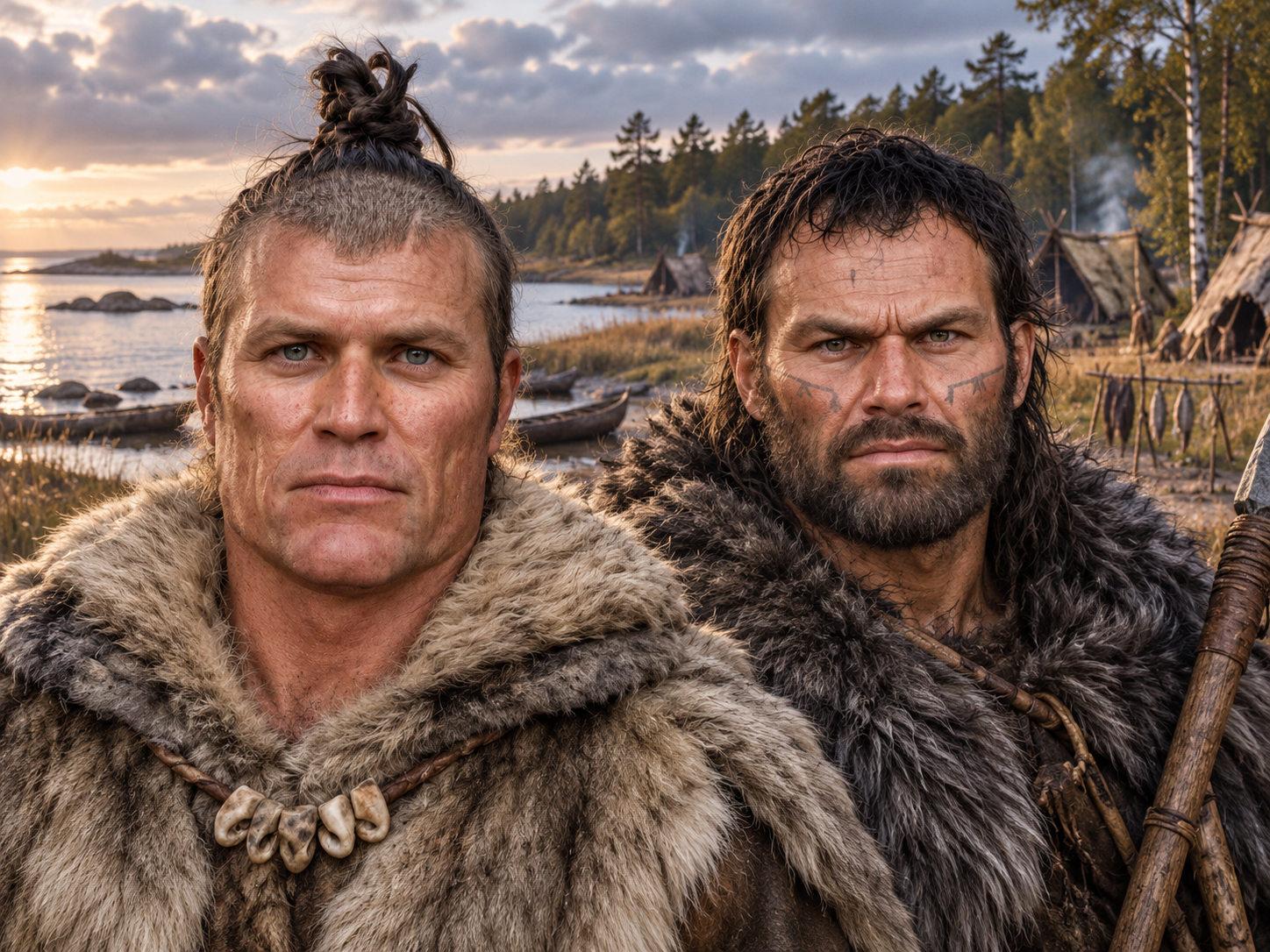
On the rocky shore of Lake Yli-Kitka in Kuusamo, northern Finland, a single grave has opened an extraordinary window onto Sámi life at the turn of the 16th–17th centuries. Discovered in 1970, this inhumation burial predates Finnish agricultural settlement in the region and represents the oldest known grave from Kuusamo. The burial lay close to the waterline within what was once the Kitka siida, one of the southernmost Sámi village communities. The skeleton belonged to a man who died at approximately 40 years of age, carefully interred with a striking assemblage of grave goods that immediately distinguished his burial from contemporary Finnish Christian graves further south.
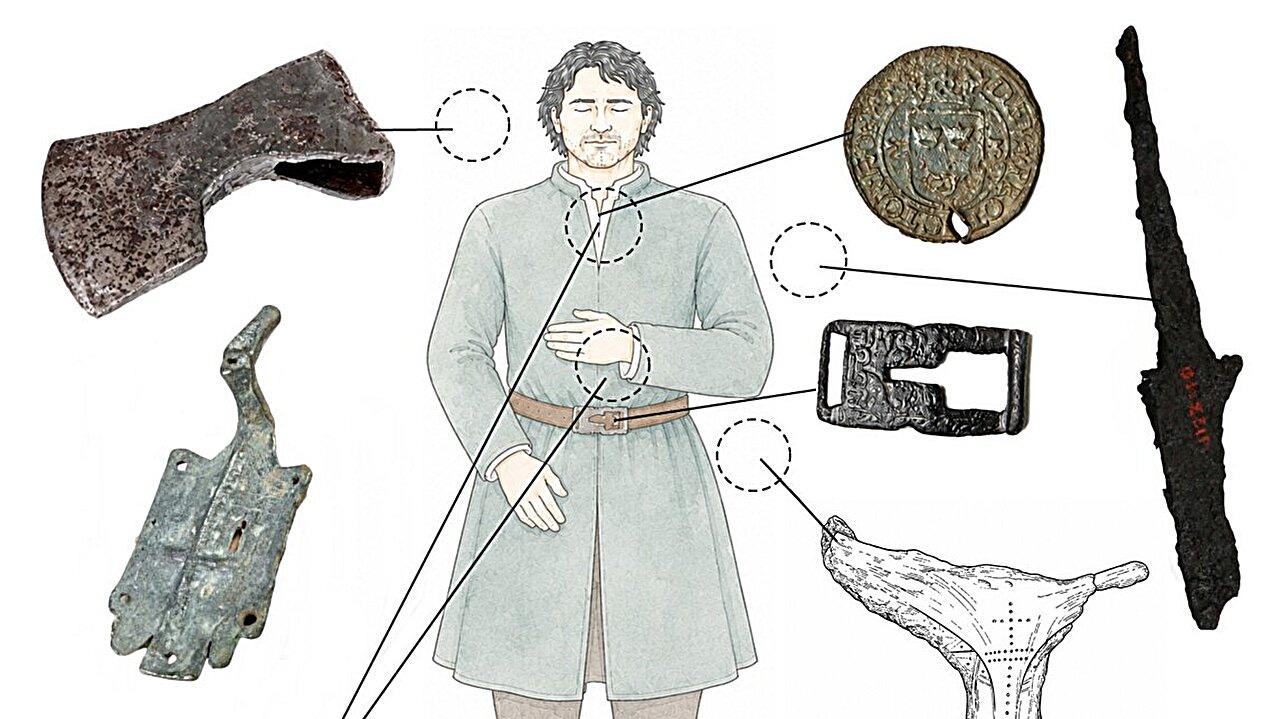
The grave goods included a reindeer-antler drum hammer, a tin bird ornament, copper rings, an iron axe and knife, a pewter belt buckle, and crucially, a Swedish 2 öre silver coin of John III minted in 1573. This coin, worn as a pendant on the chest, provides precise dating for the burial to around 1600. The drum hammer is particularly significant, as Sámi ritual specialists used such implements with drums to communicate with the spirit world. The tin bird pendant, with its distinctive styling reminiscent of eastern Christian imagery, suggests connections extending beyond local Sámi traditions to broader trade networks linking the northern interior to coastal and overseas markets.
At the time of this man's burial, Kuusamo was not yet a Finnish-speaking farming district but remained Sámi territory, home to speakers of Kemi Sámi, a now-extinct branch of the Sámi languages once common across the Kemi River drainage. These communities practiced a mixed economy of fishing, hunting and gathering, with freshwater fish particularly important throughout much of the year. Over the following century, Finnish settlers moved northward with their agricultural practices and livestock, while taxation, political pressure and Christianisation pushed earlier Sámi inhabitants northward or into assimilation. The Kemi Sámi language and traditional culture gradually faded from everyday life, making the Kitka grave not merely a burial, but a rare, tangible trace of a vanished community.
Ancient DNA extracted from the individual's teeth revealed genetics firmly anchoring him within the Sámi world. His maternal lineage belongs to mitochondrial group V, one of the dominant lineages among modern Sámi populations. His paternal line falls within a branch of the N lineage common in present-day Sámi and Finns. Across his entire genome, he clusters most closely with modern Sámi populations and with earlier individuals from Fennoscandia carrying Sámi-related ancestry. These genetic results align perfectly with his burial context, showing a man interred with ritual implements whose genes also proclaim close kinship with Sámi populations across the north.
The genetic data reveal ancestry from a small, relatively isolated population, consistent with sparsely settled Sámi groups scattered across forests, tundra and coasts. Remarkably, the Kitka individual appears to possess an even stronger component of ancient eastern or "Siberian-like" ancestry than many modern Sámi populations in Finland. Statistical analyses suggest that present-day Finnish Sámi have accumulated slightly more western European ancestry over the intervening centuries through intermarriage with neighboring non-Sámi populations.
When researchers compared his genome with thousands of modern Finns from known home regions, clear patterns emerged. The strongest and most numerous shared DNA segments appear among people in northeastern Lapland, particularly in Inari, Utsjoki, Salla, Savukoski, and Pelkosenniemi. Surprisingly, modern inhabitants of Kuusamo itself share fewer and generally shorter DNA segments with him than these northern communities, reflecting both the early disappearance of Sámi groups from Kuusamo and subsequent heavy Finnish settlement. Across Finland as a whole, approximately one in ten individuals in the studied sample carry at least one long DNA segment identical to sequences found in the Kitka individual or modern Sámi populations.
Chemical signatures preserved in the man's teeth and bones reveal an unprecedented story of long-distance movement. Different tissues form at different life stages, creating a chronological record of residence and diet. Analysis of a premolar tooth, forming between ages 3-7, shows a childhood diet dominated by terrestrial foods with clear contributions from freshwater fish and some marine input. This pattern suits early life in the inland north, where families moved between forest, river and lake environments. Oxygen isotope values indicate a cold, northern climate consistent with high latitudes, while strontium signatures match bedrock and river systems typical of northeastern Finland and adjacent shield terrain.
However, a third molar, forming during later childhood and adolescence (ages 9-18), tells a dramatically different story. The freshwater fish component virtually disappears from dietary models, replaced by substantial marine resources while terrestrial foods remain important. Most remarkably, this tooth exhibits extraordinarily low strontium isotope ratios, lower even than modern ocean water and far below any values measured from Finnish samples, ancient or modern. Such ratios are incompatible with Finland's ancient crystalline bedrock, which typically produces much higher strontium signatures.
These anomalous values point to residence on young volcanic or carbonate terrains absent from Finland's geological landscape. Comparative analysis suggests the closest match lies with Icelandic signatures, where young volcanic basalts commonly produce strontium ratios in the observed range. While alternative locations with similar geology cannot be entirely excluded, Iceland emerges as the strongest candidate given documented historical contacts between Sámi communities and Icelandic merchants along Arctic coasts.
The implications are extraordinary: this individual may have spent several formative years outside present-day Finland, possibly in Iceland itself, before returning to northern Fennoscandia. This represents not seasonal migration but long-term relocation during crucial developmental years. The timing aligns with known historical turbulence, including the 25 Years' War between Sweden and Russia (1570-1595), which directly affected northern Sámi communities through raids, deportations and territorial upheavals.
Analysis of a rib bone, which remodels throughout life and reflects the final years before death, reveals continued reliance on terrestrial and marine foods with virtually no freshwater component. This dietary pattern persisted even though he was ultimately buried beside Lake Yli-Kitka in a region where freshwater fish had long been central to local Sámi subsistence. The absence of freshwater signatures suggests he arrived in the Kitka region only shortly before death, never fully adapting to local dietary patterns despite being buried within the community.
This evidence fundamentally challenges earlier interpretations of the Kitka individual as a local noaidi or ritual specialist deeply rooted in the community. Historical sources describe noaidis as thoroughly embedded in their home siida, with training beginning in youth through long-term apprenticeship and spiritual formation. High mobility and recent arrival sit uneasily with this model. While Sámi households commonly possessed drums for divination, and not every drum user was necessarily a formal ritual specialist, the man's life history suggests a more complex identity than simple categorical labels allow.
He could have been a trader, refugee, seasonal worker, kinship guest, or some combination of these roles. His grave goods demonstrate inclusion in Sámi ritual landscapes, but his reconstructed biography suggests someone whose life bridged multiple communities and economic systems. The remarkable mobility revealed through isotopic analysis places him within the broader context of early modern Arctic trade networks, where Icelandic, English and Dutch merchants worked the Finnmark coast seeking fish and furs, while political upheavals drove population movements across vast northern territories.
The study extends beyond individual biography to explore how traces of historical Sámi populations survive in modern Finnish genetics. Long shared DNA segments between the Kitka individual and contemporary Finns reveal patterns of ancient admixture and population continuity. The strongest connections appear in northeastern Lapland, suggesting that descendants of his broader population group remain concentrated in regions roughly 250 kilometers north of his burial site, toward the upper Kemi River and modern Sámi territories.
Even after statistical adjustment for general Sámi-Finnish mixing, the Kitka individual shows particularly strong DNA connections to people from northeastern Lapland, indicating he belonged to a specific Sámi group whose genetic legacy is preferentially preserved in those northern areas. This pattern suggests that the genetic landscape we observe today results from ongoing historical processes of exchange, marriage and movement rather than representing timeless ethnic essences.
Nearly one in ten modern Finns carry detectable DNA segments shared with either the Kitka individual or contemporary Sámi populations. In northern municipalities, this proportion rises dramatically, reaching approximately two-thirds in some northeastern Lapland communities. These findings demonstrate that the Sámi world represented by the Kitka burial did not simply vanish with Finnish colonization but was gradually incorporated into new agrarian communities and state structures, leaving genetic traces among people who now identify as Finnish.
The Kitka individual's story challenges traditional narratives about Sámi isolation and limited mobility. Instead of seasonal movements within restricted territories, the evidence reveals participation in extensive trade networks, responses to political upheaval spanning vast distances, and cultural connections reaching from the Fennoscandian interior to Iceland and beyond. This broader perspective aligns with emerging archaeological evidence for Sámi involvement in long-distance exchange and political networks throughout the medieval and early modern periods.
The genetic analysis also illuminates the inadequacy of using DNA to police ethnic boundaries or modern identity claims. While the Kitka individual clearly belonged to the Sámi world both culturally and genetically, his ancestry is also detectable among thousands of modern Finns, particularly in northern regions. This overlap reflects centuries of intermarriage and cultural exchange rather than representing confusion about ethnic categories. Identity formation involves language, community membership, political structures and self-identification rather than genetic inheritance alone.
The extinct Kemi Sámi communities emerge from this analysis not as marginal populations but as active participants in a broad Fennoscandian world whose descendants, biological and cultural, are scattered among both modern Finnish and Sámi populations. Their disappearance as a distinct linguistic and cultural group represents a significant loss of human diversity, while their genetic and cultural contributions continue influencing northern Fennoscandian communities today.
 View author profile



Comments