The Stierna Family
– 3 min read


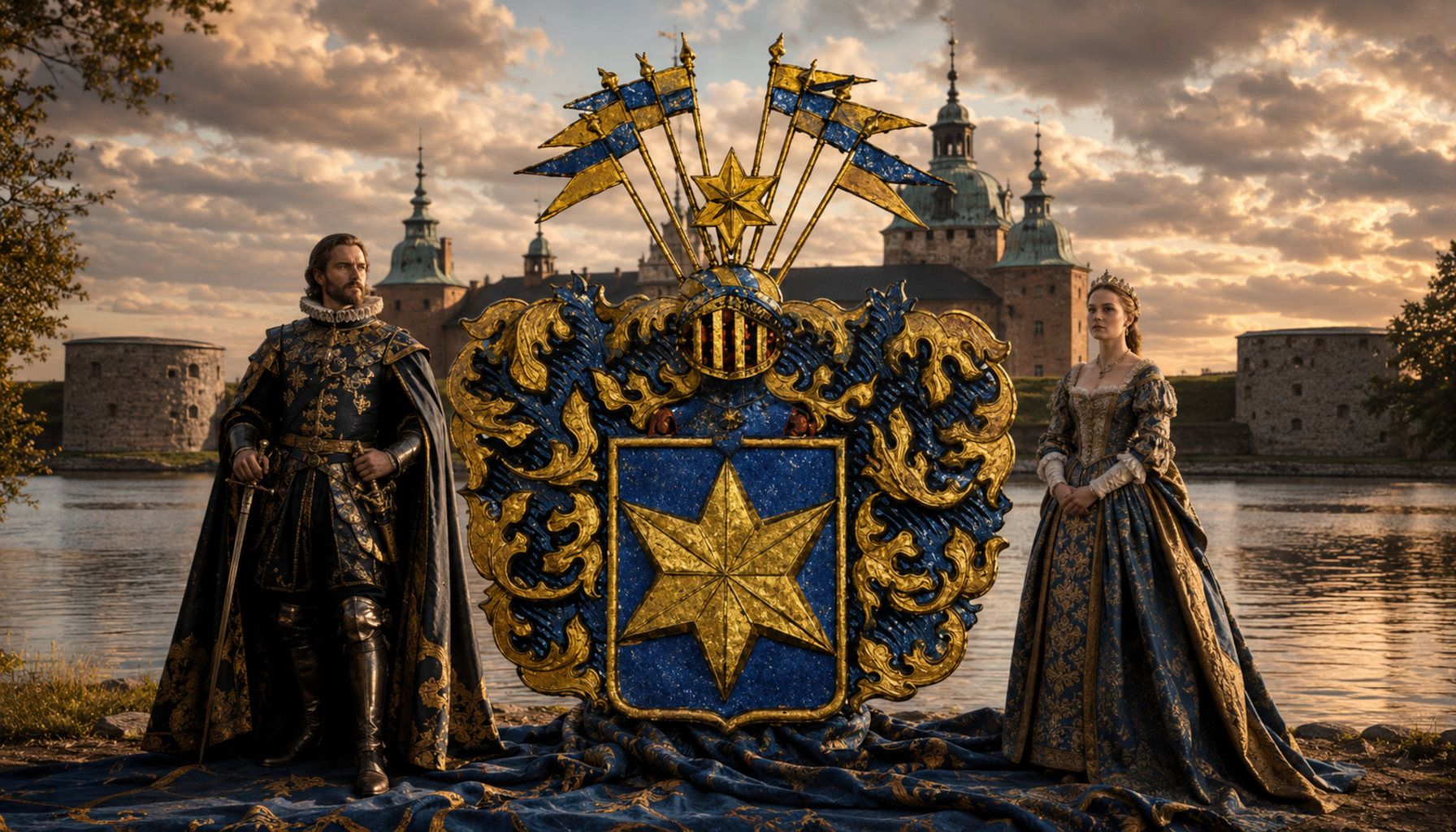
The Stierna family was one of the old noble houses of Sweden, introduced at Riddarhuset in 1625 as noble family no. 77, though its roots ran much deeper into the medieval fralse world of Smaland. This was not a family that suddenly appeared with court fashion or late noble polish. It belonged to that older provincial layer of landholding gentry whose authority rested on farms, law, service, and local reputation. Their early center lay in Smaland and Jonkoping County, especially around Saby in Backaby parish, where Nils Gregersson, active in the early 1400s, carried a star in his arms and served as district judge in Vastra harad. The family later died out on the male side in 1749, but for centuries it stood for a very recognisable kind of Swedish noble history: local, practical, martial, legal, and closely tied to the making of the kingdom. The primary family haplogroup linked with the Stierna line is R1a1a1b1a2b3a1d5a1b.
What makes the Stierna story so interesting is that it sits right on the seam between medieval regional power and the building of the early modern Swedish state. Generation after generation, members of the family served as district judges, estate holders, military officers, and royal officials. Olof Olofsson Stjaerna (1430-1498) belongs to that older phase of the lineage, when noble identity was still deeply anchored in land, kinship, heraldry, and local authority. By the 1500s, Mans Pedersson Stierna had become an important servant of the crown, holding offices in Allbo, Ostbo, Uppsala, and Kronoberg, while navigating the unrest and hard politics of Gustav Vasa's Sweden. His son Goran Mansson Stierna carried the family further into the world of castles, command, and governance, serving as commander, colonel, governor, and administrator in places such as Kalmar, Kronoberg, and Jonkoping, during the struggles involving Sigismund, Duke Karl, and the unstable early Vasa realm.
The best place to anchor the family in the landscape is Saby in Backaby parish, in the old cultural world of Smaland. This was the kind of setting from which many old Swedish noble families emerged: not from some grand urban palace, but from a landed environment of farms, parish ties, district courts, and regional power networks. Saby and its surrounding district formed part of the social geography in which men like Nils Gregersson exercised authority, where heraldic symbols such as the star were not decorative trifles but signs of lineage and standing. In historical context, this was a frontier-like inland society of forests, routes, cultivated pockets, and local assemblies, where noble influence depended on being physically rooted in place. The family's long connection to this area helps explain why the Stiernas remained so associated with law, office, and service. If you are tracing the family historically, this Smaland setting is still the right place to imagine them, and the district can still be visited today as part of the historic landscape of Jonkoping County, even if the medieval world itself survives only in fragments, names, and terrain.
The Stierna family's primary haplogroup is tagged here as R1a1a1b1a2b3a1d5a1b. That does not mean every ancient sample with this or a related branch is a Stierna ancestor, and we should be careful not to claim direct descent without evidence. But it does place the family within a wider eastern and central European genetic story visible across many ancient and medieval contexts. Related or linked samples include Avar Elite Hungary Rakoczifalva RKC052 and RKC051, Bronze Age Hungary Balaton Region Somogyvar-Vinkovci S9, Piast Dynasty Lubusz-Greater Poland Border Santok Lad PCA0404, Piast Dynasty Poland Santok Lubusz Province Gorzw Wielkopolski PCA0520, Santok Iron Age samples PCA0381 and PCA0382, Medieval Germany western Slav settler samples NDW036, NDW017, NDW025, NDW038, and NDW043, Duchy of Sandomierz Lublin Region Pidhirtsi PDH011 and PDH012, Steuden SDN028 and SDN029, Early Medieval Croatia Velim-Velistak VEM035 and VEM049, Medieval Poland Piast Dynasty Lad PCA0198, Dark Ages Hungary Gothic-associated Sandorfalva-Eperjes Ivotavak SEI-5, Bronze Age Romania Trestiana I6185, and Iron Age Ingria VII15. Taken together, these linked samples suggest a deep and mobile paternal background spread across Bronze Age, Iron Age, early medieval, and medieval societies from the Baltic and Slavic zones to the Carpathian Basin and beyond, which is exactly the kind of broad backdrop against which a Smaland noble family like Stierna can be historically situated.
If families like Stierna bring the past to life for you, DNA can add another layer to the story. Upload your DNA to MyTrueAncestry to explore ancient samples, historic matches, and the deeper population history behind your own family line.

Comments