The Saint John Family

– 3 min read


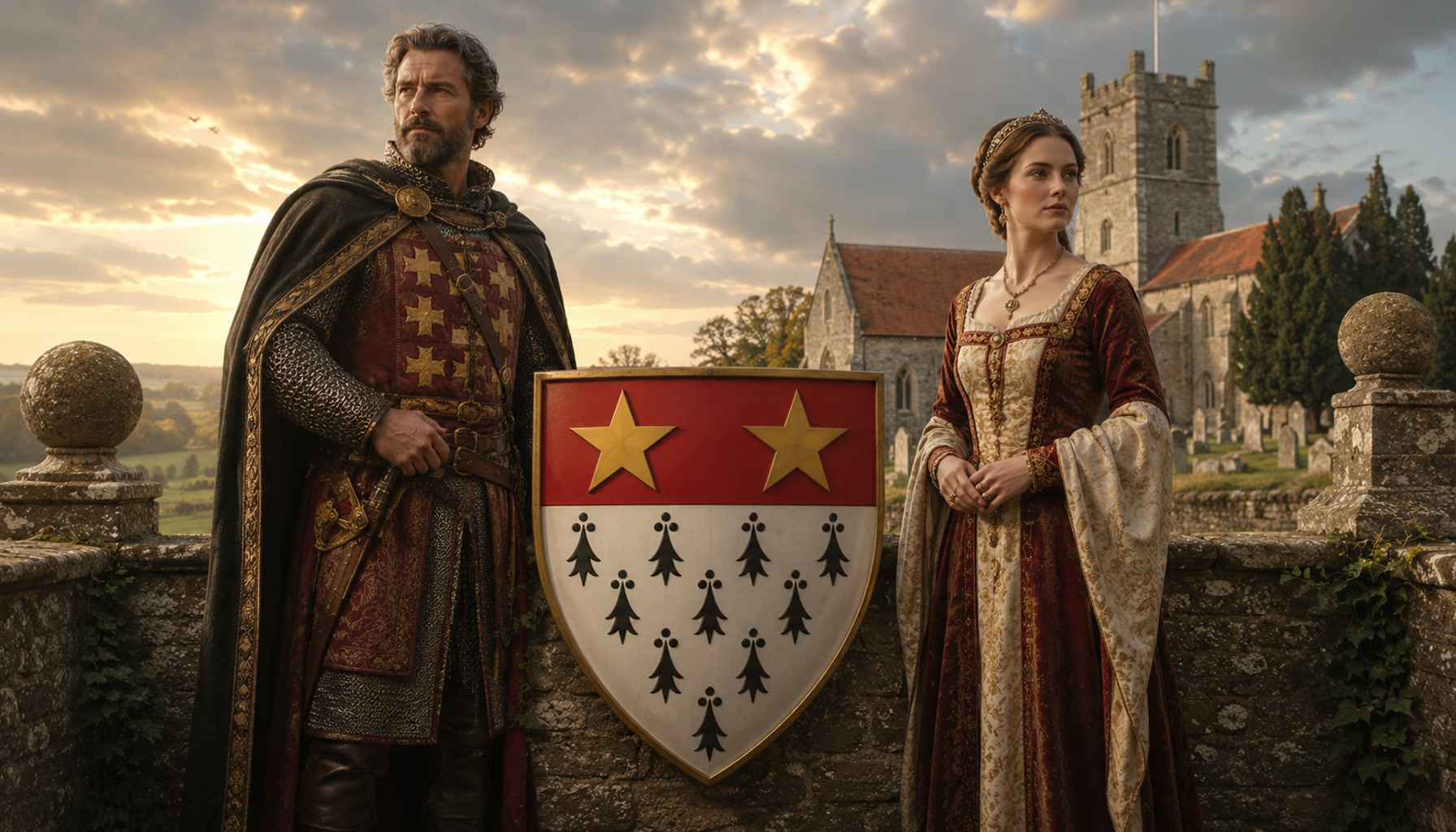
The Saint John family was one of those durable Anglo-Norman noble houses that became woven deeply into the fabric of medieval and early modern England. Their name, with its unmistakably continental and crusading-era flavor, points back to the world created after the Norman Conquest, when families of French-speaking aristocratic culture established themselves through land, lordship, and service to the Crown. Over time, the Saint Johns became firmly English in their estates, offices, and alliances, while still carrying a name that preserved that older Norman prestige. Their main historical footprint lies in places such as Hampshire and Bedfordshire, where landholding, inheritance, marriage strategy, and royal favor helped secure their place among the governing elite. Primary family haplogroup: R1b1a1b1a1a2a.
What makes the Saint Johns so interesting is that they illustrate how noble power actually worked in England: not just through titles, but through county authority, military obligation, heraldry, wardship, marriages, and the steady accumulation of influence across generations. They appear in the records of baronial society, court life, and regional administration, connected to the network of families that shaped English governance from the Middle Ages onward. Like many great lineages of Anglo-Norman origin, theirs was a story of continuity as much as ambition. The family became embedded in English aristocratic society while preserving the social memory of continental roots. Among named figures associated with the wider Saint John story is the Lord of Uchel-olau, recorded in 1436, a reminder that branches and linked traditions of noble identity could stretch across regional and marcher worlds as well as into the English peerage.
One especially evocative location linked with the family story is Wenvoe Castle in Glamorgan, south Wales. Historically, Wenvoe was a notable estate with medieval origins, later developed into a substantial country house and seat of local influence. The site stood near Cardiff and occupied that classic aristocratic landscape of parkland, status, and strategic proximity to both Welsh and English spheres of power. The older castle was succeeded by later mansion building, and the estate became associated with elite residence rather than a frontier fortress in the dramatic Marcher sense. In the 20th century the house was converted for institutional use, and the grounds became known in another chapter of their long life. The site of Wenvoe Castle is still identifiable and the estate area can still be visited in a reasonable sense, even if what survives reflects later rebuilding and reuse rather than a fully intact medieval stronghold. It is exactly the kind of place that shows how noble families anchored their identity in land: not just a building, but a statement of continuity, authority, and presence.
From a DNA perspective, the Saint John family is here tagged with haplogroup R1b1a1b1a1a2a, a lineage widely associated with long-running western and central European male ancestry. That does not mean we can simply pluck a medieval lord from a castle and match him neatly to a single ancient skeleton, and it certainly does not prove direct descent from any one excavated individual. But it does place the family within a broad and fascinating genetic landscape. Related or linked R1b1a1b1a1a2a samples appear across a striking range of contexts: Medieval Northern Spain at Las Gobas such as ldo066, ldo037, ldo046, ldo048, ldo040, and Dark Ages ldo062; elite Celtic burials in Germany including Magdalenenberg MBG013, Asperg-Grafenbuehl APG001 and APG003, Ludwigsburg Roemerhuegel LWB001, and Hochdorf HOC001; Roman and later Britain including Eddington NWC009, Fenstanton FEN008, Arbury Wooden Coffin ARB003, Duxford DUX003, Cambridge St Johns Hospital ATP_PSN_36, ATP_PSN_177 and ATP_PSN_203, Cherry Hinton ATP_PSN_944 and ATP_PSN_950, and Clopton ATP_PSN_1217; and Iron Age to Roman era southern Britain through Durotriges samples from Duropolis Winterborne Kingston such as WBK103, WBK106, WBK17, WBK36, WBK192, WBK10, WBK105, and WBK23. In other words, the haplogroup sits in a world stretching from Bronze Age and Celtic Europe to Roman Britain, medieval Iberia, and later northwestern European populations. For a family like the Saint Johns, of Anglo-Norman and English noble history, that is a useful reminder that aristocratic surnames are recent, but the paternal lines behind them run far deeper into the human past.
If the Saint John family story sparks your curiosity, the next step is to explore your own DNA history in a deeper way. You can upload your DNA to MyTrueAncestry and see how your results connect with ancient populations, archaeological cultures, and historic-era samples linked to lineages such as R1b1a1b1a1a2a.
Comments