The Princely House of Saxe-Coburg

– 3 min read


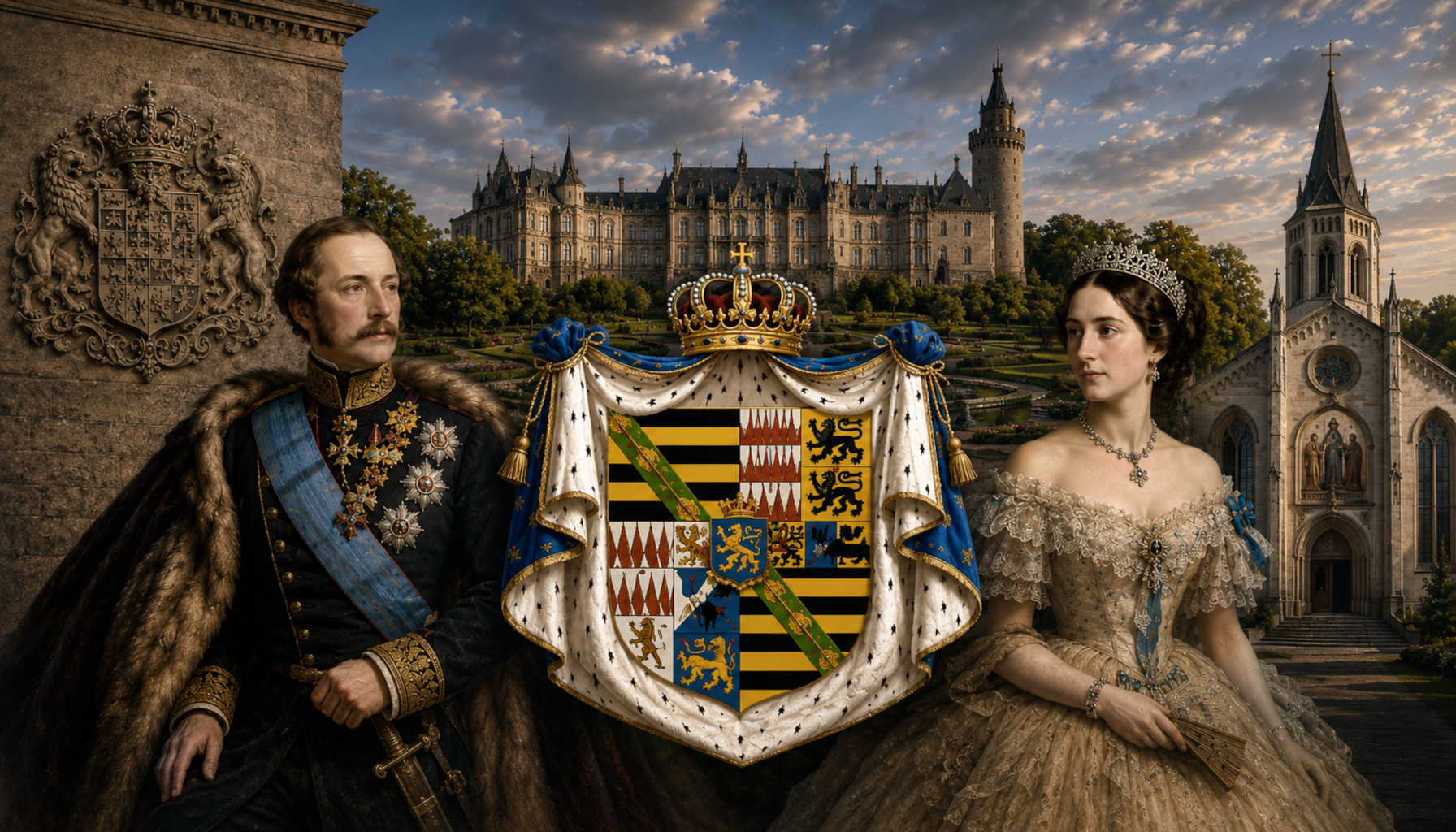
The House of Saxe-Coburg and Gotha was one of those families that began in a very local landscape and somehow ended up shaping half of royal Europe. It belonged to the Ernestine branch of the old House of Wettin, rooted in the Saxon and Thuringian lands of central Germany, especially around Coburg, Gotha, and Saalfeld. In origin it was a German princely and ducal family, part of the patchwork world of small Protestant courts within the Holy Roman Empire and later the German lands. Yet through marriage, diplomacy, and dynastic calculation, this modest house became extraordinarily influential. Its primary family haplogroup is tagged here as R1b1a1b1a1a1c1a1.
What makes Saxe-Coburg and Gotha so fascinating is precisely that contrast between scale and reach. The duchy itself was not a giant power. But the family became rulers or consorts in Belgium, Portugal, Bulgaria, and the United Kingdom, where the British royal line descended from Prince Albert of Saxe-Coburg and Gotha before the name Windsor was adopted in 1917 during the First World War. Figures such as Ernest I, Duke of Saxe-Coburg and Gotha (1784-1844), help anchor the story in its German setting: a world of ducal courts, Protestant identity, military service, dynastic marriages, and carefully cultivated prestige. Their heraldry, churches, castles, and princely residences still speak of that world, where a relatively small German house learned how to think internationally.
A particularly important location anchor for the family is Ehrenburg Palace in Coburg, one of the principal residences associated with the ducal house and a strong symbol of its local identity. The palace began as a Franciscan monastery before being transformed into a residence for the rulers of Coburg, and over time it developed into a grand court complex reflecting centuries of architectural change. Its later appearance is especially shaped by Gothic Revival work, giving it the princely silhouette many visitors recognize today, while its interiors preserve the atmosphere of a German ducal court connected to the wider politics of Europe. In historical terms, Ehrenburg matters because it was not simply a building but a stage for dynastic life: government, ceremony, court culture, family alliances, and the presentation of ducal authority. Coburg itself became the family springboard into European monarchy, and Ehrenburg Palace remains one of the clearest physical reminders of that story. It is generally supported as a site that can still be visited today, making it one of the best places to encounter the setting from which this famous dynasty emerged.
From a DNA perspective, the House of Saxe-Coburg and Gotha is tagged here with haplogroup R1b1a1b1a1a1c1a1, and while no claim of direct descent should be made from ancient or medieval individuals without specific evidence, there are many related or linked samples that help place this lineage in a wider European context. These include Lombard Warrior Elite Collegno Northern Italy samples COL_069, COL_069b, and COL_069x; Hungarian knightly samples Elek Bathory from Pericei PER01 and Ferenc Bathory PER03-1; Medieval Jutland Denmark Vor Frue Kirkegard Aalborg CGG100493; several medieval Belgian samples from Sint-Truiden Onze-Lieve-Vrouwekerk including ST0052, ST1232, ST0632, and ST3006; Iron Age Belgic Suessiones samples from Bucy-le-Long in France such as CGG022456, CGG022463, CGG022431, CGG022425, CGG022438, and CGG022419; Batavi Germanic tribe samples from Valkenburg Marktveld in the Netherlands CGG107745 and CGG107754; Medieval Poland Piast Dynasty Lad PCA0193; Early Anglo-Saxon and Saxon linked individuals such as West Heslerton I20644, I20671, I20677, Dunum DUN010, and Buckland Dover BUK059 and BUK027; Longobard Haeven HVN005; Norman Invasion era Lincoln Castle S3044; Etruscan and Roman period samples including Tarquinii R10339, Klosterneuburg R10659, and Villa Magna R58; and deeper prehistoric examples such as Teplice I13788 and I15950, Iron Age Briton I11149, Westwoud-Binnenwijzend I11972, Vlaardingen-Krabbeplas I17019, Frisian boy I12907, Bavarian elite warrior AED106, Ellwangen ELW003, and Bell Beaker De Tuithoorn I4070. Taken together, these linked samples suggest a long and geographically wide history for branches of this paternal line across Germanic, Belgic, North Sea, Central European, and western European contexts.
If the princely world of Saxe-Coburg and Gotha, from Coburg and Ehrenburg Palace to Brussels, Lisbon, Sofia, and London, sparks your curiosity, you can explore your own ancient connections through DNA. Upload your DNA to MyTrueAncestry and see how your lineage may connect with the deeper human story behind Europe's dynasties, migrations, and historic populations.

Comments