The Pacheco Family

– 3 min read


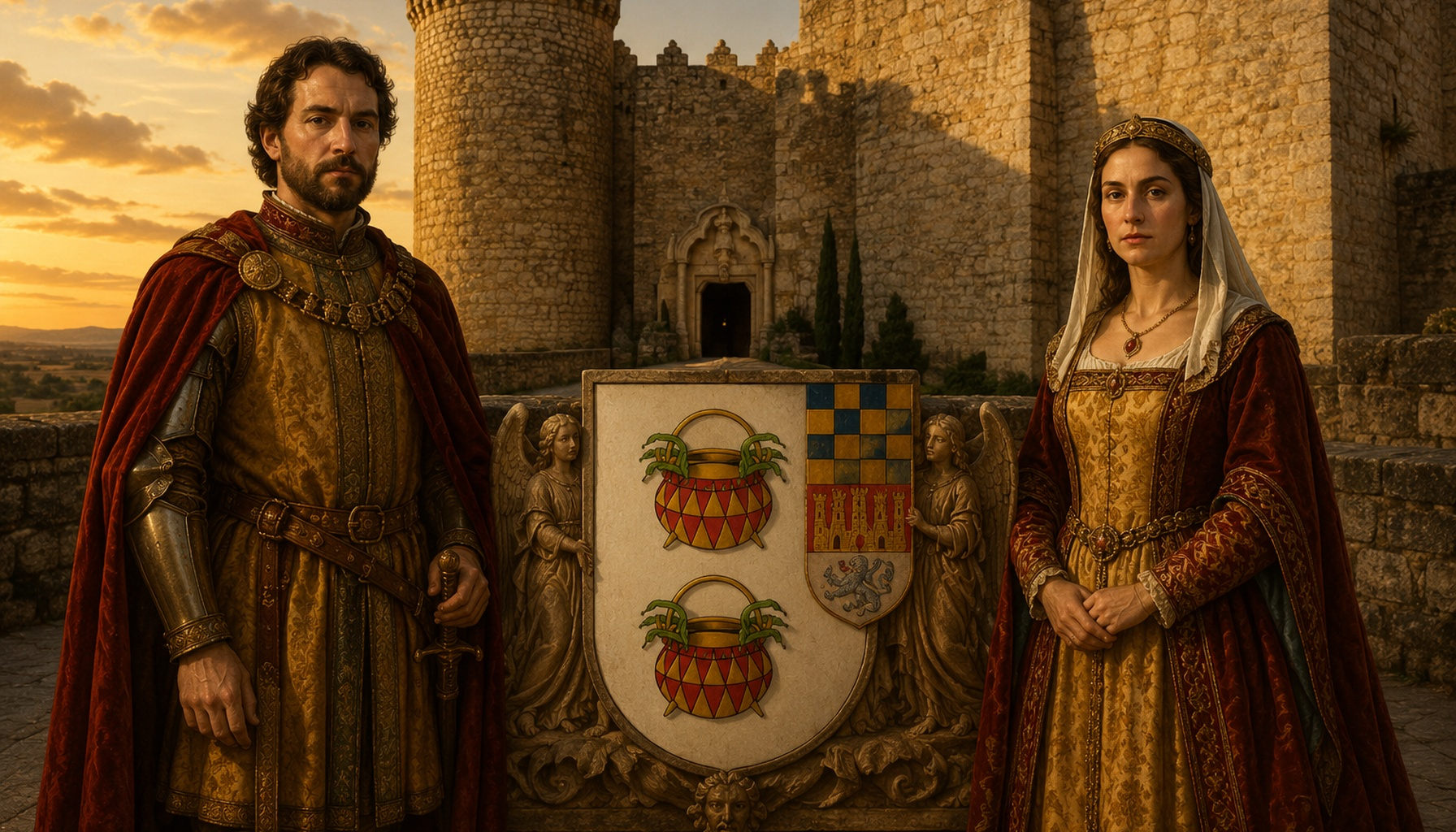
The Pacheco family was one of the historic noble lineages of Iberia, rooted in the aristocratic worlds of Portugal and Castile and later woven deeply into the political society of Spain and Portugal. In broad historical terms, House Pacheco belongs to that recognisable Iberian pattern: a family built through landholding, military service, royal favor, marriage strategy, heraldic display, and careful memory of lineage. Their name came to be associated with status, titles, estates, and influence at court, all in a peninsula shaped for centuries by frontier war, dynastic rivalry, and the growth of Christian kingdoms. Haplogroup tags linked with the family include R1b1a1b1a1a2a, with R1b1a1b1a1a2a as the primary family haplogroup.
That matters because the Pachecos did not appear in a vacuum. They emerged from a medieval Iberia where noble families were expected to fight, negotiate, marry well, hold castles, manage territories, and stay close enough to kings to matter without getting crushed by them. The family identity was preserved not simply by blood, but by coats of arms, patronage, legal memory, and the retelling of ancestry across generations. Figures such as Juan Fernandez Pacheco (1419-1474), a major Castilian grandee and Marquis of Villena, show the family at its political height, while Francisco Pacheco (1564-1644), painter and writer, reminds us that noble and connected Iberian families also moved in cultural as well as military and courtly worlds. The Pacheco story is therefore not just one of one surname, but of how aristocratic continuity worked in the Iberian peninsula.
A strong location anchor for the wider Pacheco world is Atalaya Castle in Villena, in the province of Alicante, Spain. This is one of those fortresses that instantly tells you what medieval Iberia looked like in stone: high, defensive, vigilant, and tied to contested frontier landscapes. The castle stands on a hill dominating the surrounding area, and much of what visitors see today reflects major Islamic-period and later Christian-era building phases. It is especially known for its imposing keep and its powerful double line of walls, features that speak to a region where military architecture was not decorative but essential. Villena itself became historically associated with the marquisate later tied to the Pacheco name, so Atalaya Castle helps place the family in the concrete geography of lordship, warfare, and territorial control rather than leaving them floating in abstract genealogy. Better still, the castle still stands and can be visited today, making it an unusually vivid doorway into the world in which lineages like the Pachecos operated.
Read more about House Ramirez de Arellano
From an ancient-DNA point of view, the Pacheco family's primary linked haplogroup, R1b1a1b1a1a2a, sits within a very broad and well-attested western European paternal landscape. That does not prove direct descent from any excavated individual, and it is important not to pretend otherwise. What it does offer is a web of related or linked ancient comparisons across time and place. Particularly relevant Iberian examples include Medieval Northern Spain Las Gobas samples ldo066, ldo037, ldo046, ldo048, ldo040, and Dark Ages ldo062, as well as Medieval Portugal and Kingdom of Portugal era samples such as LP115_5 from Loule, LP117_12 and LP117_7 from Santarem, LP117_3 and LP117_2 from Castro de Avelas Torre Velha, LP123_5, LP112_13, and LP114_7. Further back in Iberia, related R1b1a1b1a1a2a-linked profiles appear in Bronze Age Spain, including Almoloya Pliego individuals such as ALM036, ALM039, ALM040, ALM041, ALM046, ALM047, ALM049, ALM050, ALM052, ALM057, ALM058, ALM063, ALM064, ALM069, ALM070, ALM078, ALM080, and ALM081, along with MDP003 from Molinos del Papel and PUC002 from Villena in Alicante. Beyond Iberia, the same broader lineage appears among Celtic, Roman, and early medieval individuals across Europe, from Magdalenenberg MBG013 and Hochdorf HOC001 to Roman Britain samples like NWC009, FEN008, ARB003, and DUX003. In plain English: the Pacheco-linked haplogroup belongs to a paternal line with deep roots across the western European and especially Iberian past, fitting neatly with the long-form history of noble families shaped inside that world.
Explore the Genetic History of Portugal
If you carry the Pacheco surname, have family traditions pointing to Iberian noble roots, or simply want to see how your DNA connects with the deeper population history behind families like this one, you can upload your DNA to MyTrueAncestry and explore whether you match the Pacheco family story or related ancient DNA samples from medieval and prehistoric Iberia.

Comments