The House of Wyndham
– 2 min read


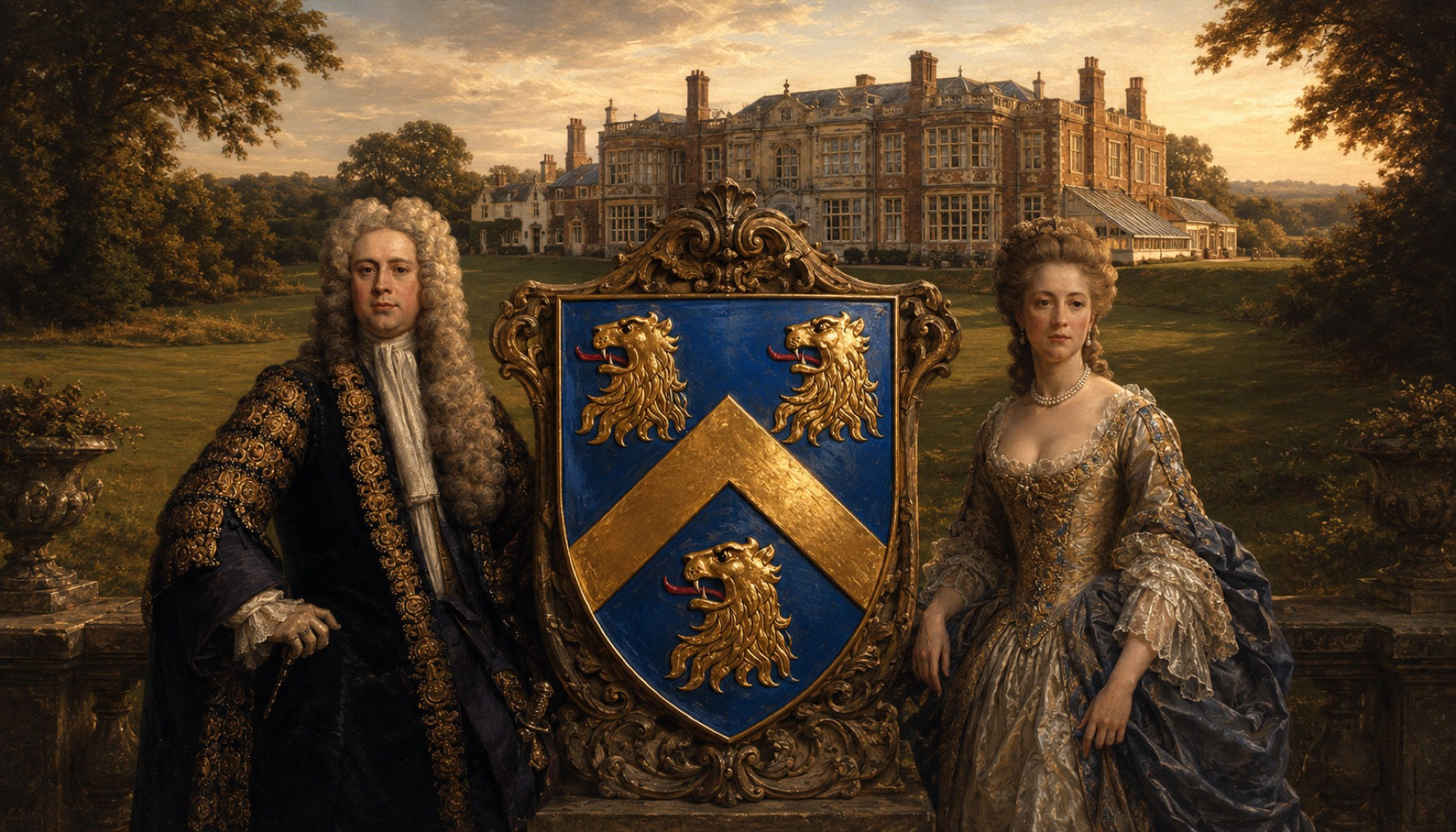
The House of Wyndham was one of those enduring English landed families whose importance rested not simply on title, but on continuity: land, office, marriage, heraldry, and long memory. Associated above all with county society, estate culture, and public duty, the Wyndham name belongs to that old world of the English gentry and noble-connected houses which shaped local life for generations while also appearing in Parliament, military service, and royal administration. In genetic tagging terms, the primary family haplogroup linked here is R1b1a1b1a1a2b3c, a branch within the wider western European R1b story.
The family name is of English origin and became established within the historic social fabric of the West Country and beyond, especially through Somerset, Norfolk, and other landed connections formed over time. Their rise fits a recognisable pattern in later medieval and early modern England: a family anchoring itself through estates, alliances, and service to crown and county, then preserving prestige through careful inheritance and public visibility. Figures such as Sir John Wyndham (1558-1645), a prominent early modern member of the family, and Sir Francis Wyndham, 3rd Baronet (1654-1716), show how the house participated in the political and social life of the kingdom. This was not merely a family of names on paper; it was a family woven into the lived machinery of English local power.
One of the great location anchors associated with the Wyndham story is Felbrigg Hall in Norfolk, a fine country house set in a substantial historic estate landscape. The hall is especially known for its elegant 17th- and 18th-century character, its impressive interiors, and its important library collection, all of which make it a vivid survival of the English landed-house tradition. Though the building reflects several phases of development, what matters most in family history terms is that Felbrigg became one of those places where lineage, property, taste, and status were gathered together under one roof: portraits, books, architecture, gardens, and memory all reinforcing family identity. Today Felbrigg Hall is in the care of the National Trust and can still be visited, making it one of the most accessible ways to step physically into the world with which the Wyndhams were connected.
The haplogroup tag R1b1a1b1a1a2b3c places the Wyndham story within a deep and widespread western European paternal landscape rather than proving any direct line to specific ancient individuals. Related or linked ancient DNA examples from this broader branch appear across a remarkably wide historical range: Celtic Durotriges individuals from Winterborne Kingston in England such as WBK36, WBK39, and WBK35; Roman era Britain at Fenstanton, Cambridgeshire, including FEN008; medieval and Dark Age northern Spain at Las Gobas, including ldo066, ldo037, ldo048, and ldo062; elite Celtic burials in southern Germany such as Asperg-Grafenbuehl APG001 and APG003 and Ludwigsburg Roemerhuegel LWB001; Bronze Age central European examples from Leubingen Sommerda in Thuringia, LEU024 and LEU025; and later medieval examples from England and the Low Countries, including Clopton, Cambridgeshire ATP_PSN_1217 and several Sint-Truiden burials in Belgium. Taken together, these linked samples show a lineage with deep roots in the Bell Beaker, Bronze Age, Celtic, Roman, and medieval worlds of Europe. For a historic English family like the Wyndhams, that is the right frame: not a fantasy of named ancient ancestors, but a real long-duration genetic backdrop stretching across the same continental networks from which later British elite society ultimately emerged.
If you want to see how your own DNA may connect to ancient populations, medieval lineages, and the wider world behind families like the House of Wyndham, upload your DNA to MyTrueAncestry and explore the past for yourself.



Comments