The House of Villeneuve
– 2 min read


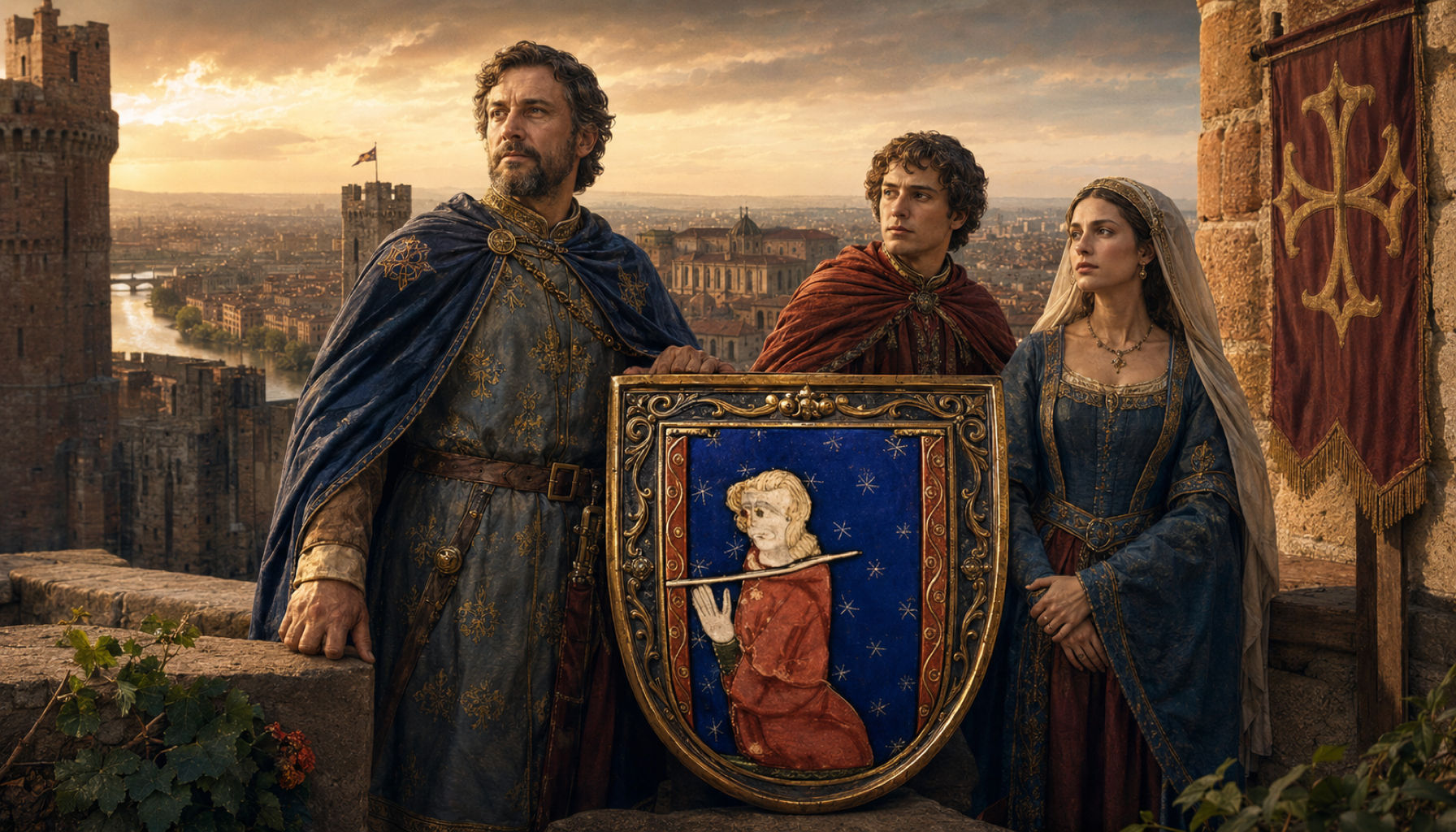
The House of Villeneuve was a French noble family rooted in the world of regional lordship, landed power, heraldic identity, and long aristocratic service. Their name is place-based, coming from one of the many "new towns" or "new estates" that appeared across medieval France, and that matters because noble identity in France was so often tied to land first and surname second. In that sense the Villeneuves belong to a very recognisable historical pattern: a family defined by estate, arms, military obligation, alliances, and the careful preservation of status over generations. Haplogroup tag: J2a1a1b1a1a, treated here as the primary family haplogroup link.
Like many provincial noble houses, the Villeneuves grew not through one dramatic founding moment but through the slow accumulation of authority: holding territory, serving greater lords, marrying well, appearing in local administration, and remaining useful to crown or church. Their story sits comfortably within the broader fabric of French nobility, where continuity mattered nearly as much as brilliance. Among the best-known figures associated with the family are Romee de Villeneuve, born around 1170 and active into the mid-13th century, Helion de Villeneuve, born around 1270 and later Grand Master of the Order of Saint John, and Gabrielle-Suzanne de Villeneuve, born in 1685, remembered in literary history as the author linked to one of the classic versions of Beauty and the Beast. Together they show the range of noble family life: administration, crusading-religious command, and cultured authorship.
A particularly strong location anchor for the family is the Chateau de Villeneuve-Loubet in Provence, in today's Alpes-Maritimes. The site reflects exactly the sort of territorial base from which noble families built memory and authority. The castle stands above Villeneuve-Loubet and preserves the impression of a fortified seigneurial residence later adapted over centuries, shaped by the political world of Provence and by the need to control land, roads, and dependants. Historically, this was the kind of place from which local justice, estate management, and family prestige radiated outward. It is not simply a picturesque relic but part of the machinery of noble life. The chateau is still known as a historic monument and, on that basis, can still be visited in at least some form, making it a rare chance to connect the paper history of the Villeneuves with a surviving landscape.
For those interested in deeper paternal origins, J2a1a1b1a1a belongs to a wider haplogroup branch with a long Mediterranean and Near Eastern history. That does not prove direct descent from any ancient individual, and it should not be presented that way, but it does give useful context for the deeper background of lineages linked to this branch. Related or linked ancient samples include Bronze Age Iran, Dinkha Tepe, sample I4274; Roman era Apollonia in Anatolia, sample I16584; Copper Age Grotta La Sassa in Italy, samples SC002 and SCA011; Early Bronze Age Castellucciana in Sicily, sample I7796; and Anatolian Roman Viale Rossini, sample R76. What this suggests, broadly, is that the wider J2a world was already moving through connected zones of the eastern Mediterranean, Italy, Anatolia, and beyond long before medieval noble surnames existed. Families such as the Villeneuves belong to the much later historical chapter of that very old human story.
If the history of the House of Villeneuve speaks to your own family curiosity, you can take the next step by uploading your DNA to MyTrueAncestry. It is a simple way to explore how your results may connect with ancient populations, historic migrations, and the deeper background behind family identity.
Comments