The House of van der Merwede
– 3 min read


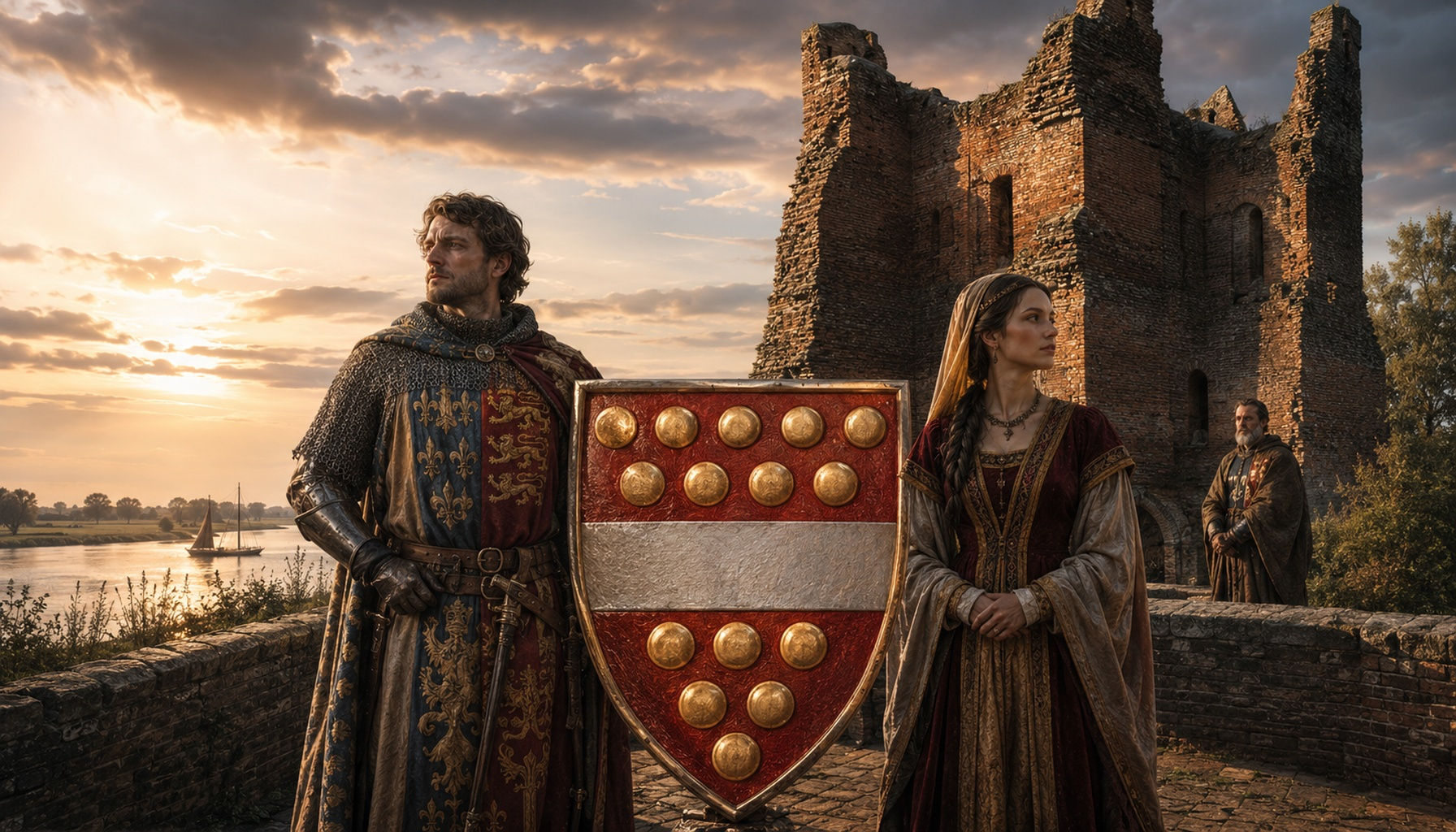
The House of van der Merwede was a noble family of the Low Countries, rooted in Holland and shaped by the watery world of the Merwede river system. Their very name points to place: "van der Merwede" means, in effect, "from the Merwede", tying the lineage to one of the great river landscapes that influenced settlement, transport, lordship, and power in the medieval Netherlands. In that sense they are a very Dutch noble house indeed, one formed not by mountain fastness or vast inland estates, but by control, identity, and service in a region of dikes, towns, ferry points, floodplains, and contested local authority. Primary family haplogroup: R1b1a1b1a1a2c1a4b3.
The family fits the broader pattern of noble development in Holland: a place-based name, heraldic continuity, alliances with neighboring lineages, and roles in civic, military, and regional affairs. Their background belongs to that rich medieval world in which noble status was sustained not only by blood and marriage, but by practical usefulness in a landscape that demanded management of land and water alike. Figures associated with the house include Daniel van der Merwede (1240-1307), Godschalk van der Merwede (1270), Margaretha van der Merwede (1380-1410), and Daniel van der Merwede (1403). Taken together, they suggest a family active across generations in the social and political networks of Holland, where noble houses often stood at the intersection of seigneurial rights, local administration, and loyalty to shifting regional powers.
The clearest location anchor for the family is Merwede Castle, a site closely associated with the van der Merwede name and with the river-bound history of South Holland. The castle stood near Dordrecht in a landscape where waterways were as important as roads, and where authority depended on who could control access, land, and local obligations. Merwede Castle is remembered today through its ruins, which preserve something of that medieval frontier between noble residence, defensive site, and status symbol. It was never simply an isolated stronghold in the romantic sense; rather, it belonged to a busy and strategic river environment shaped by trade, flooding, reclamation, and political rivalry. The surviving remains make it one of those places where Dutch medieval history becomes unusually tangible: brick, water, noble memory, and regional identity all in one. The site is known and presented as a castle ruin, and it can still be visited as a historic landmark, making it a valuable stop for anyone interested in the van der Merwede family and the old noble geography of Holland.
The haplogroup linked here with the family, R1b1a1b1a1a2c1a4b3, sits within a wider northwest European genetic story and should be understood as a lineage connection rather than proof of direct descent from any ancient individual. Related or linked ancient DNA samples associated with this branch include several Celtic Durotriges burials from Duropolis, Winterborne Kingston in England, such as WBK12, WBK20, WBK29, WBK41, WBK05, WBK30, WBK43, WBK06, WBK08, WBK18, and WBK191, along with later and geographically wider examples such as Medieval England Cambridge St Johns Hospital (ATP_PSN_192), Imperial Roman Era Zadar Croatia (I26776), Bronze Age Orkney Westray Links of Noltland (KD061), Bronze Age Calabria Cosenza Grotta della Monaca Sant Agata di Esaro (GMO015), Early Medieval Belgium Sint-Truiden Groenmarkt (ST2025), Medieval Belgium outsider from Sint-Truiden Onze-Lieve-Vrouwekerk (ST1308), Gallic France Parancot (CGG023699), Post Roman Worth Matravers Dorset (I11580), Merovingian Alt-Inden in North Rhine-Westphalia (IND013), Late Roman Klosterneuburg in Lower Austria (R10656), Late Roman Conimbriga in Portugal (R10488), Iron Age Worlebury Somerset (I11991), Iron Age Battlesbury Bowl (I21309), Bronze Age Trumpington Meadows (I3256), Bronze Age Amesbury Down (I2417), Bell Beaker Upavon (I4950), Bronze Age Bedfordshire samples I7576 and I7577, Boatbridge Quarry South Lanarkshire (I5473), Hinxton Iron Age (HI2), Early Bronze Age Thames (I5377), and Ireland Copper Age Rathlin2B. What this shows, in broad terms, is that the deeper paternal line connected with the van der Merwede haplogroup belongs to a long and mobile western European story reaching from the Bronze Age into the medieval world, well before the family itself emerged in the documentary record of Holland.
If the story of the House of van der Merwede, its riverine roots, and its haplogroup connections sparks your curiosity, you can explore your own deeper ancestry by uploading your DNA to MyTrueAncestry. It is a fascinating way to place family history alongside archaeology, ancient populations, and the long human story behind historic surnames.

Comments