The House of St Leger
– 3 min read


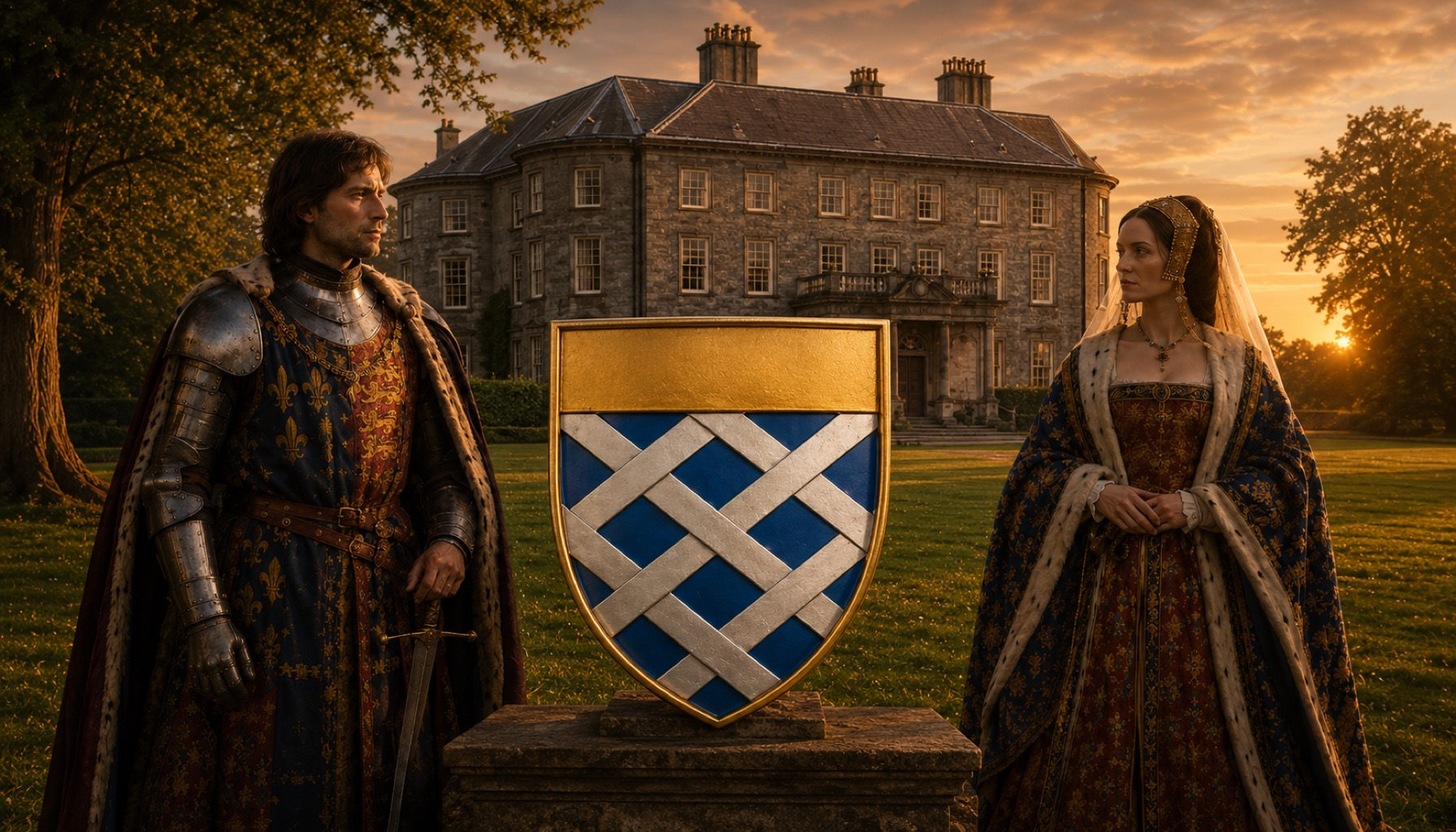
The House of St Leger was one of those durable Anglo-Norman families that managed to do what so many ambitious noble houses hoped to do but not all achieved: arrive with the Norman world, root themselves in the politics and landholding systems of England and Ireland, and remain recognisably themselves across centuries. Their story is one of estates, royal service, county office, military obligation, and careful marriage into other established lineages of the British Isles. In that sense, the St Legers fit a classic pattern of aristocratic continuity after the Norman expansion, preserving both status and a distinct heraldic identity. For DNA tagging, the family is here linked with haplogroup I2a1b2a2a1 as the primary family haplogroup.
The surname itself points back to a Norman place-name origin, almost certainly connected to Saint-Leger in France, part of the broader world from which many Anglo-Norman families drew both their names and their early prestige. From there, like other Norman-derived houses, the St Legers became woven into the social and political fabric of England and later Ireland, where land, office, and service to the crown mattered at least as much as battlefield reputation. Among the better-known figures are Bishop Thomas St Leger (1240-1320), a reminder that noble influence extended into the church as well as the manor and court, and Sir Thomas Saint Leger (1440-1483), whose life places the family squarely amid the dynastic and aristocratic struggles of late medieval England. The long history of the house shows not some romantic saga apart from government, but a family embedded in it.
A particularly useful location anchor for the St Leger story is Annery, near Monkleigh in Devon. Annery was an old estate with deep medieval associations and became tied to the St Leger family through inheritance and landed connection, illustrating perfectly how noble identity was built not only through bloodlines but through possession, stewardship, and local standing. The site, known through Annery House and the wider Annery estate tradition, sat in a landscape of rivers, agriculture, and local power, the sort of place from which county influence could actually be exercised. Although the historic house itself has a complicated history of rebuilding, decline, and loss, the location of Annery near Monkleigh remains part of the historic landscape and can still be visited in the broader sense of visiting the area and surviving heritage setting. It is a good reminder that aristocratic history is often preserved as much in place-names, estates, and landscape memory as in intact great houses.
In genetic terms, the St Leger family is tagged here to haplogroup I2a1b2a2a1. That does not mean every bearer of the name belonged to that lineage, nor does it justify any claim of direct descent from specific ancient individuals. What it does offer is a way of placing the family within a much older human story. Related or linked I2a1b2a2a1-associated samples appear across an extraordinary chronological spread: Mesolithic Ireland at Sramore, Leitrim (SRA62), famously deep prehistoric Britain with Cheddar Man from Somerset (Cheddar), Bronze Age contexts such as Praha-Stodulky-Mala Ohrada in Czechia connected with the Unetice world (I7959), Karczyn in Lower Silesia (poz498), and Pielgrzymowice Grave 669 in Silesia (poz720), Iron Age Prague in Central Bohemia (I17327), elite Celtic burial at Magdalenenberg, Villingen-Schweningen in Germany (MBG008), Migration Period Germany at Bruecken in Saxony-Anhalt (BRC039x), Early Anglo-Saxon West Heslerton in Yorkshire (I11590 and I20641), Medieval England among the Augustinian Friars (ATP_PSN_522), and even a post-medieval plague victim from Ellwangen, Germany (ELW030). Taken together, these linked samples show a lineage with deep roots in prehistoric Europe and later visibility in Celtic, Germanic, medieval English, and British Isles contexts, which is precisely the sort of layered background one might expect behind an old Anglo-Norman noble house established in Britain and Ireland.
If you are researching the House of St Leger, or simply wondering whether your own ancestry connects to the wider worlds of Norman, medieval English, or Irish aristocratic history, DNA can add another dimension to the paper trail. Upload your DNA to MyTrueAncestry to explore ancient matches, haplogroup context, and the deeper population history behind your family story.
Comments