The House of Fiske

– 3 min read


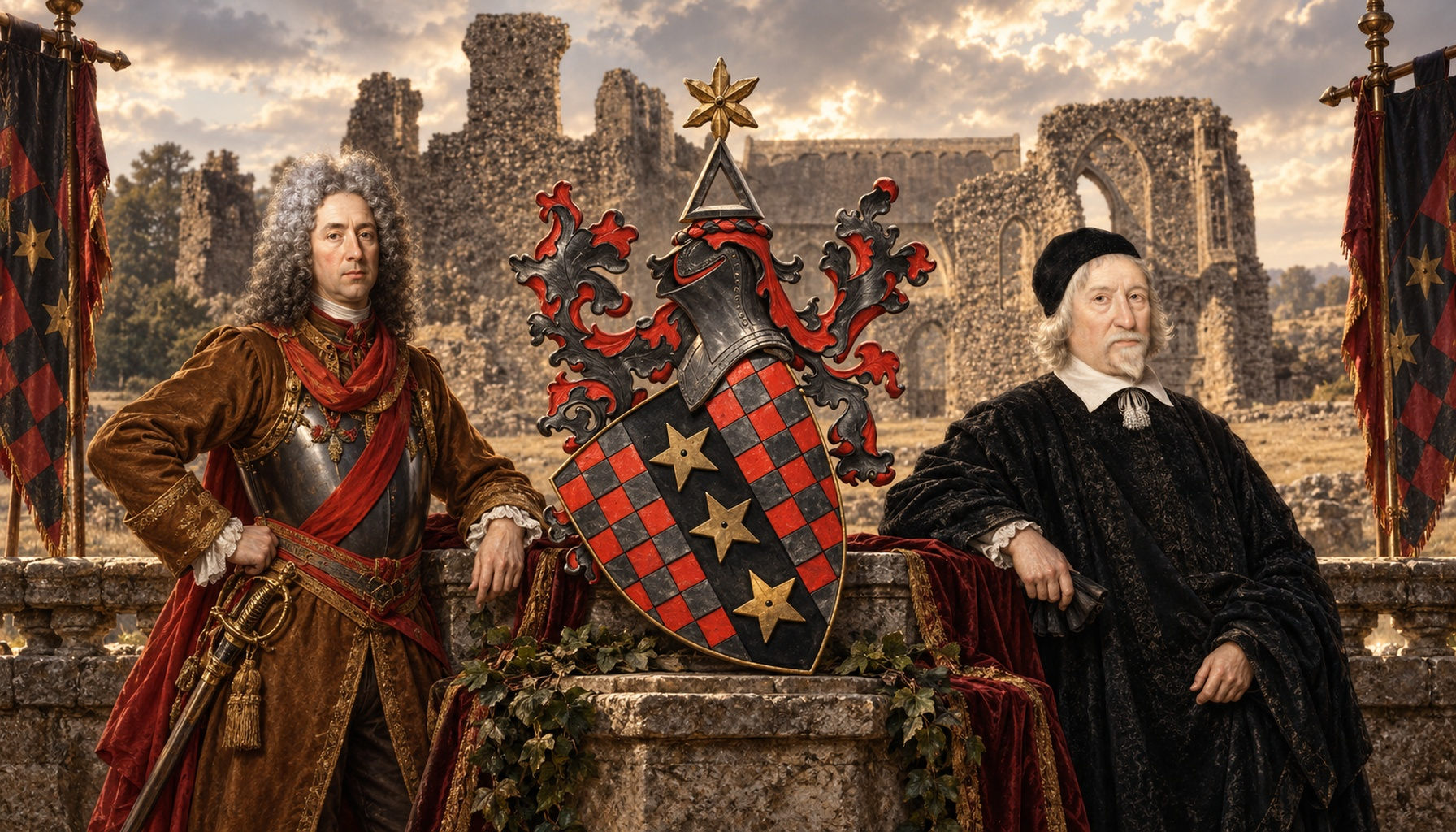
The House of Fiske was an old English family rooted above all in Suffolk, especially around Laxfield and Stadhaugh, and its best-known paternal genetic signature today is the haplogroup R1b1a1b1a1a2c1a4b2. In historical terms, this is a family that fits a very recognisable English pattern: local landholding, attachment to a manor, service in church and community, and then, in time, expansion outward into the Atlantic world. That makes the Fiskes interesting not because they were somehow isolated from history, but because they were so thoroughly inside it.
The surname and family identity grew out of the settled world of late medieval East Anglia, a region of prosperous villages, parish churches, open fields, and ambitious local families whose standing depended on land, marriage, office, and reputation. The Fiskes appear in records as landholders, manor holders, clergy, and people of consequence in their locality. Among the named figures who help anchor the story are Symond Fiske of Stadhaugh (1395-1464), Nicholas Fiske of Stadhaugh (1575-1658), and Reverend John Fiske (1608-1677), whose life points us toward the family's later religious and colonial migrations to New England. What gives House Fiske unusual depth is that its documented paternal line stretches back into the medieval period and has also attracted modern Y DNA research, offering a rare meeting point between paper genealogy and genetics.
Read more about the House of Standish
If one place captures the historic presence of the Fiskes, it is Stadhaugh Manor Farmhouse in Suffolk, the family's long-associated seat and a tangible reminder that family history is not just a string of names but something built into the landscape. Historic England lists the farmhouse as a Grade II building, noting a structure of timber-framed origin with later alterations, a house whose fabric preserves layers of local building history rather than some frozen single moment. That matters because houses like this are really archives in wood, brick, and roofline: they show adaptation, continuity, and the practical life of a gentry family whose identity was tied to place. Stadhaugh was not a fairy-tale castle, nor did it need to be. It was a manor house in the proper East Anglian sense, a working residence embedded in fields, parish life, and local authority. As a listed historic building, it remains part of the surviving heritage landscape of Suffolk, and while visitors should respect that it is a historic domestic site rather than a museum, the building and its setting can still be seen from the surrounding area, giving modern descendants and history-minded travellers a real geographical anchor for the Fiske story.
The Fiske family haplogroup, R1b1a1b1a1a2c1a4b2, also sits within a much older web of related paternal lineages seen in ancient DNA. That does not prove direct descent from any named ancient individual, and it is important not to pretend otherwise. What it does show is that the wider branch linked to the Fiskes has deep roots across Britain and parts of Europe. Related or linked samples include a notable cluster from Celtic Durotriges burials at Duropolis, Winterborne Kingston in Dorset such as WBK12, WBK20, WBK29, WBK41, WBK05, WBK30, WBK43, WBK06, WBK08, WBK18, and WBK191; Iron Age Parisi and Brittonic-era burials from Wetwang Slack, Pocklington, Melton, and Burton Fleming in East Yorkshire including I36964, I36972, I36819, I36827, I36783, I36791, I36805, I36765, I31019, I31515, I31008, I37175, I30989, I30992, I30993, I30970, I21978, I14100, I14102, I14104, I36912, I36916, I36918, I36902, I37130, I37134, I28771, I28772, I28922, I21644, I30911, I28927, I28928, I30903, I5509, and elite chariot burial I36995; as well as later linked finds such as Medieval England Cambridge St Johns Hospital ATP_PSN_192, Late Medieval Clopton Cambridgeshire ATP_PSN_1268, Post Roman Worth Matravers I11580, and more distant but related examples from Roman Croatia, Bronze Age Orkney, Belgium, Ireland, Portugal, Austria, and beyond. In plain English, the Fiske Y line belongs to a paternal tradition with a long archaeological footprint in Britain, especially in Iron Age and later populations.
Explore Roman and Early Medieval Britain DNA
House Fiske is a fine example of how local English history, documentary genealogy, architecture, religion, migration, and genetics can all meet in one family. From Suffolk manorial life to New England settlement, and from medieval records to Y DNA, it offers a story with unusual continuity. If you have Fiske ancestry, or if your paternal line falls near this branch, you can upload your DNA to MyTrueAncestry and see whether you match the family or any of these related ancient DNA samples.

Comments