The House of de Livet

– 3 min read


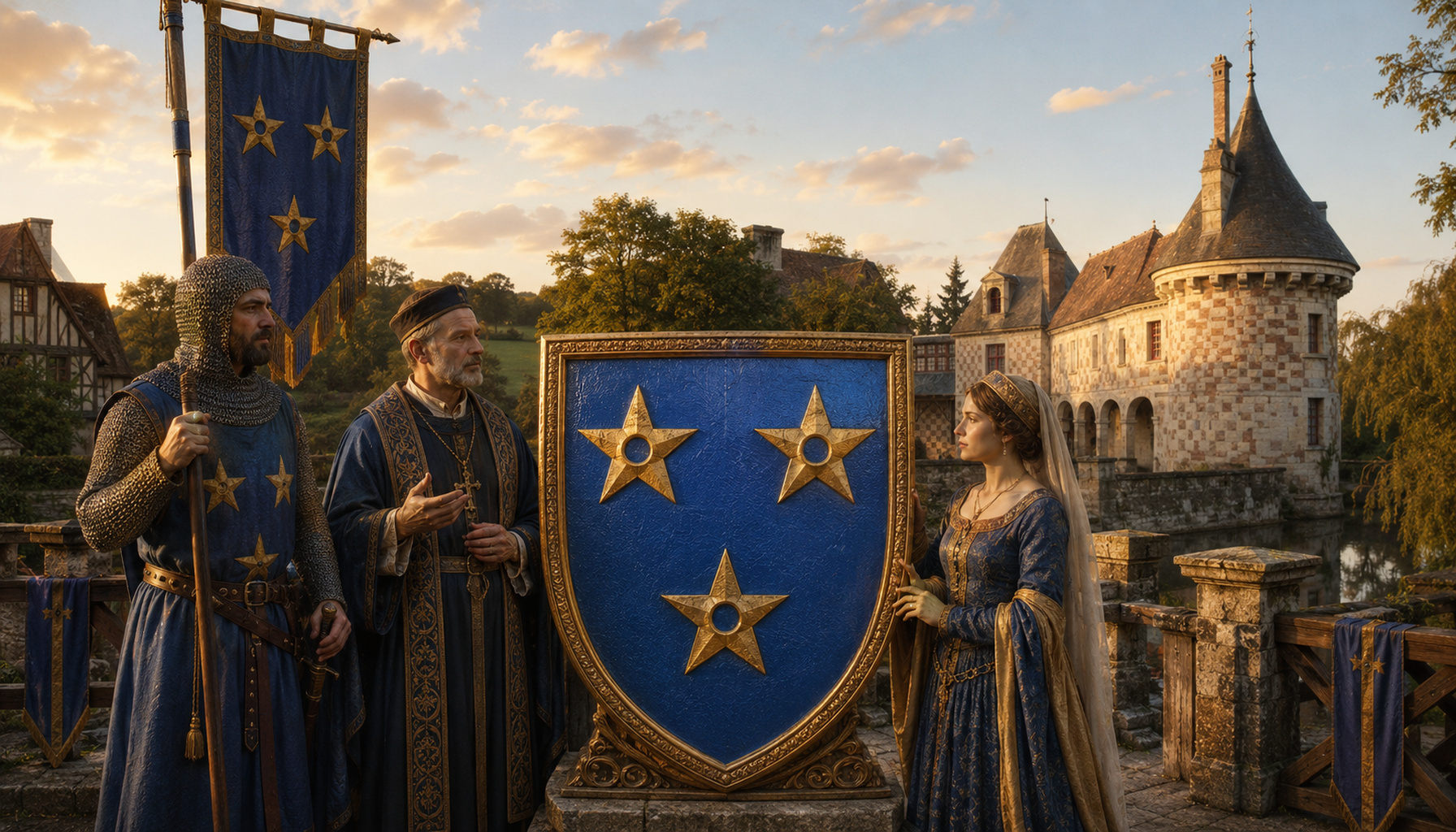
The House of de Livet was a Norman noble family rooted in the feudal world of medieval northern France, with its identity tied to land, lordship, memory, and service. As their name suggests, they came from a place called Livet, part of that very Norman habit of turning locality into lineage: a family became inseparable from the estate, and the estate from the family story. In haplogroup tagging, the primary family haplogroup linked here is R1a1a1a, a lineage with a deep and wide prehistoric and historic footprint across Europe and Eurasia.
In broader historical terms, the de Livet family fits a classic Norman pattern. They were not simply people with a surname, but a house shaped by feudal obligation, marriage alliances, heraldic identity, and participation in the politics of their region. Norman nobility built durability through continuity of estates and remembered ancestry, and families like de Livet preserved status by anchoring themselves to a named place and by serving greater powers when needed. Among the recorded figures associated with the family are Gilbert de Lyvet in 1244, Guillaume de Livet in 1431, and later Louis Charles de Levis, 1647 to 1717, showing how such aristocratic memory could stretch across centuries even as names, branches, and political worlds shifted.
The great location anchor for the family story is the Chateau de Saint-Germain-de-Livet in Normandy, in the Calvados department near Lisieux. It is one of those buildings that seems almost to perform Norman history in stone and timber. The site combines medieval and later construction, with a manor and chateau complex developed between the late Middle Ages and early modern period. It is especially known for its striking mix of materials, including patterned brick and stone, timber-framed elements, and the water-filled moat that gives it that classic seigneurial setting. The place reflects exactly the sort of landed continuity that mattered to noble houses like de Livet: residence, display, defense, management of estate, and the visible language of rank. It also passed through later aristocratic hands, which is itself part of the story of noble property in France. Happily, this is not a vanished memory on parchment alone: the chateau still exists and can be visited, making it a very real doorway into the world that shaped the de Livet name.
The primary haplogroup linked here, R1a1a1a, belongs to a very old and far-ranging paternal network, and it appears in a remarkable spread of ancient DNA samples across time and geography. These include related or linked individuals from Corded Ware contexts such as Esperstedt in Germany, Crihana Veche in Moldova, and several Czech sites; Bronze Age Unetice examples from Leubingen in Thuringia; Iron Age and steppe-connected samples like Bilsk in Poltava, Dykyi Sad in Mykolaiv, Olbia, and Sarmatian and Scythian related contexts; Germanic and northern European finds from Alken Enge in Denmark, Viking Age Sweden, Norway, and Poland, and Migration Period Hungary; medieval Slavic and central European examples from Niederwuensch in Sachsen-Anhalt, Piast era Poland, Estonia, Belgium, Finland, and England; and even later historic-period individuals from Maryland and Kenya showing how lineages travel in unexpected ways. Samples such as UKR170, UKR171, UKR083, UKR150, UKR153, LEU008, LEU033, RKO004, RKF265, PCA0218, PCA0254, PCA0384, PCA0560, NDW075, NDW014, NDW102, VK153, I0104, and many others show the breadth of the haplogroup's ancient presence. None of this proves direct descent for the House of de Livet from any one excavated individual, of course, but it does place the family's tagged haplogroup within a broad archaeological tapestry stretching from Bronze Age Europe to medieval societies much closer to Norman history.
If the story of the House of de Livet makes you curious about how your own DNA might connect with the deep past, you can upload your DNA to MyTrueAncestry and explore ancient samples, haplogroups, and historical matches for yourself.




Comments