The De la Gardie Family

– 3 min read


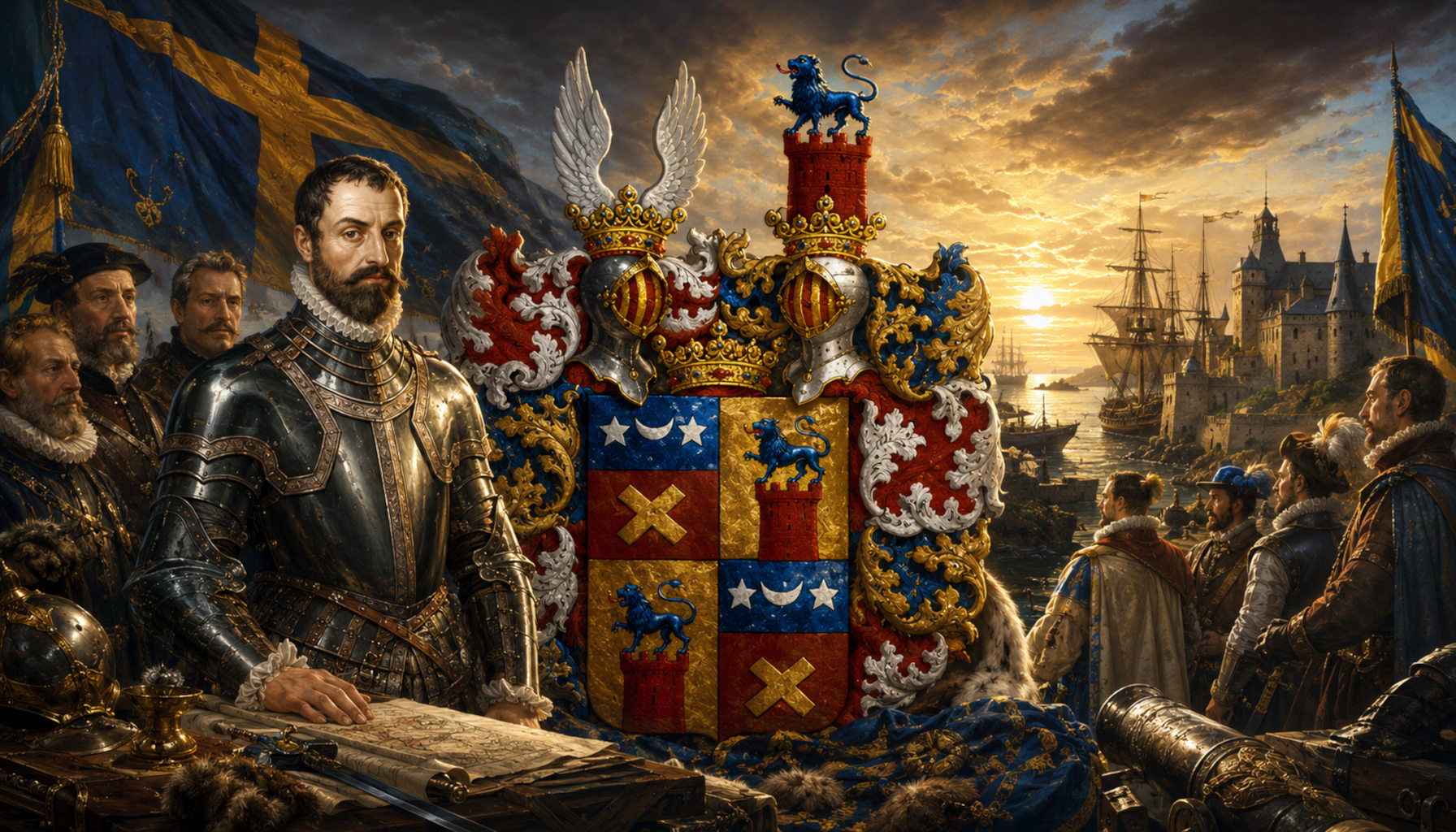
The De la Gardie family was one of the great noble houses of early modern Sweden: a Swedish baronial family entered at the House of Nobility, Riddarhuset, as baronial family no. 4, yet with roots far to the south in Languedoc in France. Their wider lineage is usually connected to the old French noble stock known as dEscouperie, with the first securely known ancestor being Robert dEscouperie around 1387. The later Swedish branch came through Jacques Scoperier, a merchant in Caunes in Languedoc, and from his son Pontus De la Gardie the family made its remarkable leap into Scandinavian history. Primary family haplogroup: R1b1a1b1a1a2a.
That is what makes the De la Gardie story so striking. It is not simply a tale of one noble family accumulating offices and estates; it is the story of movement across Europe in the age of dynastic warfare, confession, and royal service. Pontus De la Gardie (1520-1585), born at La Gardie in Languedoc and first intended for the Church, instead chose the soldier's life. After service in several continental conflicts and then in Denmark, he was captured by the Swedes at Varberg during the Northern Seven Years War and soon entered Swedish service. There he flourished under Erik XIV and Johan III, rising through sheer usefulness: military intelligence, courage, and political adaptability. Raised to the Swedish baronage in 1571, he became one of the crown's key commanders in the Baltic struggle against Russia, taking strongholds such as Keksholm, Wesenberg, Tolsburg, Narva, Ivangorod, Jama, and Koporje. His marriage in 1580 to Sofia Gyllenhielm, the natural daughter of King Johan III, bound the family into the royal orbit itself. From there the De la Gardies became deeply woven into Swedish and Finnish government, war, and court culture. Johan De la Gardie (1582-1640) held high office as councillor, governor, and land marshal, while the wider family later produced Magnus Gabriel De la Gardie (1622-1686), one of the most famous and flamboyant magnates of Sweden's Age of Greatness. In historical terms, the family stands at the crossroads of France, Sweden, Finland, Estonia, Livonia, and the wider Baltic world.
A powerful location anchor for the family is Lacko Castle, better known today as Lacko Castle or Lacko Slott, on the southern shore of Lake Vanern in Vastergotland, Sweden. The site began as a bishop's castle in the late Middle Ages, strategically placed on the Kallandsö peninsula to watch the lake routes and project authority into the region. In the 17th century it became closely associated with the De la Gardie family, especially under Magnus Gabriel De la Gardie, who transformed it into one of the grandest baroque residences in Sweden. What had once been a fortified stronghold was reshaped into an aristocratic showpiece, with richly decorated interiors, ceremonial rooms, and the unmistakable message that noble power was not just military but theatrical. In other words, this is exactly the kind of building where you can see the De la Gardie story in stone: medieval ecclesiastical origins, royal politics, noble ambition, and baroque self-fashioning all layered together. Yes, it can still be visited today, and it remains one of the most atmospheric historic castles in Sweden.
For DNA-minded readers, the De la Gardie family is tagged here with haplogroup R1b1a1b1a1a2a, a lineage with a wide and very interesting footprint across ancient and medieval Europe. That does not mean the family descends directly from any excavated individual listed below, only that these are related or linked examples showing the broader historical world in which this paternal line appears. Among the many relevant cases are Medieval Northern Spain samples from Las Gobas such as ldo066, ldo037, ldo046, ldo048, ldo040, and Dark Ages ldo062; elite Celtic burials in Germany including Magdalenenberg MBG013, Asperg-Grafenbuehl APG001 and APG003, Ludwigsburg Roemerhuegel LWB001, and Hochdorf HOC001; Roman and post-Roman examples from England and Cambridgeshire such as NWC009, FEN008, ARB003, and DUX003; Lombard elite samples from Collegno in northern Italy such as COL_150; medieval and early medieval finds in Sweden including Sigtuna mbs092, Vasterhus wes004, and Vendel-age Uppsala ven001; and a long arc of earlier Bronze Age and Bell Beaker linked finds across France, Iberia, the Low Countries, Britain, and Central Europe. Taken together, these linked R1b1a1b1a1a2a examples suggest a paternal lineage spread through many of the same connected zones that matter for the De la Gardie story itself: southern France, Iberia, the Celtic and post-Roman west, the Frankish and Germanic world, and eventually Scandinavia. It is a useful reminder that noble families of the 1500s sat on top of population histories that were already ancient, mobile, and thoroughly entangled.
If the De la Gardie family story has you thinking about how your own DNA might connect to the deeper human past, you can upload your results to MyTrueAncestry and explore ancient DNA matches, migrations, and historical context for yourself.

Comments