The de Aubigny Family

– 3 min read


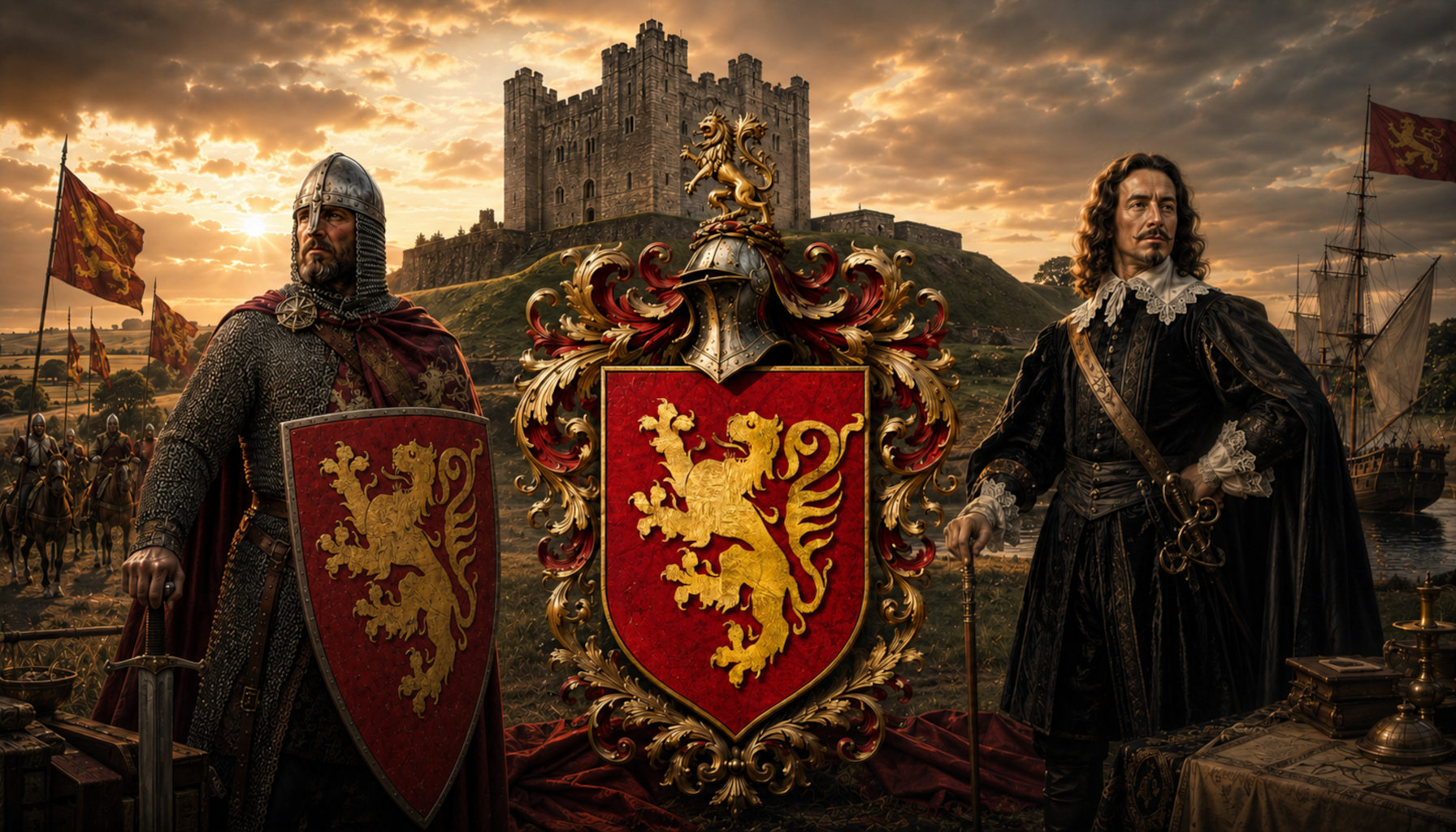
The de Aubigny family was one of those great Norman names that crossed the Channel with conquest and then rooted itself deep in the political soil of medieval England. Their name came from Aubigny in Normandy, and in the generations after 1066 they became a major Anglo-Norman noble house through the classic tools of aristocratic success: royal service, strategic marriage, landholding, and the building and control of castles. Their primary family haplogroup is linked here as R1b1a1b1a1a1c2b2a1b1a4a1a1a, a lineage tag that fits neatly with the wider story of western European noble and warrior populations, though of course any one historical family line is always more complicated on the ground than a single label suggests.
The family appears in records in several forms, including d'Aubigny and de Albini, a reminder that medieval spelling was wonderfully fluid. Among the early figures was Nigel de Albini, who died in 1129, an important royal servant under Henry I and one of the men through whom the family established serious standing in England. The most famous early representative, though, was William d'Aubigny, 1st Earl of Arundel, who rose spectacularly in the 12th century. He married Adeliza of Louvain, the widow of King Henry I, and that alliance vaulted him into the top rank of the Anglo-Norman aristocracy. He is especially associated with Castle Rising in Norfolk, one of the most striking surviving Norman keeps in England, and with the earldom of Arundel. Even the family arms, a red shield with a gold lion rampant, speak the bold heraldic language of status, ambition, and public display. Later branches and related Aubigny titles also echoed across French and Scottish history, including the Seigneur d'Aubigny in the orbit of the Auld Alliance.
The family's geographic anchor lies in Normandy, and one important place in that story is Saint-Martin-d'Aubigny, today in the Manche department of northwestern France. This is the old Norman landscape from which the name emerged: a region of fields, parishes, local lordship, and ducal power that produced so many families who later became household names in England after the Conquest. Saint-Martin-d'Aubigny belongs to that historic Cotentin world, not far from the Channel coast and deeply tied to the cross-Channel movement of people, arms, and patronage that shaped the 11th and 12th centuries. In other words, this was not some vague ancestral mist, but a real place in a densely connected Norman society. As a modern commune in France, it can still be visited, and for anyone interested in tracing the family back to its place-name origin, that is part of the pleasure: seeing how a medieval surname began in a lived landscape.
From a DNA perspective, the haplogroup tag linked here, R1b1a1b1a1a1c2b2a1b1a4a1a1a, can be placed in a broader northwestern and northern European context through related ancient samples, though not as proof of direct descent from the de Aubigny family itself. Useful linked examples include SDN003 from a medieval Western Slav settler at Steuden in Sachsen-Anhalt, ADN002 from a Saxon grave at Hannover-Anderten in Lower Saxony, VK469 from Viking Age Kopparsvik on Gotland, and VK133 from Viking Age Galgedil on Funen in Denmark. These samples show the wider human background of the medieval world in which Norman lineages emerged: a Europe connected by migration, warfare, settlement, intermarriage, and elite mobility. For a family like the de Aubignys, whose story runs from Normandy into England and onward into French and Scottish aristocratic networks, that broader genetic backdrop is especially fitting.
If the story of the de Aubigny family speaks to your own interest in Norman ancestry, medieval nobility, or deep family origins, upload your DNA to MyTrueAncestry and explore the ancient populations and historic samples linked to your results. It is a fascinating way to place family history in the much bigger story of the medieval past.






Comments