Sir Ferdinando Wainman

– 5 min read


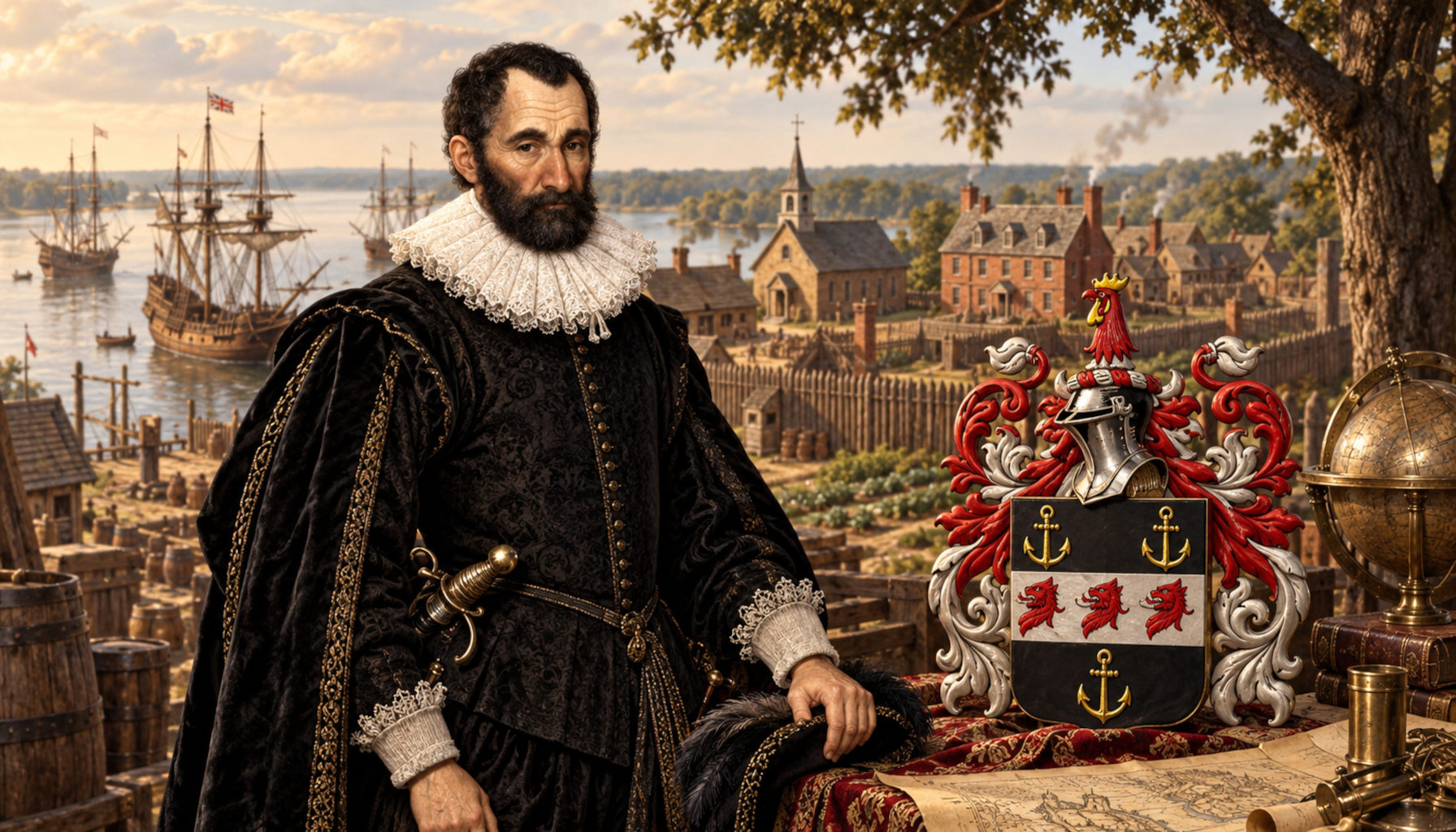
Sir Ferdinando Wainman belongs to that dramatic, precarious moment when England was trying, and often failing, to plant itself in North America. He was an English knight and military officer who arrived at Jamestown in June 1610 with his cousin Thomas West, Lord De La Warr, the newly appointed governor sent to rescue the colony after its catastrophic early years. Wainman mattered because he was not a marginal adventurer: he was one of the senior men entrusted with the settlement’s defence at a time when Jamestown’s survival was far from assured.
This was the world of James I, of chartered companies, martial discipline, and colonial improvisation. Jamestown had just emerged from the “Starving Time,” when disease, hunger, conflict, and mismanagement nearly destroyed the English foothold in Virginia. In that fraught setting, rank mattered enormously, and so did burial. The fact that Wainman was later found buried inside the church chancel tells us at once that contemporaries regarded him as a man of real standing.
Wainman served as master of ordnance and commander of the colony’s horse troops, responsibilities that placed him among the highest-ranking military officers in early Jamestown. Those titles are worth pausing over. The master of ordnance oversaw weapons and munitions; the commander of horse had a role that suggested both mobility and status in a settlement where military readiness was a daily concern. He arrived not as a speculative settler but as part of the governing and martial apparatus of England’s colonial project.
Yet his American career was astonishingly short. He died only weeks after reaching Virginia, probably in July or August 1610. That brevity is part of what makes him historically so striking. Wainman barely had time to act in the colony before becoming part of its archaeology. Even so, he is remembered as the first English knight known to have been buried on American soil. It is one of those small but telling firsts that illuminate how precarious empire could be: a man sent to defend the colony instead entered its ground almost immediately.
Explore Colonial DNA in Early Maryland
The biological sample associated with him is recorded as Sir Ferdinando Wainman Jamestown Colony of Virginia, dated to about 1610 AD. His remains were recovered from a high-status burial within the chancel of Jamestown’s church, in a carefully made anthropomorphic coffin. Archaeologists noted unusually large wrought-iron coffin nails, a detail that may sound mundane but is actually rather eloquent. Nails, coffin form, and placement inside the church all helped signal elite treatment in death.
The identification of these remains as Sir Ferdinando Wainman is best described as strongly supported rather than a simple label attached to anonymous bones. Historical records established that a very high-ranking man died at precisely the right moment in early 1610 Jamestown, and the burial itself matched that status. The archaeogenomic study published in Antiquity added an especially important clue: DNA analysis showed that this individual was maternally related to Captain William West, another prominent Jamestown colonist buried nearby. Since Wainman and West were known cousins through the West family connection, that maternal relationship provided a powerful line of support for the identification, alongside the archaeology and documentary context.
That is a good example of how ancient DNA works best in historical cases. It does not float free of the archive; it sharpens and tests an identification already grounded in burial context, status markers, and recorded history. It also has limits. DNA can strengthen the case that the skeleton belongs to the right family network, but it does not narrate Wainman’s personality, ambitions, or the exact cause of his death.
Read Another Early American DNA Case
The reported Y-DNA haplogroup for Sir Ferdinando Wainman is I1, while his mtDNA haplogroup is H10e. These two lineages describe different parts of his ancestry. Y-DNA traces the direct paternal line, passed from father to son. mtDNA traces the direct maternal line, passed from mother to child. They are therefore narrow lineage markers, not summaries of a whole person’s ancestry.
Wainman’s Y-lineage, I1, is a well-known paternal branch found in many ancient and later samples from northern and northwestern Europe. In the comparative landscape of published ancient DNA, I1-linked individuals appear across a long arc of time and place, including his Jamestown-era kinsman Captain William West Jamestown Colony of Virginia (I4652), Roman Era England Northwest Cambridgeshire Eddington (NWC010), Post Carolingian Flanders Sint-Truiden Groenmarkt (OLV054), Bronze Age Unetice Thuringia Leubingen Sommerda Germany (LEU015), Medieval England Cambridge St Johns Hospital (ATP_PSN_344), Nordic Bronze Age Sweden Falkoping 5 (NEO220 and NEO223), Nordic Bronze Age Denmark Bybjerg (NEO563), Viking Age Denmark Tjrby Randers Municipality (CGG100653), Early Anglo Saxon Cemetery West Heslerton Yorkshire (I20660 and I20666), Anglo Saxon Period Oakington England (I0775), and Post Roman Era Worth Matravers Dorset England (I11568), among many others. That spread does not mean all these men were close relatives of Wainman in any genealogical sense. It simply places his paternal line within a deep and widespread northern European lineage seen in ancient burials from Bronze Age Scandinavia to medieval England and beyond.
His mtDNA haplogroup, H10e, represents his direct maternal line. In the material supplied here, the securely relevant H10e-linked sample is Sir Ferdinando Wainman himself (I2096). The particularly important historical point is not the haplogroup label alone but the study’s finding that Wainman was maternally related to Captain William West. That tells us something specific and useful about kinship in the Jamestown church burials, whereas the haplogroup by itself only places him within a broader maternal lineage.
So what can these results tell us? They can help authenticate relationships between burials, situate Wainman within known genetic lineages, and connect the archaeology to the documented West family network. What they cannot do is prove an ethnic identity in some simplistic sense, or show that everyone with I1 or H10e today descends from him. Haplogroups are lineage signposts, not surnames preserved intact across time.
Discover DNA from Roman and Medieval Britain
What makes Wainman’s DNA historically interesting is not merely that we have genetic data from an early English colonist. It is that the DNA helps tie together a named individual, a privileged burial, and a family connection inside one of the most symbolically charged places in early English America. Jamestown is often discussed in terms of governors, charters, famine, and conflict. Here, though, we can glimpse something more intimate: kinship carried across the Atlantic, then rediscovered in the church floor four centuries later.
In that sense, Wainman is more than a knight with an early colonial epitaph. He is a rare case where history, archaeology, and genetics speak to one another with unusual clarity. The result does not tell us everything, but it does bring one of Jamestown’s most senior and shortest-lived officers into sharper focus.
MyTrueAncestry lets you compare your DNA with ancient populations and archaeological samples from worlds like early colonial Virginia, medieval England, and the deeper European past. You may discover genetic connections to the kinds of lineages and historical populations associated with Sir Ferdinando Wainman’s wider story.

Comments