Man with the Golden Bracelet
– 5 min read


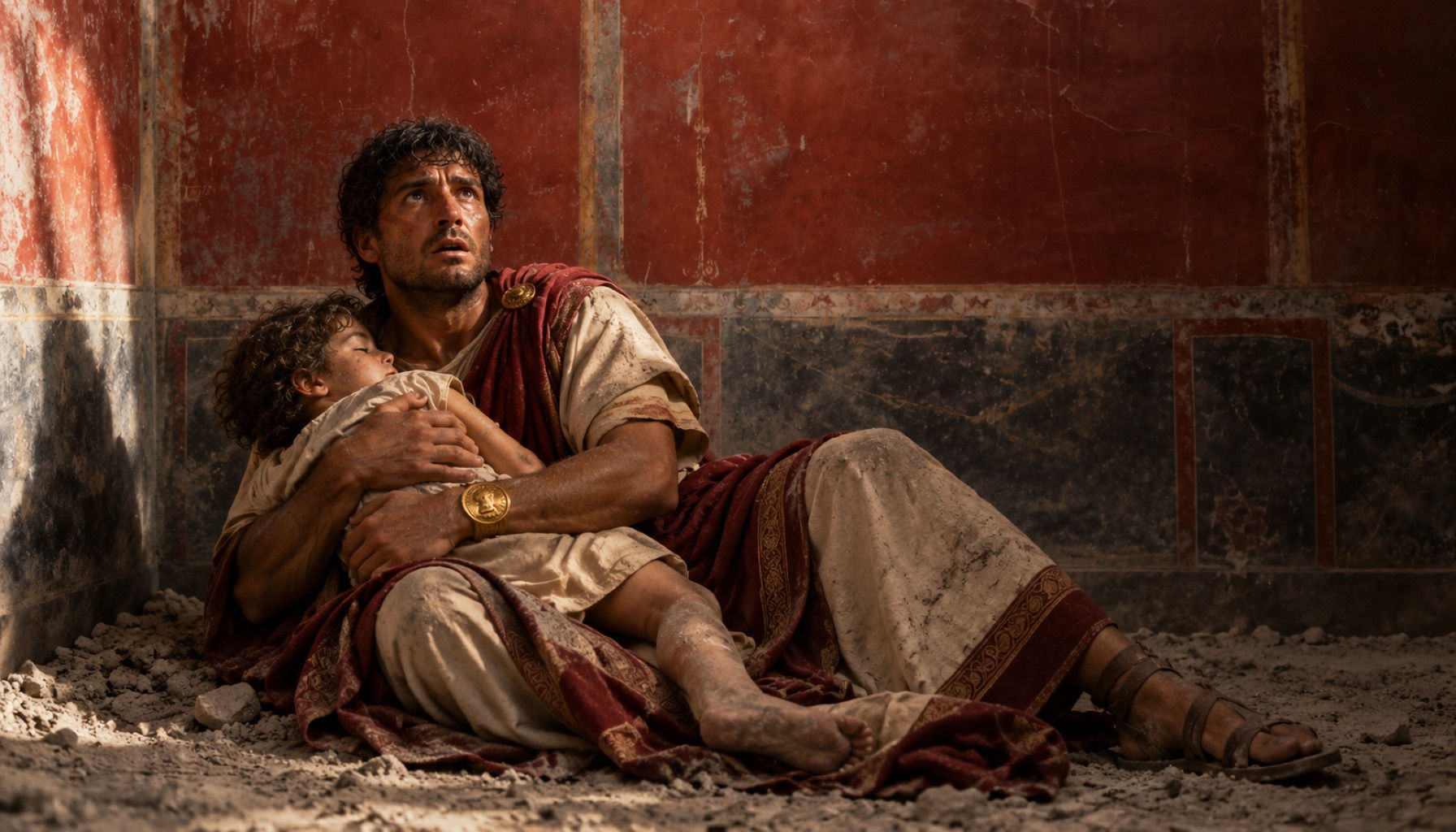
The Man with the Golden Bracelet was one of the Pompeians killed when Mount Vesuvius erupted in 79 AD, burying the city under ash, pumice, and volcanic debris. He is historically important not because he was an emperor, senator, or general, but because his remains became attached to one of Pompeii’s most famous objects: a massive gold bracelet weighing more than half a kilogram, found on his body in the richly decorated House of the Golden Bracelet.
For years, archaeologists interpreted this victim as a woman, partly because of the jewellery and partly because a small child seemed to be lying against the body. It is exactly the sort of tidy story archaeology has often liked to tell. But as so often happens, the evidence turned awkward in the most interesting way. Ancient DNA has now shown that the bracelet wearer was genetically male, and that the people found together were not the simple biological family unit that earlier interpretation imagined.
This man lived in the Roman world of the late first century AD, under the Flavian emperors, in a prosperous Campanian town closely tied to the economy and culture of the Bay of Naples. Pompeii was no provincial backwater. It was a lively urban place of trade, domestic luxury, religion, enslavement, and social ambition. The House of the Golden Bracelet itself speaks of wealth and display, the kind of elite or near-elite domestic environment in which status was staged through architecture, wall painting, gardens, and precious objects. The bracelet is not simply an ornament; it is a reminder of how Roman households used material splendour to project standing and taste.
What makes the Man with the Golden Bracelet so compelling is the sharp collision between intimate archaeology and new science. We are not looking at an anonymous bone from a cemetery with only a trench number attached. We are looking at a victim linked to a famous Pompeian cast, a specific house, and a spectacular artefact. His last moments unfolded during one of antiquity’s best-known disasters, yet his story has changed not through literary texts but through genetics. In that sense, he has become a particularly vivid example of how modern methods can force us to rethink old certainties about sex, kinship, and identity in the ancient world.
The relevant biological sample is listed as Roman Pompeii Vesuvius Victim House of the Golden Bracelet, dated to 79 AD. The importance of this sample lies in its unusually strong archaeological context. It comes from one of the Vesuvius victims found in the House of the Golden Bracelet, and the identification is not a speculative attempt to match stray bones to a famous historical name. Rather, this is a securely contextualized Pompeian victim associated with a well-known find assemblage and with the long-discussed interpretation of the individual found with the gold ornament and nearby child.
What ancient DNA contributed here was not the naming of a known person from written history, but the correction of assumptions made from body position and grave context. The recent study published in Current Biology showed that the bracelet wearer was genetically male. It also indicated that the individuals found together did not fit the straightforward parent-child or nuclear-family interpretation that had often been repeated. This is worth pausing over. Archaeologists are perfectly capable of reading bodies and contexts with great care, but jewellery does not equal sex, and proximity does not automatically equal close biological kinship.
The Man with the Golden Bracelet carried Y-DNA haplogroup T1a1a1b2b2b1a and mtDNA haplogroup U1a1. These two markers trace different lines of ancestry. Y-DNA follows the direct paternal line, passed from father to son, while mtDNA follows the direct maternal line, passed from mother to children. They tell us about two narrow lineage threads within a much larger family tree.
His paternal lineage, T1a1a1b2b2b1a, is historically interesting because related branches have appeared in a scattered but revealing set of ancient individuals across a wide zone stretching from the Mediterranean and Near East into parts of Africa and Eurasia. Among the linked examples are the same Pompeian sample I3685, Avar-period individuals from Rakoczifalva in Hungary such as RKC013 and RKF102, medieval individuals from Soqotra in Yemen including I20702 and I21108, Norman-era burials from Sicily at Catania Sant Agata La Vetere such as SAVBN10a and SAVBN10b, the Achaemenid-period sample I14635 from Kuriki Höyük in southeast Anatolia, Iron Age Hasanlu in Iran I6430, the Norman-period Lincoln Castle sample S3011, Kulubnarti in Late Makurian Nubia I6330, Early Bronze Age Bulgaria I2176, Bronze Age Yehud in the southern Levant I7184, the Canaanite-associated Rome Isola Sacra sample R42, and Iron Age Butkara I12968. That spread does not mean all these people belonged to one ethnic group or shared a recent ancestor. It does suggest that this paternal lineage, in its broader form, participated in the long human movements linking the eastern Mediterranean, Near East, northeast Africa, and parts of Europe over many centuries.
His maternal lineage, U1a1, is more modestly documented in the material supplied here, with the directly relevant linked example being the Pompeian House of the Golden Bracelet sample itself, I3685. That limits how far we should push interpretation. mtDNA can place him within a maternal lineage found across parts of western and southwestern Eurasia in both ancient and modern populations, but on its own it cannot tell us the language his mother spoke, the legal status of his family, or whether the maternal line had been local in Campania for generations.
The most important contribution of this DNA is not the haplogroup label itself, but the way genomics unsettles an old archaeological narrative. The Man with the Golden Bracelet shows, very plainly, that artefacts and body arrangement can mislead when treated as simple guides to biological sex or family structure. A gold bracelet did not make this victim female, and the presence of a nearby child did not automatically make the pair a conventional mother and child. Genetics is powerful here because it asks different questions from traditional archaeology and sometimes gives inconvenient answers.
At the same time, the DNA does not resurrect a full biography. It cannot tell us his personal name, profession, legal standing, or exactly why he was in that house when Vesuvius erupted. It does not reveal whether he owned the bracelet, was safeguarding it, or was carrying it amid the chaos. Nor do his Y-DNA and mtDNA lineages define his ethnicity in any simple sense. What they do offer is a more careful way of placing one Pompeian victim within the human diversity of the Roman world, a world connected by trade, slavery, migration, marriage, and empire.
If this Pompeian story has sparked your curiosity, MyTrueAncestry lets you compare your DNA with ancient populations and archaeological samples from the Roman world and far beyond. It cannot prove direct descent from the Man with the Golden Bracelet, but it can help you explore whether your genetic profile shows connections to the wider lineages and populations that shaped the ancient Mediterranean.






Comments