King Béla III, Árpád Dynasty

– 5 min read


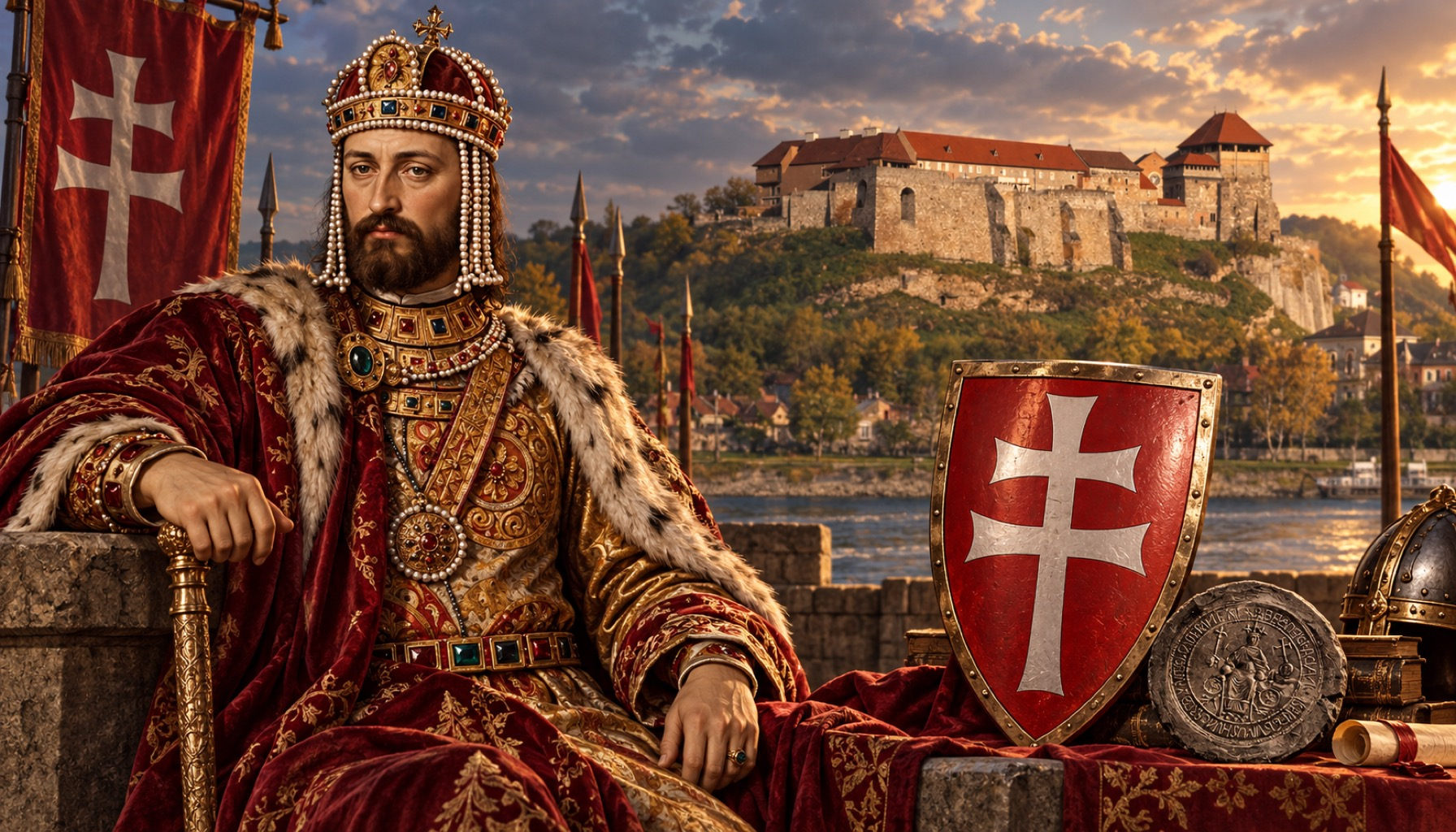
King Béla III of the Árpád dynasty, who ruled Hungary from 1172 to 1196, stands among the most consequential rulers of medieval Central Europe. He was not merely a king in the local sense. He was a prince shaped by two worlds: the Latin Christian kingdom of Hungary and the glittering, ceremonious court of Constantinople. That unusual upbringing helps explain why his reign feels so large in the sources. Béla belonged to a dynasty founded by the rulers who led the Magyar conquest into the Carpathian Basin, yet his adult life unfolded in a political landscape shared with Byzantine emperors, crusader princes, papal power, and ambitious neighboring realms.
What makes Béla especially compelling today is that he is not only well documented in chronicles and charters; he is also one of the rare medieval kings whose surviving remains have been studied scientifically. Archaeology and ancient DNA have made him central to modern efforts to understand the Árpád dynasty itself, not as legend or later genealogy, but as a biological lineage anchored to an actual excavated individual.
Béla was born into the ruling house of Hungary, the son of King Géza II and brother of Stephen III. As a younger son, his future was not straightforward. He was sent to Constantinople, where Emperor Manuel I Komnenos drew him into the Byzantine orbit with remarkable seriousness. There Béla received the name Alexios and the title of despotes, a mark of exceptional favor. For a time, Manuel even treated him as a potential heir. One can see why contemporaries paid attention: a Hungarian prince was being groomed in the political theatre of the Eastern Roman Empire.
That prospect ended when Manuel fathered a son of his own, but Béla’s Byzantine years still mattered. He married Anna of Antioch, daughter of Raynald of Chatillon, linking him to the crusader aristocracy as well as Byzantium’s diplomatic world. When his brother Stephen III died, Béla returned to Hungary and took the throne. As king, he strengthened administration and royal revenues, and later tradition remembered his court as one of the richest in Europe. Hungary under Béla was no backwater. It was a kingdom positioned between the Latin West, the Balkans, and the Byzantine sphere, and Béla was unusually well equipped to navigate all three. His reign also saw Hungarian influence extend in Dalmatia and the Balkans, regions that were constantly contested by great powers and local elites alike.
The biological sample associated with him is identified as King Bela III Arpad Dynasty, dated approximately to 1196 AD, the year of his death. Béla III and his queen, Anna of Antioch, were buried at the royal basilica of Székesfehérvár, the great burial and coronation center of medieval Hungarian kings. That matters enormously, because Székesfehérvár was not just any churchyard: it was one of the chief ceremonial hearts of the Hungarian kingdom.
The basilica itself suffered destruction over the centuries, and many royal burials there were disturbed, damaged, or lost. For that reason, identification of remains from the site must be treated with care. In Béla III’s case, however, the association is generally regarded as securely established in the historical and archaeological tradition surrounding his grave, and his surviving remains have therefore become especially valuable for research on the Árpád dynasty. The 2018 study published in Archaeological and Anthropological Sciences helped place this royal burial into a modern scientific framework, bringing together archaeology, osteology, and genetics rather than relying on older antiquarian assumptions alone.
That is an important distinction. Some medieval royal identifications are speculative, built on pious tradition or later labels. Béla III is far better placed than that. Even so, DNA does not replace the archaeological record; it works best when the burial context, historical documentation, and biological data reinforce one another.
The reported Y-DNA haplogroup for Béla III is R1a1a1b2a2a1. Because Y-DNA is passed down along the direct paternal line, this lineage is especially interesting for a king of the Árpád dynasty. In plain terms, it offers a genetic marker for Béla’s father-to-son ancestral line, the same kind of line that dynasties themselves often claimed as the backbone of legitimacy. This does not by itself define the dynasty’s ethnic identity, nor does it tell us everything about Béla’s ancestry, but it does provide a concrete paternal-line data point for one of medieval Hungary’s ruling houses.
His mitochondrial DNA, inherited through the direct maternal line, is reported as H1b. mtDNA follows a very different path from Y-DNA: it comes from one’s mother, her mother, and so on. In Béla’s case, that maternal lineage is historically interesting because medieval royal families were knitted together through repeated international marriages. A king’s maternal ancestry could connect courts and noble houses across great distances, even when politics and language differed sharply.
Both of these haplogroups should be understood as lineages, not labels for nationality or culture. Broader forms of R1a and H are found across large parts of Eurasia and Europe in many different populations over long spans of time. So Béla’s haplogroups do not “prove” that he was this or that people in a modern ethnic sense. What they do provide is a pair of biological signatures from a historically important individual whose identity is unusually well anchored.
Béla III’s DNA is historically valuable because it links a known king to the broader question of Árpád dynastic origins and continuity. That is far more useful than a floating ancient sample from an unknown grave. Researchers can use such data to compare other burials attributed to the dynasty and to test whether proposed royal relatives fit the expected paternal pattern. In that sense, Béla’s remains act almost like a reference point.
But there are limits, and they are worth stating plainly. A haplogroup alone cannot reconstruct the whole ancestry of the Árpáds, cannot reveal personality, and cannot settle every argument about medieval identity. Nor does a modern person sharing R1a1a1b2a2a1 or H1b become a close relative of Béla III by default. The shared ancestor on such a line may lie far back in time. What the genetics can do is sharpen the historical picture: this king, buried in Hungary’s royal basilica, belonged to identifiable paternal and maternal lineages that can now be studied alongside the written record.
Discover the Hungarian Conquest
Béla III is therefore a splendid example of how archaeology and genetics can enrich, rather than flatten, medieval history. Here is a ruler who moved between Hungary and Constantinople, between dynastic politics and imperial ambition, and who now also occupies a place in archaeogenetics. His bones do not replace the chronicles, but they do add something the chroniclers never could: a direct biological thread into the royal house of medieval Hungary.
MyTrueAncestry lets you compare your DNA with ancient populations and archaeological samples from the worlds that shaped figures like Béla III. You may discover genetic connections to medieval and earlier populations linked to the Carpathian Basin, the steppe, or neighboring regions of Europe and Byzantium-era history.


Comments