Janusz III of Masovia

– 5 min read


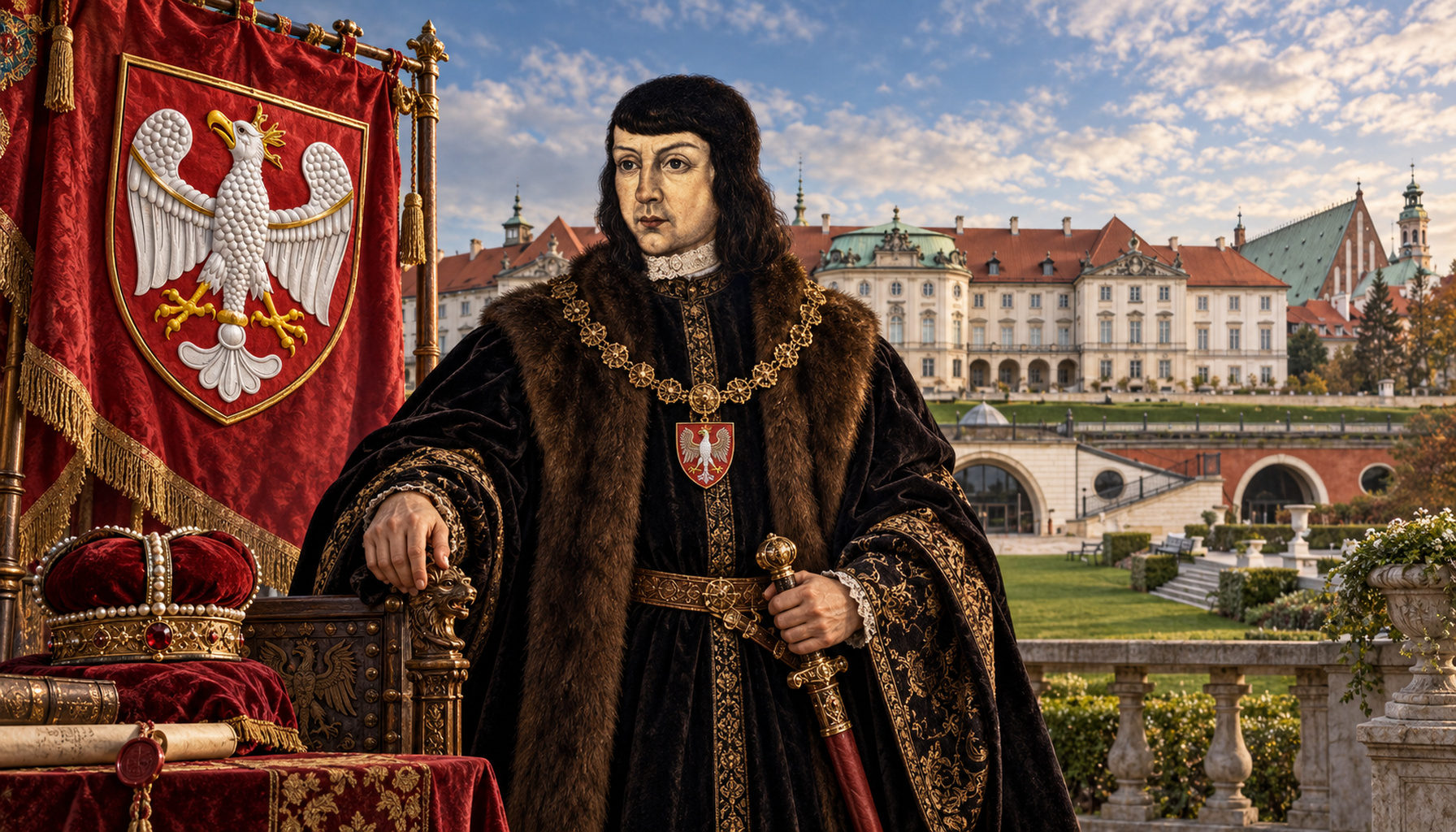
Janusz III of Masovia stands at one of those awkward but fascinating points in history where an old dynasty does not so much explode as quietly run out of road. He was Duke of Masovia in the early 16th century, the last male representative of the Masovian branch of the ancient Piast dynasty, and a ruler whose death in 1526 helped bring an end to the semi-independent duchy centred on Warsaw. In political terms, his life belongs to the moment when medieval regional lordship was being overtaken by the firmer, more centralised power of the Polish Crown.
That alone would make him worth remembering. But Janusz is especially interesting because he is not known to us only through chronicles, charters, and dynastic tables. Ancient DNA recovered from Piast burials now gives us a direct biological window into this final generation of Masovian rulers. It is a splendidly archaeological sort of twist: the last duke of a fading branch of the Piasts reappears not in pageantry, but in the laboratory.
Born into the ruling family of Warsaw and Masovia, Janusz III inherited a duchy with a long Piast pedigree but an increasingly fragile future. Masovia had for centuries occupied a somewhat special position within the Polish lands, ruled by its own Piast line while larger political currents swirled around it. By Janusz’s day, however, this autonomy was under pressure. The Polish kingdom had grown stronger, and the survival of small dynastic enclaves depended on careful management, fortunate succession, and, above all, heirs.
Janusz governed first alongside his older brother Stanisław. After Stanisław’s death in 1524, Janusz became sole duke. His court was centred on Warsaw, and that matters. Warsaw was not yet the great capital city it would later become, but it was already the political heart of Masovia, with the ducal castle as the seat of power. This was the world of late medieval dynastic rule shading into the early modern age: clerks, nobles, privileges, inheritance claims, and the constant question of what would happen when a ruling line failed.
That question was answered brutally quickly. Janusz died suddenly in 1526, only about 24 years old, and left no legitimate heir. With his death, the male line of the Masovian Piasts came to an end, and the Duchy of Masovia was incorporated into the Polish Crown. It is one of those moments that can seem almost administrative on paper, yet it marks a genuine historical turning point: a regional principality with deep medieval roots disappeared into a larger political structure, and a dynasty that had once helped shape Polish history lost one of its last surviving branches.
The ancient DNA sample associated with this ruler is listed as Janusz III Piast Duke of Masovia, sample PCA0252, with an approximate date of 1526 AD. That is exactly the date one would expect for Janusz III’s death, which makes the sample historically very suggestive and important.
In this case, the article data supplied here identifies the sample directly with Janusz III rather than merely with an anonymous Piast-period burial. So the article can reasonably treat this as a securely attributed historical individual within the framework of the published study. At the same time, one should be properly cautious: the information provided here does not set out the full chain of archaeological and historical identification, such as tomb context, inscriptions, funerary records, or later forensic confirmation. That means we should not invent a more elaborate proof than the evidence presented. What we can say is that researchers have associated sample PCA0252 with Janusz III, and that this places the genetic evidence right at the end of the Masovian Piast line.
That is historically valuable in itself. With many medieval rulers, we have names but no bodies, or bones but no secure names. Here, the significance lies in the meeting of dynastic history and excavated human remains: the laboratory sample is not just “a nobleman from medieval Poland,” but a figure tied to a very specific political ending.
The Y-chromosome haplogroup reported for Janusz III is R1b1a1b1a1a2b. Because Y-DNA is passed largely along the direct paternal line, this lineage is of particular interest for a male dynast such as Janusz. In plain terms, it gives us a marker for his father’s father’s father line, stretching back far beyond the historical Piasts themselves. It does not tell us everything about Janusz’s ancestry, but it does tell us something specific about one narrow line of descent.
The mtDNA haplogroup, by contrast, is unknown or not reported here. Mitochondrial DNA tracks the direct maternal line, passed from mother to child. Since no mtDNA haplogroup has been supplied, it would be quite wrong to guess it from geography, dynasty, or anything else. Sometimes the science is wonderfully precise; sometimes it remains incomplete, and one has to live with that.
As for the Y-lineage itself, R1b is a very broad and historically widespread branch found across much of western Eurasia. The more specific designation given here, R1b1a1b1a1a2b, is the important one, because it places Janusz in a narrower paternal lineage than the umbrella label R1b alone. Yet even this does not make the haplogroup a dynastic badge in the heraldic sense. Haplogroups are lineages, not ethnic certificates. They do not prove that someone was “Polish,” “Piast,” or “Masovian” in any simple cultural sense.
What they can do is help researchers compare male-line continuity across burials. In studies of ruling houses, that is often the real prize. If several historically connected Piast males share closely related Y-DNA, that supports paternal continuity within the dynasty or within particular branches of it. If a result differs sharply, it may raise questions about identification, branching, or the deeper history of the line.
A short ancient-DNA note is also worthwhile here. Janusz III’s sample, PCA0252, belongs to a wider scatter of ancient individuals linked in databases to the same broad Y-lineage label R1b1a1b1a1a2b, including other Piast-associated males such as Wenceslaus of Płock (PCA0654), Kazimierz I of the Masovian Piasts (PCA0575), several Masovian and non-Masovian Piast dynasty samples, and a much wider chronological spread reaching back to prehistoric and later historic contexts across Europe and beyond. A few examples from the long comparative list include the Magdalenenberg elite burials in Germany, Roman-era individuals from England, and Neolithic and Bronze Age samples from Anatolia, the Caucasus, and Central Europe. The sensible point is not that Janusz was closely related to all these people; plainly he was not. Rather, his Y-line falls within a paternal branch with a deep and geographically wide history, while the specifically Piast comparisons are the most historically useful for dynastic questions.
For the maternal side, the only ?-linked sample explicitly available in the supplied data is Janusz III himself, PCA0252. So the honest conclusion is simply that his direct maternal haplogroup cannot be discussed further from the material given here.
The fascination of Janusz III’s DNA is not that it transforms him into a genetic caricature, but that it anchors a documented ruler in biological evidence at the very moment his line failed. His genome cannot tell us the whole story of Masovia’s incorporation into the Polish Crown; politics, law, and dynastic accident did that. Nor can a haplogroup reveal his language, personality, or loyalties. What it can do is contribute to the authentication and reconstruction of Piast family history, especially along the paternal line that mattered so much in dynastic succession.
There is something rather poignant in that. Janusz III is historically remembered because he left no legitimate male heir and because his death ended a branch of one of Poland’s oldest ruling houses. Ancient DNA does not undo that ending. It simply lets us glimpse, with unusual intimacy, the biological trace of the young duke whose death closed the book.
Discover medieval paleogenomics
MyTrueAncestry lets you compare your DNA with ancient populations and archaeological samples from the worlds that shaped rulers like Janusz III of Masovia. It is a way to explore genetic connections to medieval Europe, dynastic-era populations, and deep ancestral lineages without pretending that shared DNA markers alone can prove direct descent from any one historical person.






Comments