House von Amsberg
– 3 min read


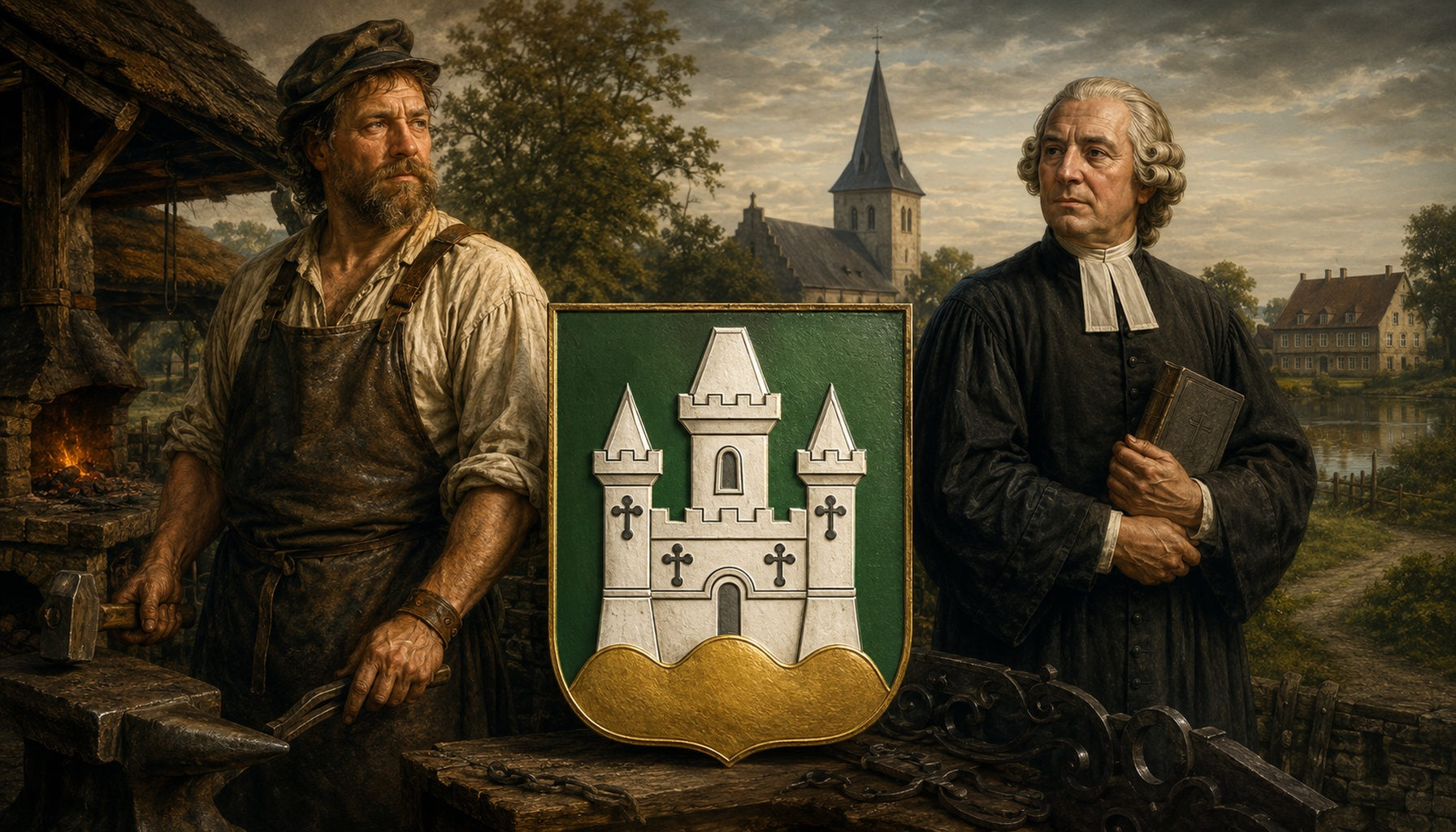
House von Amsberg was a German noble family rooted in Mecklenburg, shaped by the world of regional lordship, service, and long family memory. Like many noble houses in northern Germany, the von Amsbergs emerged from a landscape of estates, obligations, and local influence, where status was maintained not simply by title but by continuity: holding land, serving rulers, and preserving a family name across generations. In haplogroup terms, the primary family line is tagged here with R1a1a1b1a2b3a3a1b1, placing the house within a much wider paternal story found across parts of central, eastern, and northern Europe.
The family heritage fits a recognisable German aristocratic pattern. Mecklenburg, with its old feudal structures and durable noble culture, provided the setting in which families such as the von Amsbergs took shape. Over time, the house became linked not only to local and regional traditions but also to modern European monarchy through dynastic marriage. That is why the name is now far better known than many comparable German noble lines. Among the named figures associated with the family are Juergen Amtsberg (11640-686), a very early ancestral reference in family tradition, Prince Claus of the Netherlands (1926-2002), who brought the name into twentieth-century international public life, and King Willem-Alexander of the Netherlands (1967-), in whom that connection between German noble background and Dutch constitutional monarchy remains visible. Heraldry, public duty, and the careful carrying forward of identity are central to the family story.
A key modern location anchor for the von Amsberg story is Noordeinde Palace in The Hague. Although not a medieval family castle in Mecklenburg, it is one of the most important places through which the family entered the public life of a reigning royal house. Noordeinde Palace has long functioned as a working royal palace of the Dutch monarchy and today serves as the official workplace of the Dutch king. The site has a long history: what began as a noble residence developed over centuries into a palace closely tied to the House of Orange. It sits in the historic centre of The Hague and is known not just for court life and state business but also for its place in royal ceremony and public visibility. The palace itself is generally not open as a full-time interior museum, but the exterior, palace grounds in the broader area, and the royal stables are known points of public interest, and parts connected with the estate can be visited at certain times, so it is reasonable to say that visitors can still experience this royal setting today.
For readers interested in deeper paternal context, haplogroup R1a1a1b1a2b3a3a1b1 also appears in a range of ancient and medieval DNA samples linked to central and eastern European historical populations. These are not evidence of direct descent from House von Amsberg, and they should not be presented that way, but they do help sketch the broader human landscape in which this lineage moved over time. Related or linked examples include Avar Elite Hungary Rakoczifalva (RKC052) and (RKC051), Bronze Age Hungary Balaton Region Somogyvar-Vinkovci (S9), Piast Dynasty Lubusz-Greater Poland Border Santok Lad (PCA0404), Piast Dynasty Poland Santok Lubusz Province Gorzw Wielkopolski (PCA0520), Santok Iron Age samples (PCA0381) and (PCA0382), Medieval Germany Sachsen-Anhalt Western Slav Settler Niederwuensch samples (NDW036, NDW017, NDW025, NDW038, NDW043), Steuden samples (SDN028, SDN029), Duchy of Sandomierz Lublin Region Pidhirtsi (PDH011, PDH012), Early Medieval Croatia Velim-Velistak (VEM035, VEM049), Medieval Poland Piast Dynasty Lad (PCA0198), Bronze Age Romania Trestiana (I6185), and Iron Age Ingria (VII15). Taken together, they point to a lineage with a long and varied presence across the European past, especially in zones where Slavic, steppe, and frontier histories overlapped.
If the story of House von Amsberg, Mecklenburg nobility, royal connection, and haplogroup R1a1a1b1a2b3a3a1b1 has sparked your curiosity, you can explore your own deeper ancestry too. Upload your DNA to MyTrueAncestry and see how your family story may connect with ancient populations, medieval lineages, and the wider human past.

Comments