House of le Strange
– 3 min read


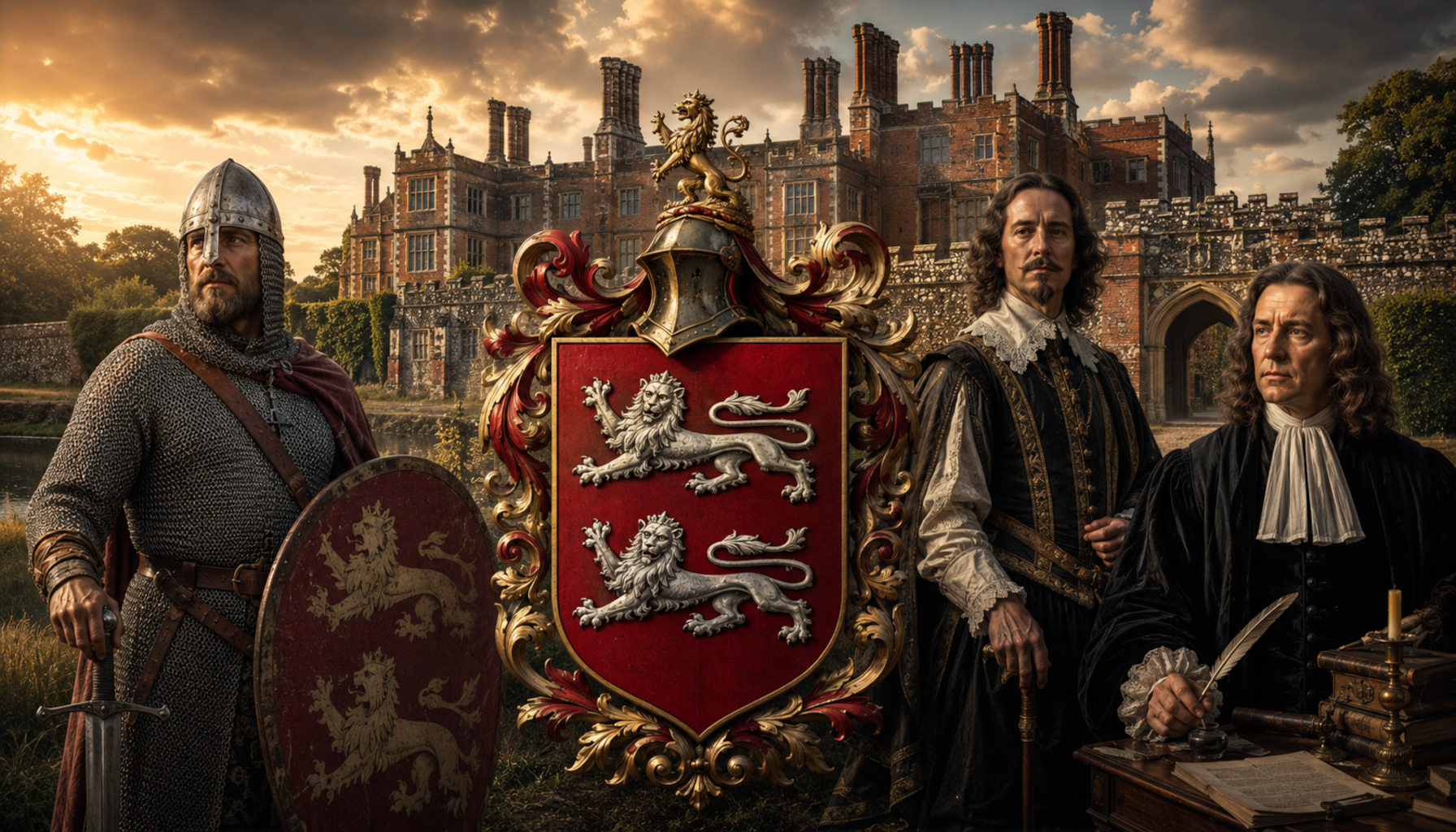
The le Strange family, later often written L'Estrange, was one of those classic Anglo-Norman houses whose story seems to carry the whole texture of medieval England within it: conquest legend, marcher warfare, knightly service, estate power, heraldry, royal politics, and a long afterlife in the gentry world of Norfolk. Tradition linked the family to the Norman settlement after 1066, with tales of a Roland le Strange among the followers of William the Conqueror, though the firmer medieval record places the family in the border country of Shropshire, especially at Knockin, where they held a significant lordship near the Welsh frontier. In DNA terms, the primary family haplogroup linked here is R1b1a1b1a1a2c1a4b4a1a, a branch within the great western European R1b line.
The name itself, from Old French estrangier or estrange, suggests "the stranger" or "the foreigner", which is wonderfully fitting for a family that arrived in the wake of conquest and then embedded itself deeply into English history. From the marcher world of castles, raids, loyalties, and crown service, the le Stranges developed into a durable noble and gentry house, with branches reaching into Norfolk and establishing Hunstanton as a major family centre. Their heraldry, a red shield with two silver lions passant, has exactly the bold, declarative quality one expects from an Anglo-Norman military lineage. Named figures help pin this long story down: Home le Estraunge appears in 1255, and Thomas de Strang in 1340, reminders that the family was not merely legendary but visibly active in the documentary record across the high and later Middle Ages. In later centuries the line produced the L'Estrange baronets of Hunstanton, Sir Nicholas L'Estrange, and Sir Roger L'Estrange, the sharp-edged royalist writer, translator, pamphleteer, and Restoration censor whose career carried the family name into the literary and political life of early modern England.
Hunstanton Hall in Norfolk became the great location anchor of the family and remains one of the most tangible ways of encountering the le Strange story on the ground. The hall, near the north Norfolk coast, is a moated house whose surviving fabric is largely medieval, with important later alterations. It is especially noted for its substantial brick gatehouse, often dated to the late fifteenth century, and for the layered feel of a residence that began as a fortified manorial seat and evolved into a long-lived family home. This is exactly the sort of place where one can see the transition from medieval lordship into the world of county society and estate culture. Hunstanton Hall remained associated with the L'Estrange family for centuries, and that continuity matters: it turns an abstract lineage into something architectural and local. The hall has been known to open to visitors on selected occasions rather than as a constantly open museum, so it can still be visited in a limited and reasonably supported sense, especially through special open days or heritage events.
From an ancient-DNA perspective, Haplogroup R1b1a1b1a1a2c1a4b4a1a belongs to a wider western European paternal landscape that turns up across Britain and the Continent in different periods. That does not mean direct descent from any one excavated person, and it is important not to overclaim. What it does mean is that the le Strange paternal line, as tagged here, sits within a network of related or linked ancient samples spread across Iron Age, Roman, post-Roman, and medieval contexts. Among those linked examples are Celtic Durotriges burials from Duropolis at Winterborne Kingston in England, including WBK12, WBK20, WBK29, WBK41, WBK05, WBK30, WBK43, WBK06, WBK08, WBK18, and WBK191; medieval England Cambridge St Johns Hospital ATP_PSN_192; Imperial Roman Era Zadar Croatia I26776; Bronze Age Orkney Westray Links of Noltland KD061; Bronze Age Calabria Cosenza Grotta della Monaca Sant Agata di Esaro GMO015; Early Medieval Belgium Sint-Truiden Groenmarkt ST2025; Medieval Belgium Outsider Sint-Truiden Onze-Lieve-Vrouwekerk ST1308; Gallic France Parancot CGG023699; Post Roman Worth Matravers Dorset I11580; Merovingian Alt-Inden IND013; Late Roman Klosterneuburg R10656; Late Roman Conimbriga R10488; Iron Age Worlebury I11991; Iron Age Battlesbury Bowl I21309; Bronze Age Trumpington Meadows I3256; Bronze Age Amesbury Down I2417; Bell Beaker Upavon I4950; Bronze Age Bedfordshire I7576 and I7577; Bronze Age Boatbridge Quarry I5473; Celt Hinxton HI2; Early Bronze Age Thames I5377; and Ireland Copper Age Rathlin2B. In plain English, that is a broad reminder that the paternal ancestry associated with this line has deep roots in the population history of Britain and Atlantic Europe long before the medieval le Stranges appear in written records.
If the story of the House of le Strange speaks to you, whether through family history, heraldry, Norfolk roots, Norman legend, or the deeper trail of Haplogroup R1b1a1b1a1a2c1a4b4a1a, you can explore your own connections by uploading your DNA to MyTrueAncestry. It is a fascinating way to place your family story against the much older human past.
Comments