House of Hesse
– 3 min read


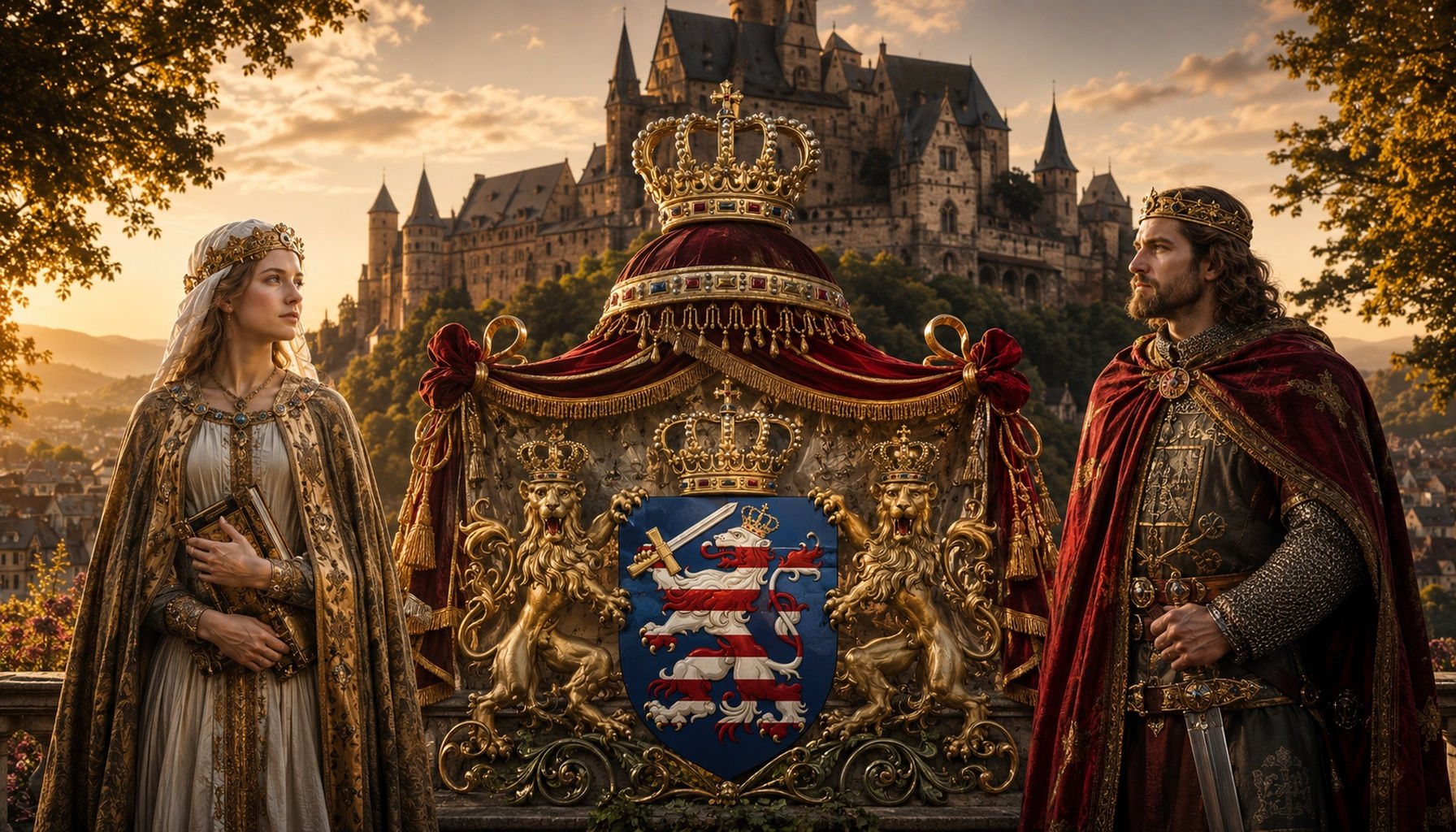
The House of Hesse was one of the great princely families of the German lands, rooted in the old territorial world of central Germany and most closely associated with Hesse in the Holy Roman Empire. Over centuries, this dynasty became identified with landgraves, electors, grand dukes, confessional politics, military power, and a remarkable web of royal marriages stretching across Europe. In genetic tagging terms, the primary family haplogroup linked here is R1b1a1b1a1a2c1a6c, a lineage with a deep and wide story across western and central Europe.
The family's background belongs to that wonderfully intricate medieval landscape in which lordship was not just about blood, but also inheritance, church patronage, castles, imperial favour, and survival in a patchwork political order. The wider ancestral tradition reaches back into the noble world associated with figures such as Reginar Longneck (850-915), while the specifically Hessian ruling line took firmer shape with Henry I Landgrave of Hesse (1244-1308), who established Hesse as a durable territorial principality after the inheritance struggles surrounding Thuringia and Brabant. From there the house developed into multiple ruling branches, most famously Hesse-Kassel and Hesse-Darmstadt, each carrying forward the classic marks of German princely identity: sovereignty over territory, Protestant statecraft, dynastic ceremony, military service, and careful positioning in imperial and European diplomacy.
One of the finest location anchors for the House of Hesse is Marburger Schloss, the castle rising above the town of Marburg. This was not some decorative afterthought but one of the most important early residences of the Landgraves of Hesse, with medieval origins going back to the 11th century and major building phases in the 13th, 15th, and 16th centuries. Perched on a hill above the Lahn valley, it is exactly the sort of place that tells you what princely power looked like in the German Middle Ages: defensive, visible, administrative, and symbolic all at once. The castle became closely tied to the emergence of Hesse as a territorial state, and Marburg itself gained added dynastic prestige through its association with Saint Elisabeth of Hungary and the wider religious and political life of the region. The structure survives in substantial form and can still be visited today, making it one of the most tangible places to encounter the world from which Hessian rulership grew.
The haplogroup tag R1b1a1b1a1a2c1a6c also has an interesting ancient-DNA landscape behind it. That does not mean we should leap into claims of direct descent from any one excavated individual, but it does allow us to place the lineage in a broader historical frame. Related or linked samples appear across a striking range of contexts, especially in Iron Age and later western Europe: Celtic Durotriges burials from Duropolis at Winterborne Kingston such as WBK12, WBK20, WBK29, WBK41, WBK05, WBK30, WBK43, WBK06, WBK08, WBK18 and WBK191; Dark Ages and medieval Las Gobas in northern Spain including ldo039, ldo052 and ldo242; Gallic and Belgic contexts such as Verona Seminario Vescovile 3214s and 3214, Bucy-le-Long CGG022427, and Parancot CGG023699; as well as later Roman, early medieval, Saxon, Merovingian, Pictish, Anglo-Saxon, Irish, Scandinavian, and British Bronze and Iron Age individuals including I26776, KD061, I2859x, I19909, CGG018915, CGG018915x, GMO015, ST2025, ST1308, AHPS144, 12880A, 12884A, I11580, BUK055, LAK010, IND013, HAD018, KIL025, SWG003, EAS004, R10656, R10488, I2565, I2611, I27380, I14358, I12935, I13726, I19211, I16504, I5440, I19855, I21312, I5511, I3567, I3566, I27384, I27385, VK31, Rathlin2B, I6492, and KNS-A1. In plain terms, this is a lineage pattern that fits well within the long population history of Atlantic and northwestern Europe, later feeding into the elite and non-elite societies from which medieval dynasties like the House of Hesse eventually emerged.
If the House of Hesse, German princely history, and deep R1b lineages spark your curiosity, you can explore your own ancient connections by uploading your DNA to MyTrueAncestry. It is a lively way to place family history alongside archaeology, dynasties, and the much older human story behind them.


Comments