House Andrade
– 3 min read


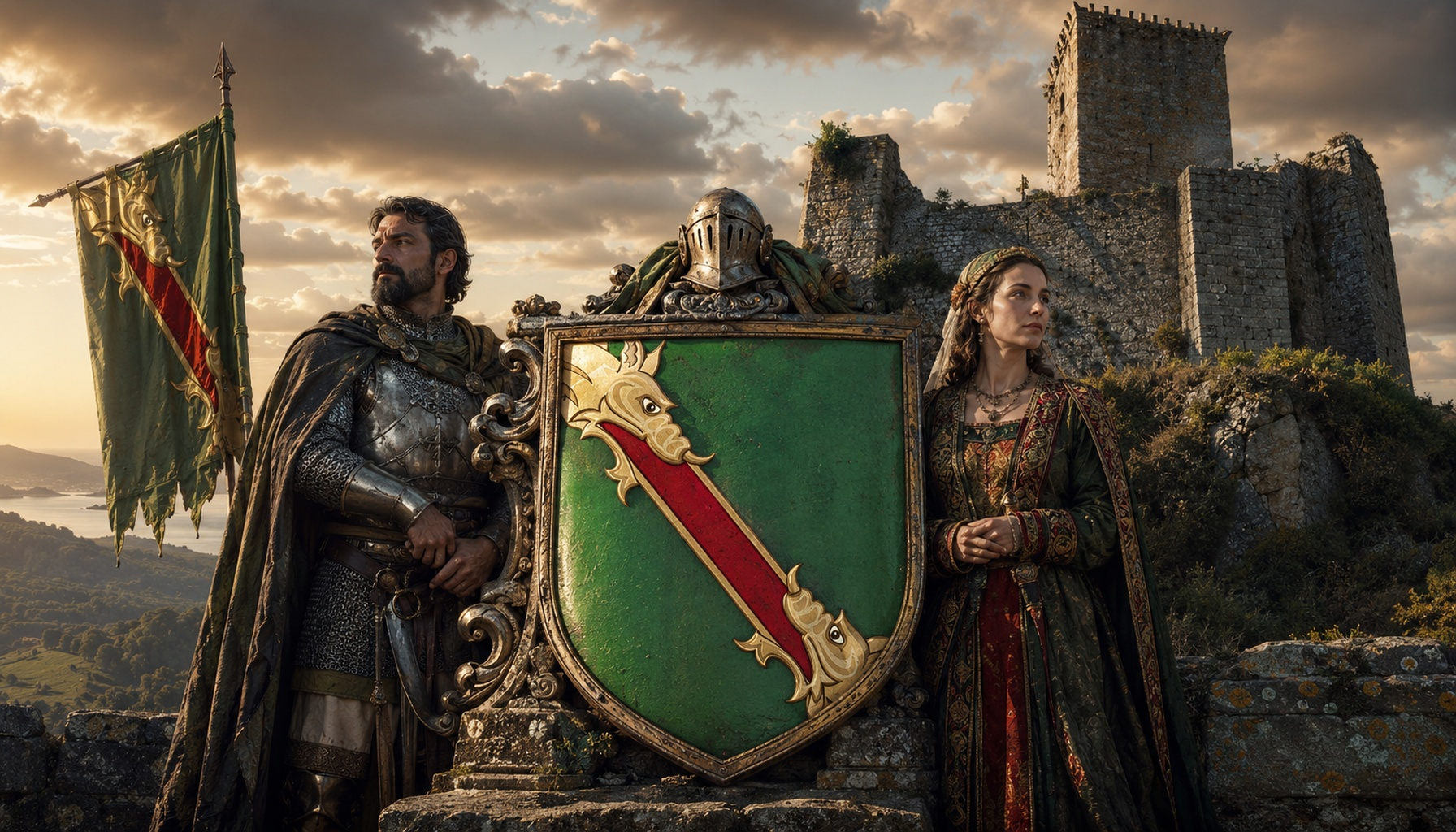
The House Andrade was one of the notable noble lineages of north-western Iberia, rooted above all in Galicia and closely tied to Portugal and the wider aristocratic world of the peninsula. This was a family made powerful not by myth alone, but by the very solid medieval ingredients of land, castles, military service, marriage alliances, heraldry, and local authority. In historical terms, Andrade fits a familiar Iberian pattern: a regional noble house that rose through lordship and service, held on through property and kinship, and built an identity that lasted for centuries. Haplogroup tags linked with the family tradition here include R1b lineages, with the primary family haplogroup given as R1b1a1b1a1a2a1b3.
The family background is very much a frontier-Atlantic story. Galicia and northern Portugal were never sealed compartments; they were deeply connected zones of movement, warfare, patronage, and intermarriage. In that world, the Andrades emerged as territorial nobles, their status reinforced by fortified residences, control of estates, and ties to kings and magnates. Among the best remembered figures are Fernan Perez de Andrade "The Good" (1330-1397), one of the great Galician lords of the later Middle Ages, remembered for patronage, building activity, and political importance, and Nuno Freire de Andrade, active in the early 15th century and part of the same wider noble tradition. The enduring significance of the house lies not just in a few famous names, but in how thoroughly it represents the social machinery of Iberian nobility: land, arms, marriage, and public power passed down across generations.
The family's great location anchor is the Castle of Andrade in Galicia, traditionally associated with the municipality of Pontedeume in the province of A Coruna. As a fortified medieval tower-house complex, it expresses exactly the kind of lordly presence that gave families like the Andrades their authority on the ground. The structure is especially known for its imposing keep, rising in a stark vertical form that still conveys the message medieval castles were meant to send: protection, status, jurisdiction, and control of the surrounding landscape. The castle as seen today reflects medieval construction with later phases of damage, decay, and restoration, and it remains one of the most tangible monuments connected with the Andrade name. It is not merely a backdrop to family history; it is the stone embodiment of regional lordship in late medieval Galicia. It is also a known heritage site and can still be visited, making it one of those rare places where a noble lineage can still be encountered in the landscape rather than only on paper.
The primary haplogroup associated here, R1b1a1b1a1a2a1b3, belongs to a wider west Eurasian paternal branch with deep roots and a very broad historical footprint across Iberia and beyond. That does not prove direct descent from any ancient individual, of course, but it does place the Andrade story in a larger genetic landscape shared by many populations connected to Atlantic Europe, Iberia, Gaul, Britain, and later medieval societies. Related or linked samples assigned within this broader haplogroup trail include Bronze Age and later individuals from Iberia such as Murcia Almoloya Pliego samples ALM036, ALM039, ALM041, ALM050, ALM052, ALM058, ALM063, ALM064, ALM070, and ALM081; Valencian Bronze Age Puntal de los Carniceros sample PUC002; Bronze Age Valencia Lloma de Betxi I3997; Bronze Age Spain Cogotas I12209; Celtiberian Spain esp005; Late Iron Age Cantabrian Spain I19991; Ibiza Puig des Molins I27620; Burgos Tablada de Rudron Virgazal I6470; and Post Roman Miroico Portugal R10503. Beyond Iberia, linked examples include Merovingian Frankish Eltville Germany EV8, Belgic Gaul ISL6950, Belgic Suessiones CGG022434, Roman Sardinia I21964, Iron Age Sicily I13128, Prague Jinonice I14185, Melton Quarry I7629, Constantine Island Cornwall I16454, Celtic Briton samples I12771, I11143, I14327, I12413, I20630, Trethellan Farm I16450, Medieval Morbihan I15027, Viking Age VK365, Viking invader VK261, Napoleon-era YYY095A, Crusader-linked SI-41, and colonial Maryland I35260. Taken together, these do not map a single family tree, but they do show how a lineage label like R1b1a1b1a1a2a1b3 sits inside a long and mobile human story stretching from Bronze Age Iberia to medieval and early modern Europe.
If the history of House Andrade speaks to your own family story, DNA can add another layer to the picture. Upload your DNA to MyTrueAncestry to explore ancient samples, regional connections, and the deeper background behind lineages linked to Iberia and the Atlantic world.

Comments