Haplogroup T1a1a1b2b2b1a1a2

– 5 min read


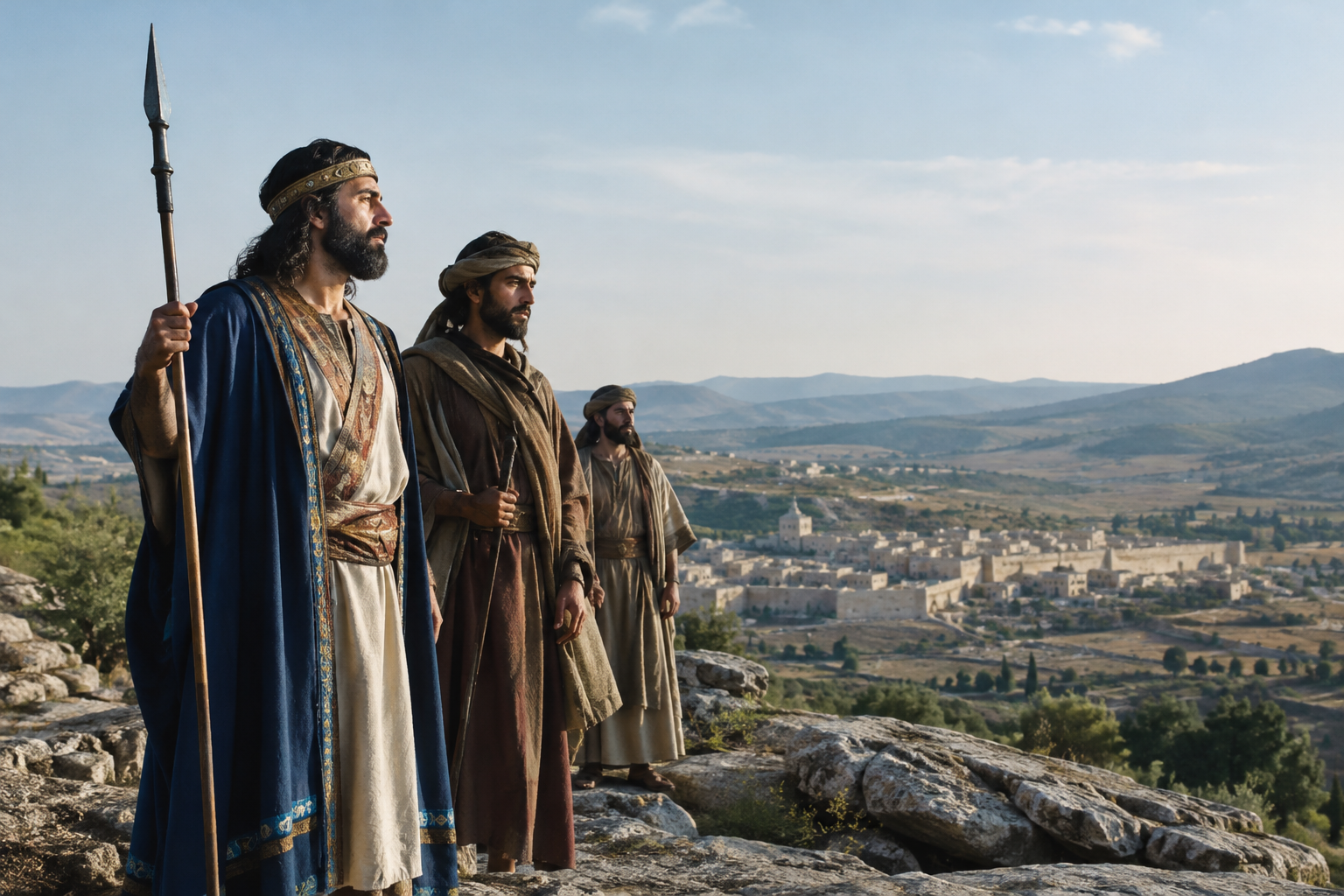
At Abel Beth Maacah, a mound in northern Israel near the routes that link the Levant to Syria and beyond, ancient DNA has put a very specific paternal line into an Iron Age setting. One of the individuals from the site, sample I2201, dated to around 928 BC and associated here with the Kingdom of Israel, is linked in MyTrueAncestry's classification to the Y-DNA haplogroup T1a1a1b2b2b1a1a2.
That sounds forbiddingly technical, but the archaeological point is quite straightforward. Y-DNA follows one direct male line only: father to son to son. It does not tell us everything about a person's ancestry, language, or identity. What it can do, especially when tied to a named excavation and a historical landscape, is anchor one paternal branch in a real community at a real moment in the past. In this case, that moment sits in the early Iron Age Levant, in a town that mattered precisely because it stood at a frontier of contact.
Abel Beth Maacah is one of those places where archaeology and history naturally rub against each other. The site lies in the far north of ancient Israel, close to the upper Jordan and the approaches from the Beqaa Valley and inland Syria. In historical terms, it occupied a strategic position on the edge of kingdoms and exchange networks; in archaeological terms, that makes it exactly the sort of settlement where one might expect a mixture of local continuity and outside connections.
That is why I2201 matters. We are not looking at an abstract haplogroup map detached from context, but at an individual from a settlement embedded in the political world of the Iron Age southern Levant. The branch name T1a1a1b2b2b1a1a2 is extremely narrow, much narrower than the broad parent haplogroup T. So it would be rash to load this one sample with grand claims about the whole history of haplogroup T. Still, its appearance at Abel Beth Maacah places this paternal line within the lived population of an important northern town in the centuries when Israelite, Aramaean, and Phoenician spheres overlapped and competed.
A genetic study of ancient Near Eastern populations, linked to this sample through research on the region's ancient DNA, helped show just how much the southern Levant was shaped by long-term mixture rather than by any single, sealed-off ancestry. That wider context makes a lineage like this especially interesting: not because it proves a single migration story, but because it belongs to a landscape where mobility was normal.
Bronze and Iron Age Mesopotamia DNA
With a long terminal label like T1a1a1b2b2b1a1a2, the temptation is to treat it as if it carried a ready-made ethnic badge. It does not. The sensible way to read it is as a fine-grained paternal signature found in one ancient male line at Abel Beth Maacah. The wider haplogroup T has a deep history in western Asia, northeast Africa, and parts of the Mediterranean, but that larger background should not be collapsed into a neat biography for this one sub-branch.
What can be said more confidently is that the presence of this branch in Iron Age Israel fits the Levant's role as a corridor rather than a cul-de-sac. Towns like Abel Beth Maacah did not sit still while history happened elsewhere. They were plugged into trade, warfare, diplomacy, marriage exchange, and population movement. A Y-chromosome lineage found there may represent local descent over generations, recent movement into the area, or a much older branch maintained within the region. Archaeology and genetics together can narrow the possibilities, but they do not magically turn one sample into a dynastic family tree.
To understand why this single sample is worth noticing, it helps to remember the date. Around the 10th century BC, the northern Levant was politically fractured and culturally busy. Kingdoms rose and fell; cities shifted their alliances; imperial powers had not yet imposed the later kinds of large-scale centralization seen under Assyria. A site such as Abel Beth Maacah could be tied to the Kingdom of Israel in one historical framing while still remaining connected to neighboring populations through ordinary human realities like commerce, craft, and marriage.
That is precisely the setting in which Y-DNA becomes useful. A lineage like T1a1a1b2b2b1a1a2 is not a headline on its own. It becomes meaningful when attached to a place where borderland life can be studied archaeologically. In this case, the line shows that the paternal diversity of Iron Age communities in the Levant included branches that modern testers may not expect if they think only in terms of later political or religious identities.
Earlier burial history in Israel
There is only one ancient individual listed here, and that scarcity is part of the story. Ancient Y-DNA evidence is often frustratingly uneven. Some regions and periods give us clusters of related males from cemeteries; others offer only isolated snapshots. But snapshots can be historically valuable when they come from the right place. I2201 is one of those cases.
Abel Beth Maacah has significance beyond the single genome because it helps populate the map of ancient paternal lines in the Levant with something more precise than guesswork. Historians have long known that the northern kingdom's frontier world was entangled with Phoenician coastal networks, inland Syrian states, and older Canaanite traditions. Genetics does not replace that picture; it adds a human thread to it. A man carrying this paternal branch was part of that society, not a footnote floating above it.
That matters, too, for people researching their own paternal ancestry today. Modern carriers of rare or geographically patchy T-lineages can sometimes feel stranded between sweeping narratives built around more common branches. Ancient evidence like I2201 reminds us that these lines were present in historically important communities and need not be treated as marginal simply because they are less frequently discussed.
The most responsible way to read this evidence is not as a claim that all men of haplogroup T descend from ancient Israelites, or that this exact subclade belonged to a named biblical tribe, court, or royal house. None of that follows from the data. But neither should the result be flattened into something dull. Abel Beth Maacah was a connected place, and connected places are where lineages travel, persist, and become woven into new political worlds.
Seen in that light, T1a1a1b2b2b1a1a2 is a useful archaeological clue. It places one paternal line of this branch in the early Iron Age northern Levant, in a settlement poised between local tradition and regional exchange. That is not a complete biography of the haplogroup, but it is a firm historical foothold.
Eastern Mediterranean genetic influence
If your Y-DNA falls under T1a1a1b2b2b1a1a2, the strongest point from the present evidence is simple and valuable: this paternal line is attested in an Iron Age individual from Abel Beth Maacah in northern Israel, sample I2201, around the 10th century BC. That does not assign you a kingdom, an ethnicity, or a royal pedigree. It does, however, place your direct paternal line within the documented human landscape of the ancient Levant - a world of towns, frontiers, and long-distance ties where identities were layered and movement was ordinary.

Comments