Haplogroup T1a1a1b2b2b1a1a1
– 5 min read


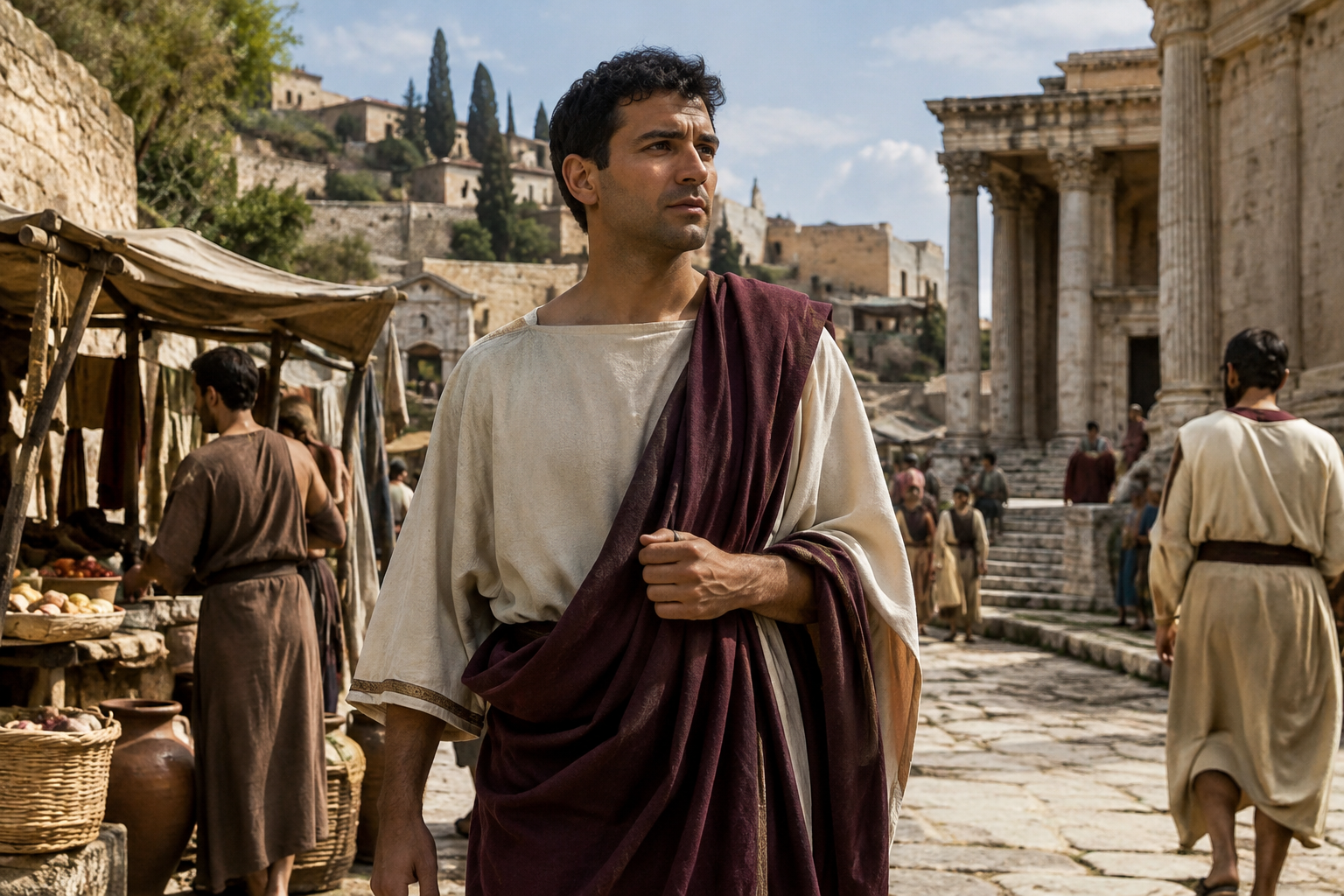
A man identified as QED-2, buried in Roman-period Lebanon around AD 250, is a small but arresting piece of evidence for the Y-DNA haplogroup T1a1a1b2b2b1a1a1. We are not dealing here with an emperor, a conquering army, or a legendary dynasty. We are looking instead at an ordinary citizen from the eastern Mediterranean at a time when Roman rule connected cities, villages, ports, and pilgrim routes from Britain to Syria. That is precisely what makes him interesting.
The value of a lineage like T1a1a1b2b2b1a1a1 lies in scale and caution. Y-DNA follows one direct paternal line only, not a person's whole ancestry, language, or identity. But when a branch appears in an ancient individual from Roman Lebanon, it helps place that paternal line in a real historical landscape: one shaped by long local continuity, imperial movement, and the intense mixing of peoples that marked the Roman Near East.
The single ancient individual attached here, QED-2, is described as a Roman Era citizen from Lebanon, dated to about AD 250. Even from that sparse description, the context is historically rich. Lebanon in the third century AD sat within one of the most urbanized and commercially active parts of the Roman Empire, close to old Phoenician coastal centers, inland routes to Syria, and the cultural orbit of cities such as Berytus, Sidon, Tyre, and Heliopolis.
This was not a peripheral backwater. Roman Lebanon belonged to a region where older Levantine populations lived within an imperial system that brought in soldiers, merchants, administrators, enslaved people, pilgrims, and migrants from many directions. So when a paternal branch such as T1a1a1b2b2b1a1a1 appears here, the immediate historical question is not whether it was "Roman" or "native" in some simplistic sense. The better question is how paternal lines persisted, mixed, and circulated in one of antiquity's busiest crossroads.
A broader ancient DNA study of Near Eastern populations published in research on the region's genetic history helped show just how important long-term continuity can be in the Levant, even amid repeated political change. That matters for interpreting QED-2. A Roman-period burial in Lebanon does not automatically represent recent immigration from elsewhere in the empire; it may just as well reflect a local family line living under Roman rule.
Eastern Mediterranean DNA in Rome
The article haplogroup is extremely specific: T1a1a1b2b2b1a1a1. That is not the same thing as making claims about all of haplogroup T, or even all of T1a. The broader T family has a long and geographically wide history across parts of western Asia, northeast Africa, and the Mediterranean world. But a fine-grained terminal branch such as this one represents a much narrower twig on that paternal tree, and its detailed spread cannot be reconstructed from one ancient Lebanese sample alone.
Still, even one securely placed ancient occurrence is useful. It tells us that this paternal line, or a very close ancestral branch, was present in the Roman Levant by the mid-third century AD. For testers today, that places the lineage within a documented historical setting rather than leaving it floating in the abstract language of SNP trees and branch labels.
There is also an important methodological point. Ancient DNA often resolves some male samples to a broad parent branch, while modern testing can identify much finer subclades. In cases like this, one should be careful not to overstate how precisely the ancient man's Y chromosome was classified in the underlying research versus later reporting. The historical value remains real either way: this is evidence for the branch in Roman Lebanon, not proof of a neat one-line migration story.
Roman rule in the Levant did not wipe the slate clean. Cities changed, legal systems changed, languages overlapped, and imperial institutions pressed hard on everyday life. Yet families remained embedded in local landscapes that had already been inhabited for millennia. That is why Roman-period genomes from the eastern Mediterranean are so often interesting: they sit at the meeting point of continuity and mobility.
A burial like QED-2's belongs to that meeting point. By AD 250, the empire was in one of its more turbulent centuries, but eastern provinces still sustained dense civic life and commercial exchange. Men carrying many different paternal lines could be found in the same towns, and those lines need not map neatly onto ethnicity, religion, or legal status.
If your own paternal line falls under T1a1a1b2b2b1a1a1, the most responsible historical reading is not a fantasy of one heroic founder. It is something both less romantic and more interesting: your direct male line belongs to a strand of ancestry that was present in the Levantine world of the Roman Empire, among real communities living inside one of history's largest imperial systems.
Ancient DNA has repeatedly shown that Roman-period populations could be surprisingly heterogeneous. That does not mean every burial ground was full of long-distance migrants, but it does mean the empire created opportunities for movement on an extraordinary scale. The eastern Mediterranean was especially central to those networks, and Lebanon stood in the thick of them.
So QED-2 matters not because he can stand for all Romans, nor because he unlocks a hidden dynasty, but because he anchors this haplogroup in a documented imperial-era setting. In practical terms, that helps separate two different kinds of historical question. One asks where a deep paternal branch ultimately emerged over prehistory. The other asks where we can actually see it in an ancient person. For T1a1a1b2b2b1a1a1, one such sighting is Roman Lebanon around AD 250.
This distinction is especially useful for family historians. Many paternal branches have older prehistoric roots but only become visible to us in the historical record through chance discoveries and DNA preservation. QED-2 is one of those rare moments when a branch steps out of the tree diagram and into an identifiable human setting.
It is tempting to read modern nation-states backwards into antiquity, but Roman Lebanon was part of a larger eastern Mediterranean continuum. Coastal exchange linked Lebanon with Cyprus, southern Anatolia, Egypt, and the Aegean; inland routes connected it with Syria and beyond. Paternal lines could persist locally for centuries and yet also circulate across these routes through marriage, military service, trade, enslavement, and urban migration.
That is why the appearance of a T-lineage in Lebanon does not demand a single explanation. It may represent deep regional continuity. It may reflect older population movements before the Roman period. It may also fit the ordinary human traffic of the empire itself. Good archaeology resists the urge to choose one dramatic answer when several sober ones are possible.
Eastern Mediterranean Influence
T1a1a1b2b2b1a1a1 is not illuminated here by a grand cemetery full of related males or a named ruling house. Instead, it is illuminated by something more modest and often more trustworthy: one dated ancient individual in a well-defined historical world. QED-2 shows that this paternal branch belonged, at least by the Roman period, to the human landscape of Lebanon and the wider Near East.
For someone researching this haplogroup today, that is the key takeaway. Your direct paternal line is not just a modern test result; it has a documented foothold in the Roman eastern Mediterranean, where local continuity and imperial connectivity lived side by side.



Comments