Haplogroup T1a1

– 5 min read


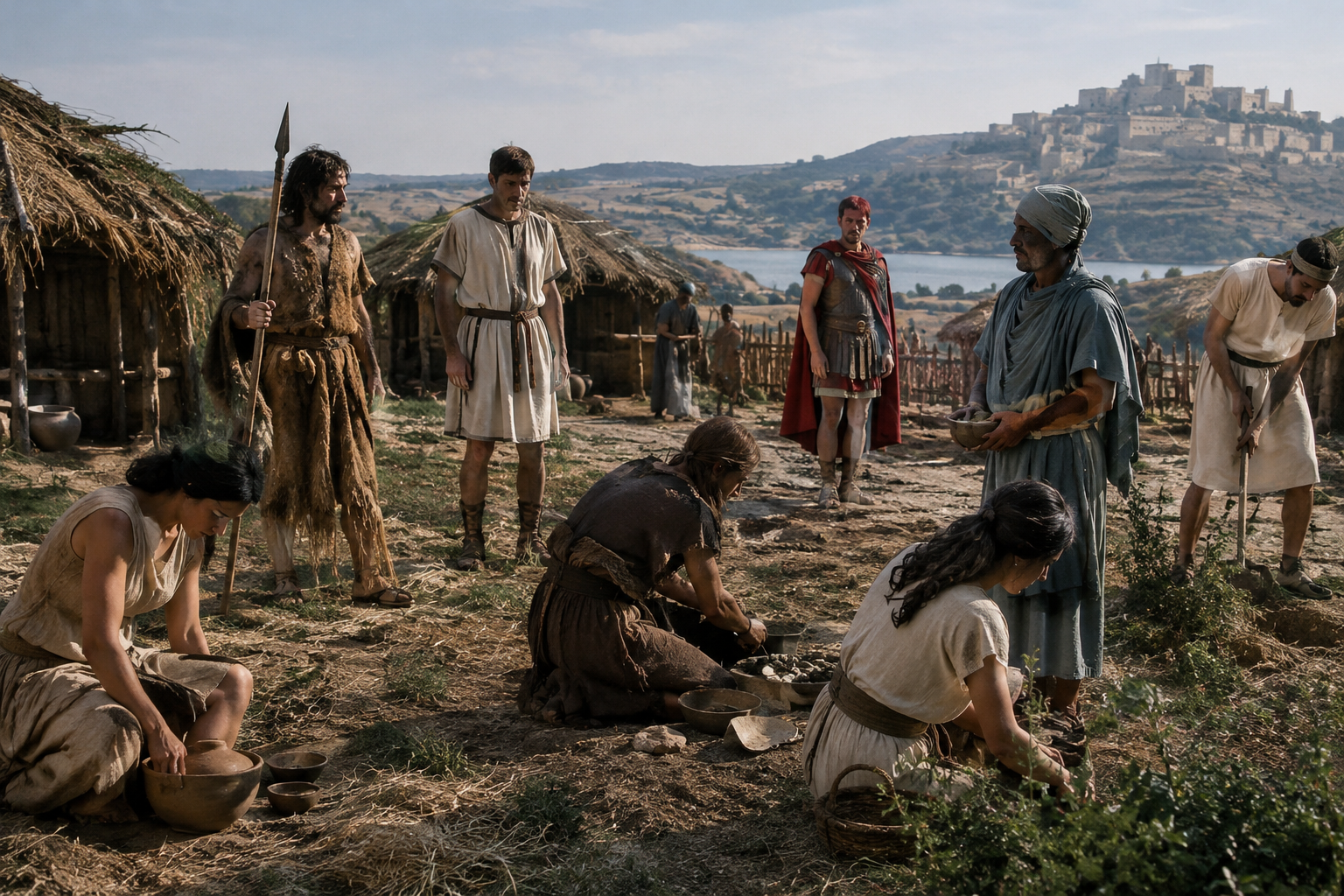
At Asparn-Schletz in Lower Austria, archaeologists uncovered one of the grimmest sites of early Neolithic Europe: a settlement edge filled with the dead, usually dated to around 5000 BC. Among the individuals from this massacre horizon is sample I24887, reported in association with Y-DNA haplogroup T1a1. That matters because T1a1 is not one of the paternal lines most people expect to meet in early central European farming communities, and yet here it appears in a moment of crisis at the frontier of the first farming world.
This is a good reminder of what a Y-chromosome lineage can and cannot do. Y-DNA follows one direct paternal line only, not a person's whole ancestry, language, or identity. But when the same branch turns up in very different archaeological settings, it can still tell an intriguing historical story. For T1a1, the supplied ancient evidence points toward a lineage with deep links to the Near East and eastern Mediterranean, yet one that also appears unexpectedly among Europe's early farmers and later in the highly connected worlds of Rome and Carthaginian Sicily.
Asparn-Schletz has become famous because it captures the violence that could accompany the spread and consolidation of farming in Neolithic Europe. The site belongs to the world of early agricultural communities in the Danube region, where settlements, land use, and local rivalries were reshaping society. Sample I24887 places T1a1 in that setting: not in a royal tomb or an exotic outpost, but in the harsh realities of village life on a contested frontier.
We should be careful here. One individual does not make an entire culture "a T1a1 culture", nor does it prove a single migration story on its own. Still, its presence is striking when read beside other early Neolithic evidence from central Europe, because it suggests that the paternal makeup of the first farmers was more varied than later simplified narratives sometimes imply.
Lower Austria Kinship Networks
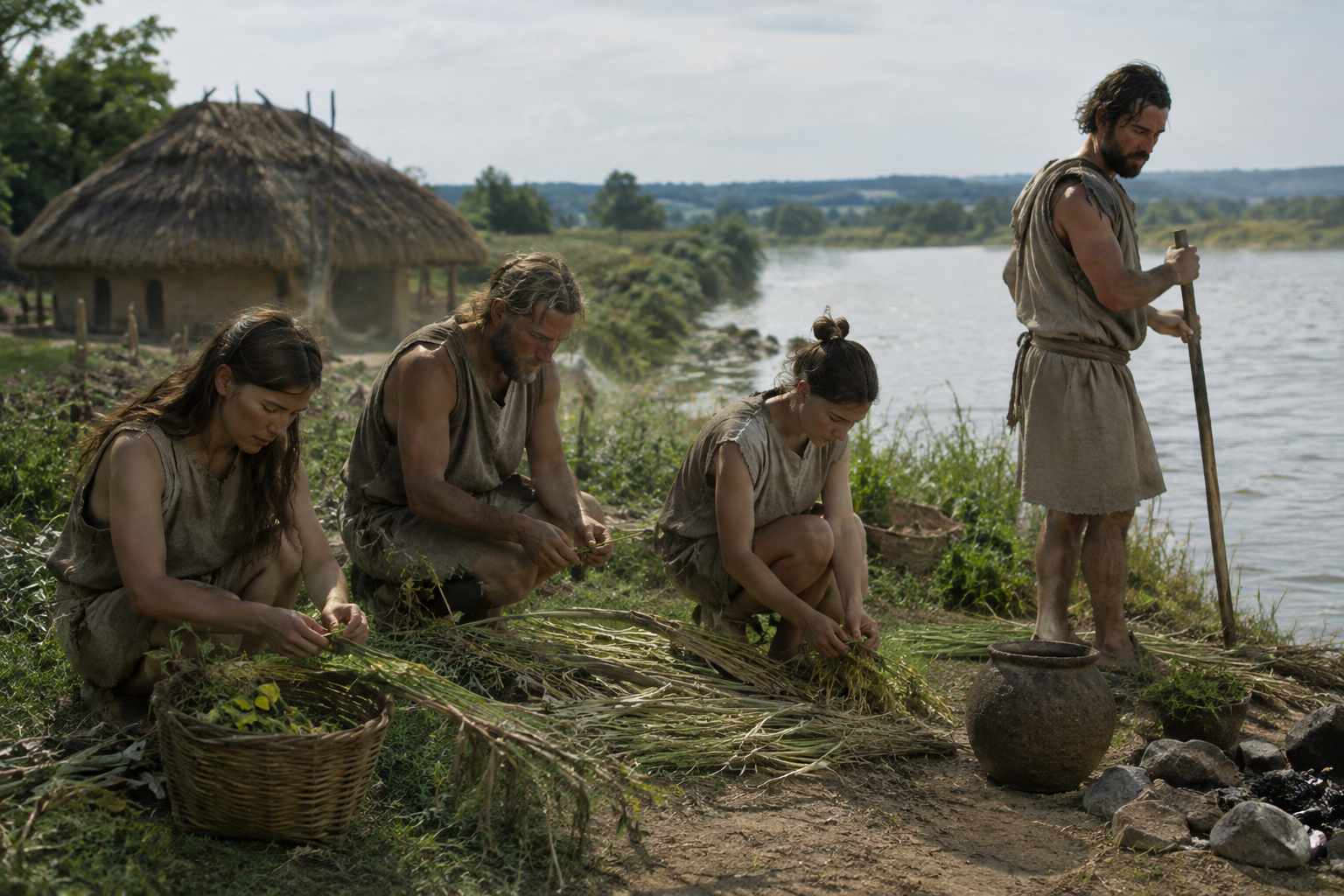
Two more supplied samples deepen that picture. DER031 comes from Derenburg-Meerenstieg II in Germany, dated here to around 6000 BC, and TR61 comes from Trebur Grossgartach, around 4800 BC. Both belong to the long Neolithic transformation of central Europe, when farming communities spread, divided, mixed, and established local traditions that were never as uniform as old textbook maps made them look.
Taken together with Asparn-Schletz, these German and Austrian finds suggest that T1a1 or a closely associated paternal branch was present in parts of the early Neolithic world north of the Alps. That does not mean the lineage was common everywhere, and it certainly does not tell us that all these men belonged to one close family. What it does suggest is that the male lines carried by Europe's first farmers included branches whose deeper background likely lay further southeast, in the wider zone linking Anatolia and the Levant to the Balkans and the Danube.
A major ancient DNA study of the Levantine Chalcolithic and related populations helped establish just how important the Near East was as a reservoir of lineages later seen elsewhere in western Eurasia; one important piece of that wider background is the research published at https://www.nature.com/articles/s41467-018-05649-9. For T1a1, the point is not that every central European carrier came directly from the same place, but that the branch fits a broader pattern of Neolithic and post-Neolithic connectivity rather than a purely local development.
If you want a geographically convincing eastern anchor in this small dataset, the clearest candidate is I1187 from Peqi'in Cave in the Chalcolithic Levant, dated here to around 3900 BC. Peqi'in is one of the standout sites for understanding the complex societies of the southern Levant in the Copper Age, with cave burial practices that have drawn intense archaeological and genetic attention. A T-associated paternal line in this region is far less surprising than one in Neolithic Austria, and that contrast is precisely what makes the whole pattern interesting.
The Levantine evidence does not "explain" every later T1a1 appearance by itself. But it does place the haplogroup in a region that mattered enormously for the spread of farming, metallurgy, exchange, and long-distance contact. When a paternal branch turns up in the Levant, then among early European farmers, and later in Roman and Punic-period settings, we are not looking at a neat arrow on a map so much as a long-lived corridor of human movement across the eastern and central Mediterranean.
Readers interested in the broader prehistoric background of this world may want to compare it with our post on Neolithic expansion in the Aegean, another region crucial to the spread of early farming and its people.
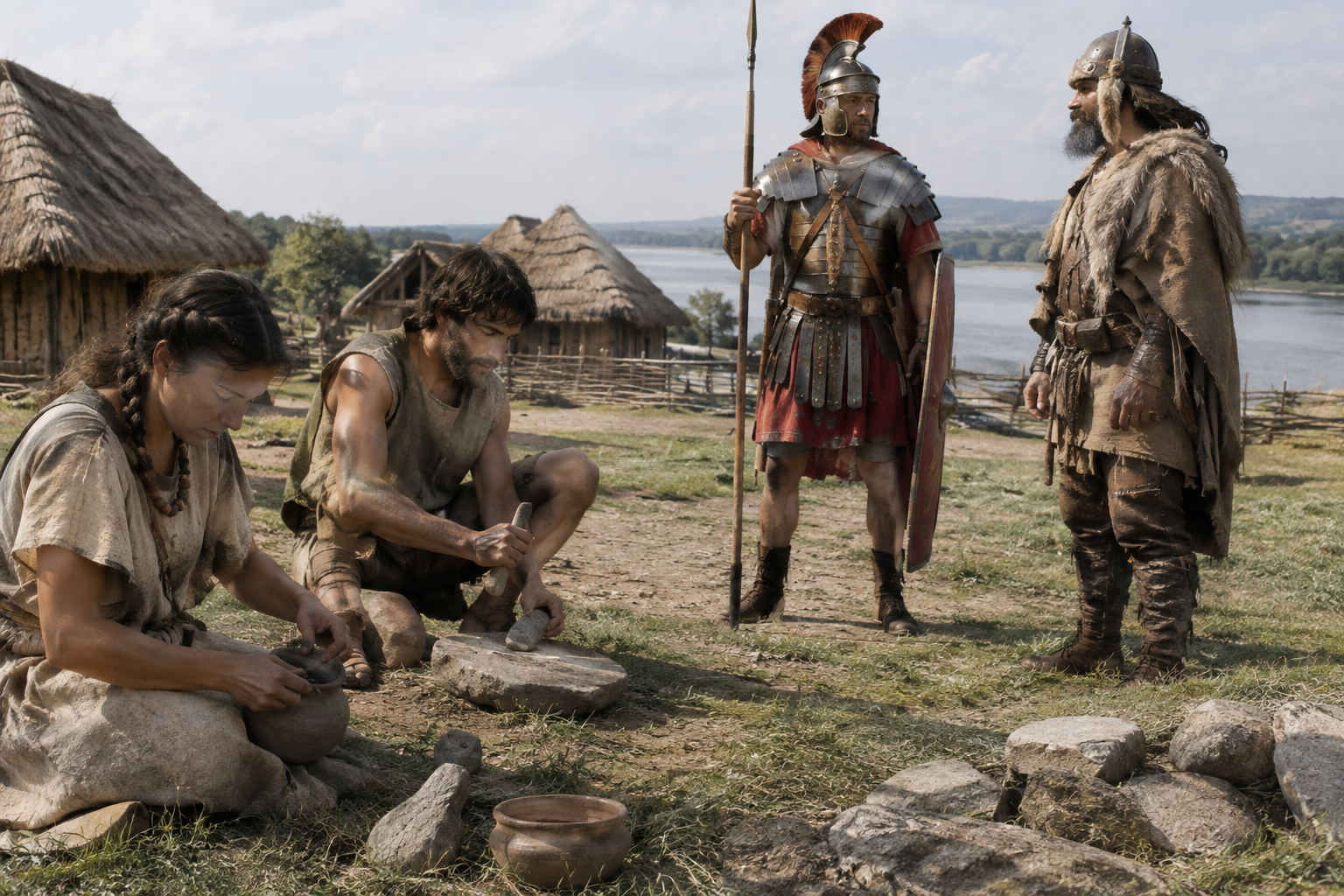
By the Roman imperial period, T1a1 appears in a very different historical landscape. Sample BOG019, dated here to about AD 225, comes from Boğazkale in Galatia, Anatolia. This was a world of provinces, roads, military recruitment, urban centers, and mobile populations. In other words, exactly the kind of environment where a paternal lineage with older eastern Mediterranean roots might persist, spread, or reappear in new local combinations.
What matters about an Anatolian Roman-era example is not just geography, but continuity of setting. Anatolia had been one of the great demographic engines of the ancient world for millennia, and Roman rule did not erase that depth. A related MyTrueAncestry discussion, All Roads Lead to Rome - the DNA Journey from Anatolia, explores the wider significance of Anatolian ancestry in the Roman sphere, and T1a1 sits very comfortably within that larger story.
Research on Roman and adjacent Mediterranean populations has repeatedly shown that these communities were anything but isolated. One relevant line of work on ancient Italian and island populations can be found in https://www.sciencedirect.com/science/article/pii/S0960982222018243, which helps frame the sort of mobility and mixture that make lineages like T1a1 historically intelligible in the Roman age.
Another especially revealing sample is I7453 from Lilybaeum in western Sicily, dated here to around 350 BC in the Carthaginian era. Lilybaeum was no sleepy backwater. It was one of the key strongholds of Punic Sicily, tied into the commercial and military networks of the western Mediterranean. A T1a1-associated male lineage in that setting fits a world shaped by seafaring, colonial foundations, mercenary movement, and dense contact between North Africa, Sicily, and the broader Mediterranean.
Again, caution matters. A Punic-era individual carrying T1a1 does not make the haplogroup "Phoenician" in any simple or exclusive sense. But the Lilybaeum sample does show that this paternal branch was present in one of the Mediterranean's most cosmopolitan regions at a historically important moment, when Carthaginian and Greek spheres overlapped and Rome was about to redraw the political map.
That wider Sicilian picture is worth placing beside our coverage of Paleogenomics of Ancient Italian Islands and Diverse Origins of the Ancient Punic People. Both themes matter here: islands preserve local continuity, but they also magnify mobility.
On the evidence here, T1a1 is most interesting not as a badge of one people, but as a marker of long-term connections between the Levant, Anatolia, the Mediterranean, and the first farming societies of Europe. Peqi'in Cave gives it a convincing eastern Mediterranean setting; Derenburg, Trebur, and Asparn-Schletz place it among early European farmers; Boğazkale and Lilybaeum show it still present in the connected worlds of empire and maritime exchange thousands of years later.
For someone researching a T1a1 paternal line today, that does not produce a single straight pedigree into one named ancient population. What it does offer is a historically grounded possibility: your direct male line belongs to a branch that appears, at least in the current evidence here, in some of the very networks that linked the earliest farmers of Europe with the older civilizations of the Near East and the Mediterranean.
Comments