Haplogroup R1b8

– 5 min read


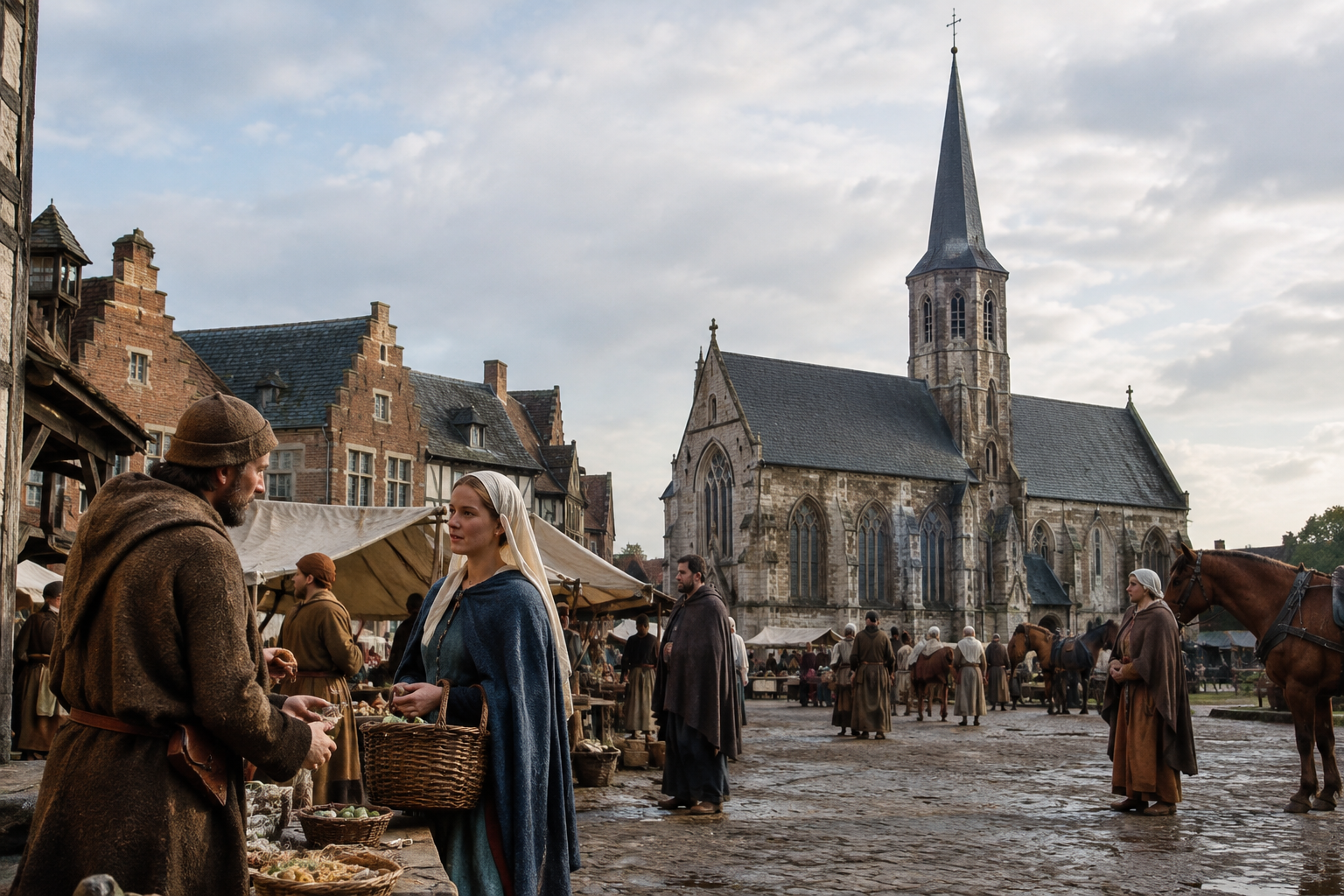
At Sint-Truiden in medieval Belgium, two men dated to around AD 900 stand out for a very specific reason. One, sample ST1803, came from Sint-Truiden Groenmarkt; the other, ST2241, from the Onze-Lieve-Vrouwekerk. Both have been associated with the Y-DNA haplogroup R1b8, a small detail on paper, but one that becomes interesting when the archaeology is set beside the history of an early medieval town taking shape in the old Frankish world.
That is the right scale on which to approach R1b8 here: not as a grand civilizational banner, and not as a shortcut to ethnicity, but as a paternal line glimpsed in a specific place at a specific time. Y-DNA follows one direct male line only, yet even that narrow thread can be revealing when it appears in well-contextualized burials from an urbanizing landscape.
Sint-Truiden was no remote hamlet. By the early Middle Ages it belonged to a zone of monasteries, market growth, local lordship, and Christian burial practice that helped define the southern Low Countries after the end of Roman rule. Around AD 900, this was a region shaped by Carolingian inheritance, ecclesiastical institutions, and the practical realities of settlement continuity.
The two R1b8-linked men come from different burial settings within the same town: ST1803 from Groenmarkt and ST2241 from Onze-Lieve-Vrouwekerk. That matters. It suggests that the lineage was present within the community, but not in a way that can simply be reduced to one grave cluster or one family tomb. Medieval towns were social mosaics, and the same paternal branch can appear in more than one context without implying dynastic dominance.
A recent ancient DNA study on medieval Sint-Truiden examined exactly this larger question of how urban communities formed and how genetically mixed, or homogeneous, they could become over time. The research behind these burials can be found here: https://genomebiology.biomedcentral.com/articles/10.1186/s13059-025-03580-z.
R1b is one of the major Y-chromosome families of western Eurasia, but that broad fact is not enough on its own. R1b8 is a narrower label, and the important point is to keep it narrow. We should not lazily pour the whole prehistory of R1b into these Sint-Truiden burials, nor pretend that one branch automatically identifies a language, a people, or a political allegiance.
What the Sint-Truiden evidence does show is that a paternal line classed here as R1b8 was present in an early medieval Belgian community around AD 900. That places the branch firmly inside the lived world of post-Roman northwestern Europe: churchyards, market settlements, regional mobility, and populations whose ancestry was already the product of many earlier layers.
In other words, this is not a story about an isolated lineage arriving fully formed out of nowhere. It is a story about one paternal branch embedded in the population of a medieval town whose people were already heirs to Roman provinces, Frankish kingdoms, and older prehistoric movements now long invisible without DNA.
There is a temptation, whenever two men in the same town share a haplogroup label, to turn them into close relatives or representatives of a leading house. Archaeology is usually less tidy than that. Unless a study demonstrates close kinship directly, two men sharing a Y-line in the same town may reflect anything from a wider local lineage to a more distant paternal relationship spread across generations.
ST1803 and ST2241 are therefore most useful as evidence of recurrence rather than proof of pedigree. The recurrence matters because it hints that R1b8 was not a one-off curiosity in Sint-Truiden. Yet the evidence is still local and limited. These two burials illuminate a community; they do not define all of medieval Belgium.
This is one reason ancient DNA is at its best when used with restraint. A pair of graves can sharpen the outline of a town's demographic history, but they cannot, by themselves, map the full spread or origin of a branch. The value lies in the grounded context: named samples, dated burials, real places.
Sint-Truiden sat within a region where continuity and mobility had long gone together. The Low Countries were never sealed off. Roman military and civilian networks had tied the area to the Rhine frontier and beyond; the post-Roman centuries did not erase those connections so much as rework them. By AD 900, people in towns like Sint-Truiden were living in landscapes already transformed by centuries of movement, resettlement, and institutional change.
That makes these R1b8 finds historically suggestive. A paternal lineage found in early medieval Belgium need not point to one dramatic migration event. It may just as plausibly reflect the normal accumulation of male lines in a region where ancestry had been blending for generations. The archaeology of northwestern Europe often shows precisely that sort of continuity-with-change rather than simple replacement.
Several MyTrueAncestry features have explored this broader frontier world from different angles, including post-Roman and Roman-period communities in adjacent regions. Together they offer a helpful backdrop for understanding why a medieval Belgian Y-line should be read as part of a layered population history rather than a neat ethnic label.
Roman-Barbarian Frontier Blending
The sites themselves deserve attention. Groenmarkt and Onze-Lieve-Vrouwekerk are not just coordinates on a map; they represent burial in a Christianized urban environment. By around AD 900, burial space was increasingly bound up with church institutions, community identity, and the social geography of the town.
When a paternal lineage appears in such settings, it places that line within established local society. Not necessarily elite society, and not necessarily an old local dynasty, but within a community structured by parish life, ecclesiastical authority, and the rhythms of an early medieval settlement. This is a different kind of evidence from a warrior cemetery, an isolated rural grave, or a princely mausoleum. It is evidence for ordinary historical embedding.
That may sound modest, but modesty is exactly what makes the result useful. Too much haplogroup storytelling chases spectacular origins and misses the middle ground where most people actually lived: in towns, near churches, within communities that were stable enough to bury their dead in recognized places yet connected enough to absorb older and wider ancestry streams.
For someone researching a present-day R1b8 paternal line, the Sint-Truiden burials offer something solid and specific: this branch, or a reported association with it, appears in real early medieval men from Belgium around AD 900. That does not turn every modern bearer into a descendant of these individuals, still less into a member of any noble house. What it does provide is a historically grounded glimpse of the branch within the urbanizing society of the early medieval Low Countries.
In that sense, R1b8 is most interesting here not as a mythic origin story but as evidence of continuity inside a lived medieval world. Two named burials, two sites in one town, and one paternal thread running quietly through them: that is often how ancient DNA is at its most persuasive.

Comments