Haplogroup R1b3

– 5 min read


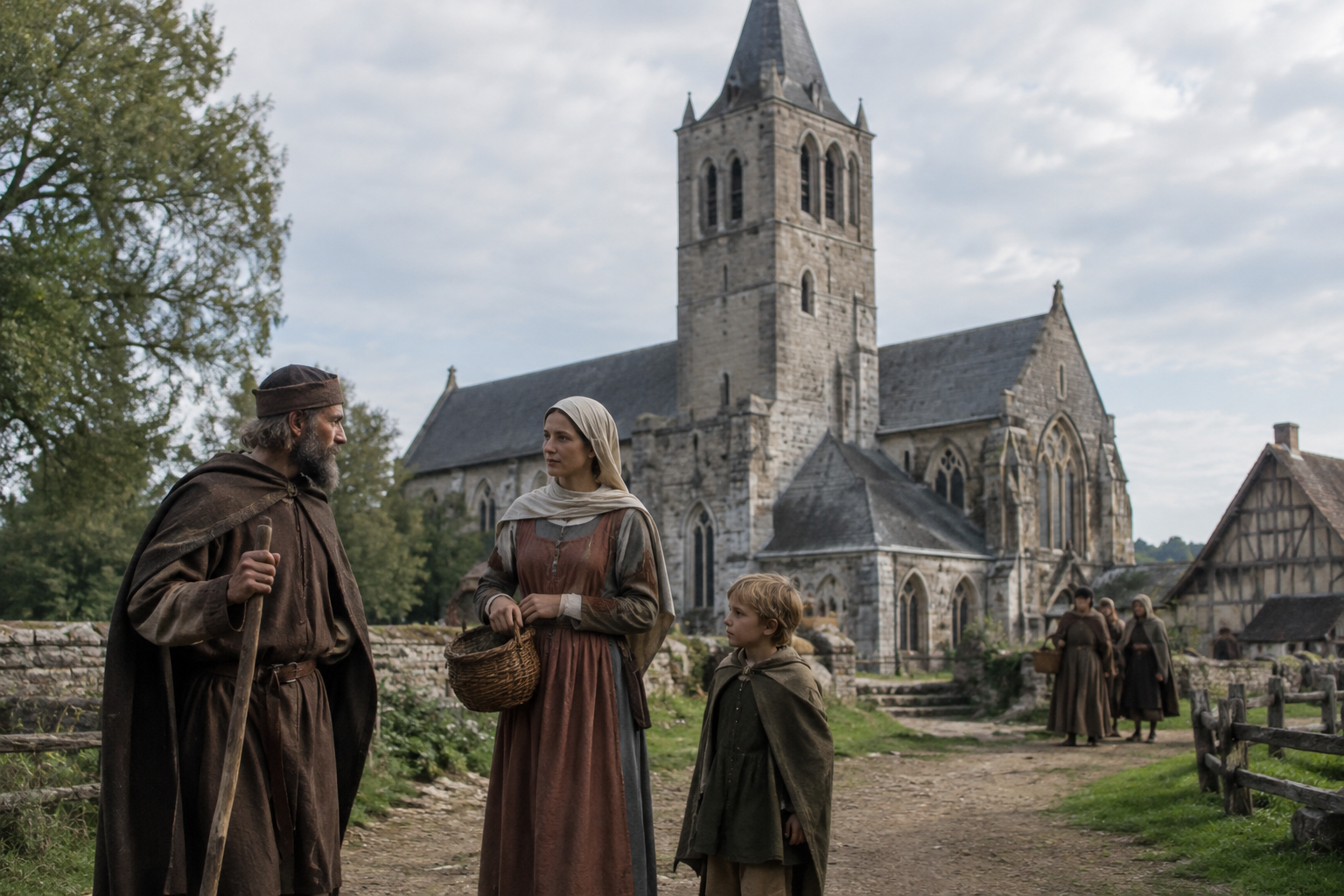
In the church of Onze-Lieve-Vrouwekerk at Sint-Truiden in medieval Belgium, one buried man stands out precisely because he did not quite belong. The individual identified as ST0572, dated to around AD 900, was classified as an "outsider" in a study of the town's early medieval population. That label is archaeologically more interesting than it may sound. It places one paternal line, reported here under R1b3, inside a growing Christian town whose burial ground was already drawing people from beyond its immediate local community.
Sint-Truiden was no remote hamlet. In the early Middle Ages it was an important ecclesiastical and urban center in what is now Belgian Limburg, part of the busy zone between the Meuse and Rhine worlds. A man like ST0572, buried in church context yet genetically distinguishable from the local majority, reminds us that Y-DNA traces only one direct paternal line, but that line can still illuminate movement, settlement, and belonging in a place where medieval identities were being constantly remade.
The most useful way to understand R1b3 here is not to begin with sweeping origin stories, but with the town itself. Sint-Truiden grew around an abbey foundation and became part of the densely connected network of settlements that linked the Carolingian and post-Carolingian Low Countries. By about AD 900, churchyards like that of Onze-Lieve-Vrouwekerk were no longer serving only a tiny local kin group. They served clergy, townspeople, dependents, travelers, and newcomers.
An ancient DNA study examining these burials, published in Genome Biology, focused on urbanization and genetic structure in medieval Sint-Truiden. Even without forcing more precision than the evidence allows, the appearance of ST0572 in this context matters because it points to mobility in a town often imagined as stable and parochial. Medieval cemeteries were not simply mirrors of one isolated village population.
The label "outsider" should also be handled carefully. It does not mean stranger in the dramatic sense, nor does it prove a specific homeland, language, or ethnic identity. It means that, within the analytical frame of the study, ST0572 showed signals that set him apart from the main local pattern. That alone is enough to make him valuable evidence for the social history of the region.
R1b3 is the haplogroup identifier attached to this article, but one should be cautious with such labels. Haplogroup names can reflect different levels of resolution in different datasets and naming systems, and ancient samples are not always typed down to the fine terminal branch used in modern testing. For that reason, it is safest to say that ST0572 is associated here with the broader paternal branch reported as R1b3, rather than pretending we have a neat dynastic-grade lineage label from one burial.
That caution does not make the evidence dull. On the contrary, it brings the real historical question into focus: how did paternal lines associated with wider western European R1b diversity circulate through early medieval towns? In a place like Sint-Truiden, the answer is unlikely to be a single migration event. It is more likely to involve generations of movement through marriage, service, trade, church networks, and the shifting political landscapes of the post-Carolingian world.
In other words, R1b3 here is best read as a thread in an urban story. Y-DNA can show continuity of a male line, but it cannot by itself tell us whether ST0572 spoke an early Romance dialect, a Germanic one, both, or neither; whether he arrived from nearby or from far beyond; or whether his family had been mobile for centuries. Archaeology and historical setting have to do the rest of the work.
Early medieval Belgium sat in a landscape that modern borders badly obscure. This was a contact zone between older Roman provincial frameworks, Frankish political power, monastic institutions, and regional communities shaped by river routes and local lordship. The Meuse-Rhine region was full of movement: soldiers, clerics, merchants, craftspeople, and peasants all moved through it, even if not all left written records.
That is why a burial like ST0572 is historically plausible in a very grounded way. He need not have been a heroic migrant from some distant horizon. He may instead represent the ordinary but profound mobility that made medieval towns what they were. The churchyard catches that process in miniature: a community burying its dead in sacred ground, while the DNA shows that not every person interred there came from the same close ancestral pool.
This wider regional pattern has parallels in other work on frontier and post-Roman populations around the Lower Rhine and neighboring zones, where archaeogenetics increasingly reveals a messy, mixed human reality rather than tidy textbook peoples. That does not make ST0572 a Roman, a Frank, or anything else by genetic decree. It does make him part of a landscape in which ancestry, culture, and political identity did not map neatly onto one another.
One of the temptations in haplogroup writing is to leap from a single male-line assignment to a large-scale ethnic tale. But ST0572 is more useful than that. Because the sample is tied to a named church site, a date around AD 900, and a study concerned with urban population structure, he gives us a more disciplined insight: paternal diversity was present inside an early medieval Christian burial community in Sint-Truiden.
That may sound modest, but modest evidence is often the most durable. It tells us that by the turn of the first millennium, communities in the Low Countries were already incorporating men whose ancestry did not match the dominant local genetic profile. The burial ground was not simply the resting place of one unbroken village lineage. It was part of an urbanizing social world.
Seen that way, R1b3 is not a badge of ethnic purity or a shortcut to tribal identity. It is a marker that helps recover the lived consequences of medieval mobility. Someone carrying that paternal line was present in a church-centered community at Sint-Truiden, participating in the same sacred and social landscape as his neighbors even while retaining a distinguishable ancestral signal.
Germanic Languages and Genomics
For people researching their own paternal ancestry, the key lesson is not that ST0572 was "your ancestor" in any direct sense. It is that a lineage reported here as R1b3 was present in the urbanizing Low Countries during the early medieval period, and in a context that hints at movement rather than isolation. That makes this sample especially relevant for anyone whose paternal story may lie in the long history of circulation across northwestern Europe.
The Sint-Truiden evidence also fits a bigger archaeological truth: medieval Europe was knitted together by mobility at many scales. Some men crossed frontiers as retainers or clerics, some married into new communities, some moved between rural and urban worlds, and many left no written trace at all. Ancient DNA occasionally gives one of them back to us. In ST0572, associated with R1b3, the result is not a legend of conquest but something better: a real man in a real burial ground, showing how early medieval towns were built from more than one local line.

Comments