Haplogroup R1b1a2a1

– 5 min read


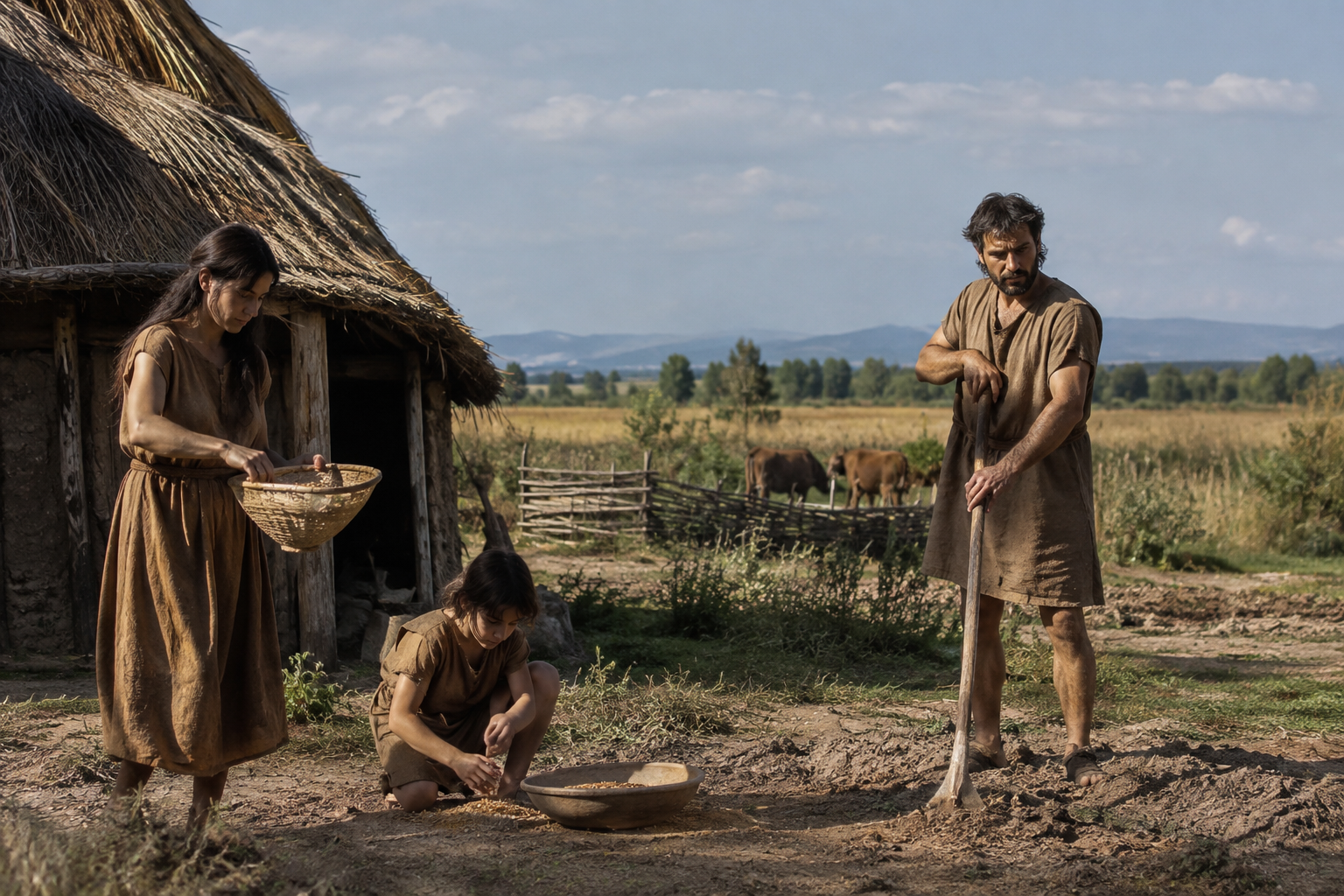
At Olmo di Nogara in northern Italy, one Late Bronze Age individual identified as 9323_Oss offers a small but telling glimpse into a much larger paternal story. Dated to around 1250 BC, this burial belongs to a world of fields, settlements, exchange networks, and formal treatment of the dead in the Po Valley. The reported Y-DNA association here is R1b1a2a1, a branch within one of western Eurasia's major paternal lineages.
That matters because a single Y-chromosome result, even from one man, can place a direct paternal line inside a real archaeological setting rather than a vague map of modern frequencies. In this case, the setting is not a legendary dynasty or a named conqueror, but Late Bronze Age Italy: a period when communities in the north of the peninsula were already tied into wider European systems of movement, metalwork, and social change.
Olmo di Nogara is one of those places that rewards close attention. It sits in the Verona area, in the broad and fertile Po Valley, a region that was heavily occupied in later prehistory and deeply connected to developments across continental Europe. By about 1250 BC, northern Italy was not isolated at all. It was part of a landscape shaped by farming, exchange, and shifting local hierarchies.
The sample 9323_Oss belongs to that landscape. The available record ties him to the Late Bronze Age and to the haplogroup label R1b1a2a1. We should be careful here: that does not automatically give us a very fine terminal subclade, nor does it tell us his language, status, or exact community role. What it does give us is a direct paternal marker anchored to a documented burial context in prehistoric Italy.
Researchers working on late prehistoric Italian funerary evidence have used sites like Olmo di Nogara to ask broader questions about community structure and social inclusion. One research lead associated with this material is this study on late prehistoric Italy and burial evidence, which shows the sort of archaeological framework in which such individuals are being examined.
R1b1a2a1 is a paternal-line label, tracing one line of descent from father to son. It is only one thread in any person's ancestry, but it is a particularly useful one for studying how male lines appear, persist, or change across archaeological periods.
In broad terms, R1b lineages are well known in later European prehistory, especially after the major demographic changes of the 3rd and 2nd millennia BC. But it is important not to pour the whole history of R1b into this narrower label as if every branch behaved identically everywhere. The significance of 9323_Oss is local and contextual: it shows that a paternal line reported as R1b1a2a1 was present in Late Bronze Age northern Italy, among real communities living in a region that linked the Alps, the Adriatic, and the wider European plain.
That fits a pattern archaeologists have been refining for years. The Bronze Age was not simply an age of objects moving around; people moved too, and sometimes lineages spread with them. Yet local continuity also mattered. A Y-DNA result from one burial cannot, by itself, prove a mass migration or identify a tribe. It is best read as evidence of who was there, in one paternal sense, at one particular place and time.
For many readers, Italy's past begins mentally with Etruscans, Greeks, and Romans. Genetics keeps reminding us that the deeper foundations are older and more regionally varied. By the Late Bronze Age, centuries before Rome became a major power, northern Italy already contained long-established populations shaped by earlier Neolithic and Bronze Age transitions.
The Po Valley was especially important because it was a corridor as much as a homeland. Routes across the Alps connected Italy with central Europe, while river systems and overland paths linked communities across the plain. When a paternal lineage like R1b1a2a1 turns up here, it belongs to that connected world: not necessarily to dramatic invasion, but to the slow, cumulative building of prehistoric networks.
That wider Italian context has become clearer through ancient DNA from multiple regions and periods. For readers interested in how these regional histories continued to develop long after the Bronze Age, the later genomic picture in the peninsula is explored in related work on ancient Amiternum from Roman to early medieval Italy.
There is a temptation, with ancient DNA, to prefer royal tombs, mass graves, or spectacular cemeteries. But ordinary archaeological individuals often do more honest historical work. 9323_Oss matters precisely because he is not propped up by later legend. He places this paternal branch in a specific Late Bronze Age community in Italy, and that is solid ground.
From a public-history point of view, this is rather refreshing. Instead of pretending that every haplogroup result points straight to a famous family or a heroic migration, the evidence asks us to think about settlement history, local burial practice, and regional population structure. A man buried in the Verona area around 1250 BC may tell us less about prestige, but more about the real human background of European paternal ancestry.
That same lesson appears again and again in archaeogenetics: lineages become meaningful when tied to context. Similar questions about population continuity, mobility, and regional mixture appear in studies of central and western Europe during the Bronze and Iron Ages, including discussions of how burial evidence and genetics can be read together.
Placed in a bigger frame, this Olmo di Nogara result belongs to the long reshaping of European paternal lineages after the Copper Age and into the Bronze Age. Italy did not experience that process in exactly the same way everywhere. Island populations, mountain zones, central Apennine communities, and the great northern plains all had their own local histories.
That is why each securely placed ancient sample is useful. A northern Italian Bronze Age man associated with R1b1a2a1 helps fill in the paternal map before the classical world, before Latin expansion, and before medieval dynasties that later dominate written history. If your own paternal line falls under this branch or one near it, the value of the match is not that it identifies a famous ancestor. It is that it places your deep father-line among the kinds of populations already established in prehistoric Europe and present in Late Bronze Age Italy.
Readers interested in how ancient DNA is clarifying broader Italian regional history may also enjoy the work on Etruscan origins and change in Bologna, which explores another northern Italian setting where archaeology and genetics meet.
The strongest insight from R1b1a2a1 here is not romance but placement. At least one direct paternal line associated with this branch was present in northern Italy around 1250 BC, in the settled Bronze Age world of Olmo di Nogara. For someone researching a modern paternal line, that does not promise descent from a named house or a single prehistoric people. It does, however, offer something better grounded: a genuine ancient foothold for this lineage in the human landscape of pre-Roman Italy.
Comments