Haplogroup R1b1a1b1b3

– 6 min read


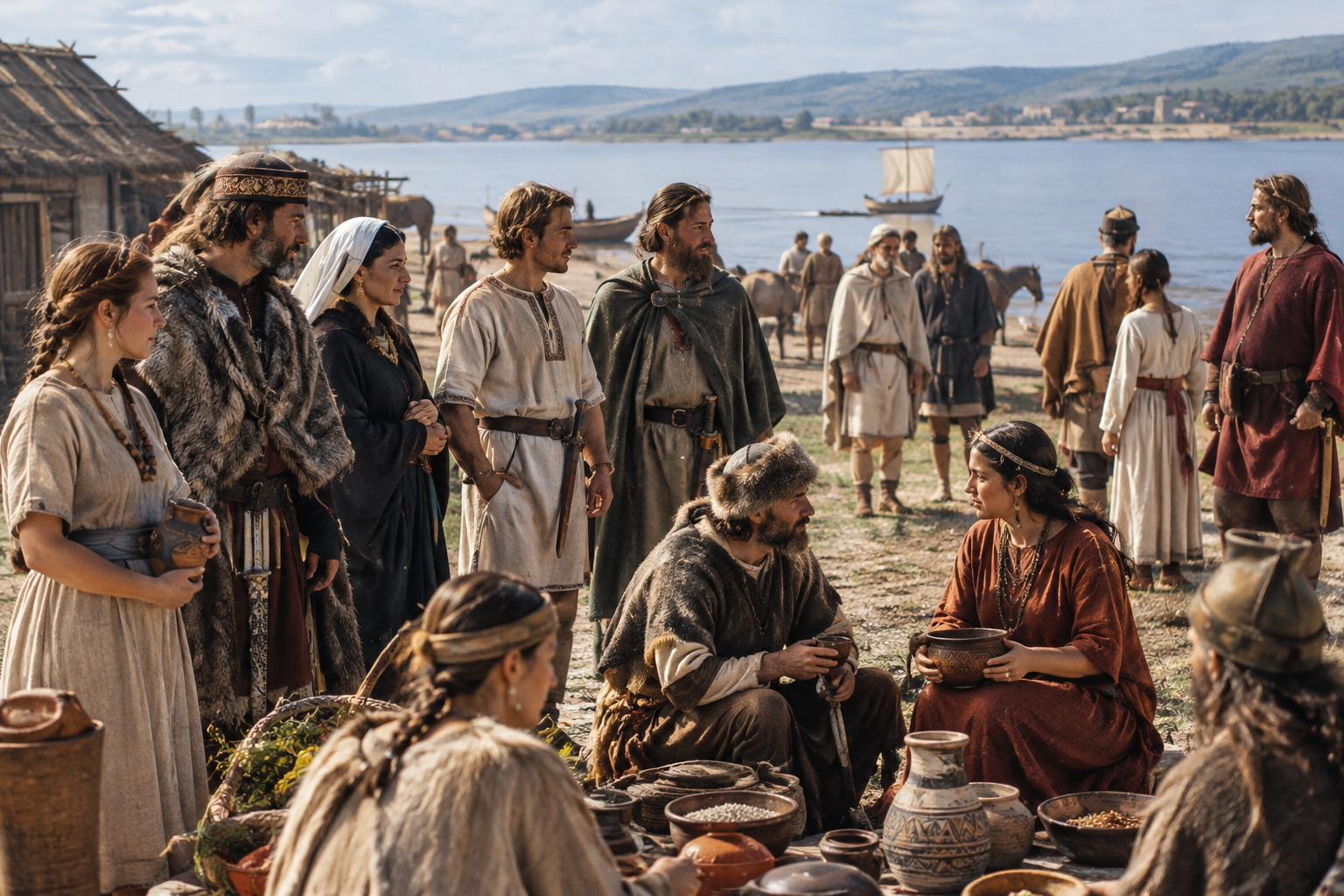
Some Y-chromosome lineages seem to sit quietly in the background of history until ancient DNA brings them into sudden view. Haplogroup R1b1a1b1b3 is one of those cases. It appears in a striking spread of archaeological contexts: among steppe-associated burials in Bronze Age Hungary and Moldova, in Afanasievo-related individuals deep in the Altai, in Central European Bronze and Iron Age contexts, and later in Mediterranean settings as varied as Phoenician-era Sicily and medieval Ibiza.
That is exactly what makes it interesting. Not because it tells a simple story - it does not - but because it helps us watch paternal lineages move through very different worlds: wagon-using herders on the Eurasian steppe, early Bronze Age communities in Central Europe, Iron Age populations in Bohemia and Hungary, and later the mixed societies of the Mediterranean. As ever, Y-DNA traces only one direct paternal line, not a person's whole ancestry. But that single line can still be a powerful historical clue.
R1b1a1b1b3 belongs within the wider R1b family, one of the major Y-chromosome groupings found across large parts of western Eurasia in both ancient and modern populations. For readers not steeped in phylogenetic jargon, a haplogroup is simply a branch on the paternal family tree of humanity, defined by inherited mutations passed from father to son.
For a branch this specific, caution matters. We should not lazily dump onto R1b1a1b1b3 every grand claim ever made about all R1b lineages. What the supplied evidence does support is that this branch, or closely related paternal lines, appears in contexts strongly tied to steppe-linked Bronze Age expansions and then later in a broad arc stretching into Central Europe and the Mediterranean. Ancient DNA is what allows us to see that pattern, sample by sample, burial by burial.
Explore North Pontic migrations
The earliest supplied appearances of this haplogroup sit in landscapes that archaeologists have long treated as crucial to Bronze Age mobility. One example is I7847, from Early Bronze Age Moldova Yamnaya Ciumai Taraclia, dated 2960 BC. Another is I2761, from Early Bronze Age Hungary Yamnaya Ketegyhaza-Torokhalom-Kishalom, dated 2578 BC. Even without overclaiming, those two burials matter. They place this paternal line in Yamnaya-associated settings on both the steppe fringe and within the Carpathian Basin, a region that became one of Europe's great crossroads.
Then the story stretches dramatically east. The supplied Afanasievo-related individuals are especially revealing: I5277 from Early Bronze Age Elo bashi Afansievo Culture dated 3000 BC, I5273 from Early Bronze Age Lower Tyumechin Afansievo Culture dated 2950 BC, I5269 from Afanasievo Elo Altai Republic Russia dated 2956 BC, and I3952 from Afanasievo Karasuk Khakassia Russia dated 2717 BC.
That distribution is a historian's delight. In plain terms, it shows closely related paternal ancestry appearing not only in eastern Europe but also far into the Altai and Minusinsk Basin world. This does not mean every one of these men belonged to the same recent family. It does suggest that the wider paternal stock behind this branch was part of the human movements linking the Pontic-Caspian world with Inner Asia during the Early Bronze Age.
If you want a broader look at that eastern dimension, MyTrueAncestry readers may also enjoy the work gathered in Ancient DNA and Genetic History of the Mongolian Steppe, which helps frame how steppe mobility can connect regions that seem, on a modern map, extraordinarily far apart.
Discover the Mongolian steppe story
The next act unfolds in Central and northwestern Europe, and it is here that R1b1a1b1b3 becomes particularly useful for thinking about continuity and reshuffling. We find I13467 at Bronze Age Mala Ohrada CWC Central Bohemia, dated 2463 BC. "CWC" points to the Corded Ware cultural horizon, long central to debates about the spread of steppe-derived ancestry into Europe.
Not far away in historical terms, though separated by centuries, stands I13026 from Early Bronze Age Bell Beaker Molenaarsgraaf Netherlands, dated 1890 BC. Bell Beaker contexts are among the most discussed in European archaeogenetics because they helped transform the paternal landscape of much of western and central Europe. Again, we should not pretend one subclade explains the whole phenomenon. But this sample shows that the lineage was present in that world too.
By the Iron Age, the line still appears in Central Europe: I14983 from Iron Age Hallstatt Lovosice NW Bohemia, dated 550 BC, and I4996 from Iron Age Vas County Hungary, dated 296 BC. Hallstatt immediately evokes early Celtic archaeology, though one must not equate a haplogroup with a language or ethnic label. What these finds do show is that this paternal branch, or very near relatives, persisted through the changing societies of Bohemia and the Carpathian region from the Bronze Age into the Iron Age.
That long Central European backdrop makes this related article especially relevant for readers who want the wider setting of these later prehistoric populations: Ancient DNA Reveals Central European Origins and Spread of Celtic Languages.
Read about Central European Celtic origins
Then comes a splendid twist. This same haplogroup turns up not only in steppe and Central European burials, but also in later Mediterranean contexts. I24680, from Phoenician Era Mozia Sicily, dated 805 BC, places the lineage in one of the great contact zones of the ancient sea. Mozia was a Phoenician settlement in Sicily, a place of merchants, sailors, colonists, and cultural mixture. A Y-chromosome lineage there is not a badge of a single identity; it is a reminder that Mediterranean communities were peopled by men whose deeper paternal origins could reach in many directions.
The same is true of ldo131, from Medieval Ibiza Al-Andalus, dated 950 AD. Medieval Ibiza belonged to a connected Islamic Mediterranean world, linking Iberia, North Africa, and the islands between. This sample does not prove some neat unbroken paternal chain from Yamnaya camps to Andalusi Ibiza. But geographically and historically, it shows how lineages that once appear in Bronze Age steppe-connected settings can later be found in thoroughly urban, maritime, and multi-faith societies.
Readers interested in that island world should follow up with Genetic and Disease Diversity in Medieval Islamic Ibiza Burials, which offers a wider view of the population setting behind samples like ldo131.
The supplied noble-family field is empty, and that absence is worth saying aloud rather than papering over. Too often, discussions of haplogroups rush from ancient burials to castles and dynasties as if one automatically explains the other. It does not. Without specific family data here, the responsible thing is not to invent clans, castles, or heraldic lineages for R1b1a1b1b3.
Still, the historical lesson is an important one. Many medieval and early modern noble houses sat in regions where steppe-derived and Central European paternal lineages had been present for millennia. Genetics can illuminate the long population history of those regions, while charters, chronicles, and castle remains illuminate the much later political families who controlled them. Those are different kinds of evidence, and they complement one another best when kept distinct.
If you enjoy that intersection between dynastic history and DNA, one especially relevant example from the MyTrueAncestry archive is Ancient DNA reveals Hungary's Arpad dynasty burials. It shows what it looks like when written history and genetic evidence really can be brought into direct conversation.
See dynastic DNA in medieval Hungary
So what does R1b1a1b1b3 reveal? Above all, range. It appears in Yamnaya-associated contexts in Moldova and Hungary, in Afanasievo-related burials in the Altai, in Bronze Age Bohemia and the Netherlands, in Iron Age Bohemia and Hungary, and later in Sicily and Ibiza. That is not a tidy origin story for a modern nation, ethnicity, or surname. It is something more interesting: evidence that one paternal branch participated in the enormous reshaping of Eurasian populations from the Bronze Age onward.
Ancient DNA also reminds us how limited written genealogy can be. Medieval documents may preserve the names of lords, abbots, tax collectors, and kings, but not the far older movements that shaped the paternal lines of ordinary and elite men alike. Conversely, Y-DNA can map deep paternal relationships while saying nothing by itself about language, status, or personal identity. Put together, though, archaeology, history, and genetics let us see the past in sharper focus.
If your own Y-DNA falls somewhere within the broad R1b world, discoveries like I7847, I2761, I5277, I13467, I14983, or ldo131 may help you place that paternal line in a much bigger historical frame. Not as proof that you descend from any one ancient man or any noble family, but as evidence that your direct paternal line belongs to a story stretching from Bronze Age steppe movements to the crowded ports and settlements of later Europe.
MyTrueAncestry lets you compare your DNA with ancient individuals and historical populations from sites like these, helping you explore where parts of your ancestry may fit into the human past. Those matches do not by themselves prove direct descent from a specific ancient person or membership in a royal or noble house, but they can offer a fascinating window into the worlds your ancestors once inhabited.
Comments