Haplogroup R1b1a1b1b

– 6 min read


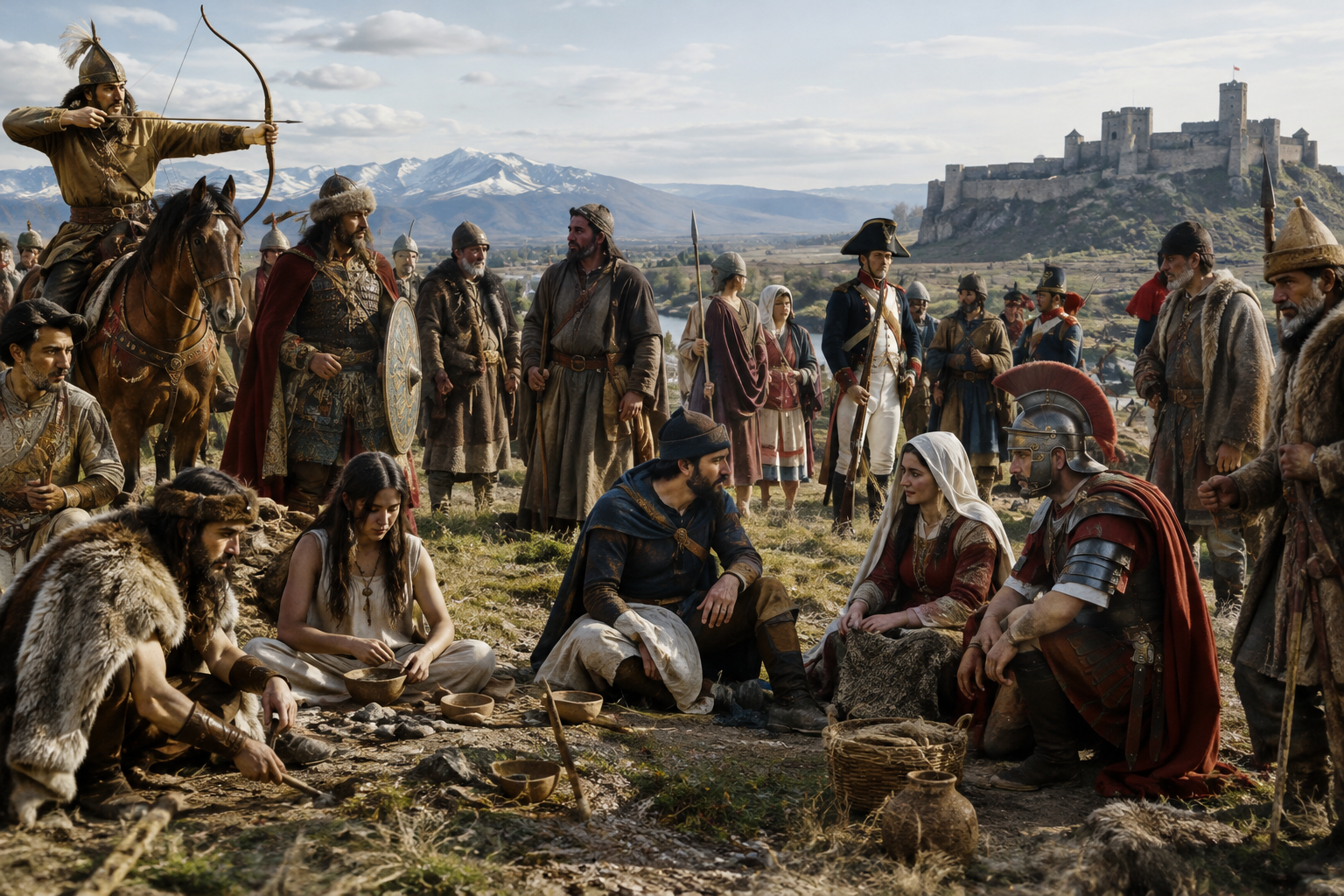
Haplogroup R1b1a1b1b sits in one of the most historically consequential branches of the Y chromosome, but its interest lies not in grand slogans about "the R1b story" so much as in the scatter of real men who carried related paternal lines across an enormous stretch of time and landscape. When ancient DNA places this lineage in the Caucasus, on the Eurasian steppe, in Bronze Age Hungary, in Iron Age Armenia, in Roman frontiers, and later in medieval and early modern contexts, it gives us something much better than myth: a map of movement, survival, and reshaping.
As ever with Y-DNA, a small caution is needed at the start. A Y haplogroup tracks one direct paternal line only: father to father to father. It does not represent a person's total ancestry, identity, language, or ethnicity. And with a relatively specific branch such as R1b1a1b1b, we must be careful not to dump the whole history of broad R1b onto it uncritically. Still, the ancient samples linked to this branch show a striking pattern. They place related paternal lines in precisely the zones where archaeologists and historians have long watched populations meet: the North Caucasus, the Pontic-Caspian steppe, the Carpathian Basin, the Balkans, Italy, Britain, Armenia, and Iran.
The earliest horizon in this dataset points east of Europe proper, toward the Caucasus and the steppe world beside it. One notable sample is ESY010, from Neolithic Russia Caucasus Essentukskiy Maykop, dated to 3600 BC. Another is KMM002, from Early Bronze Age North Caucasus Komsomolec, dated to 2800 BC. These do not prove a single homeland in any simplistic sense, but they do place this paternal line in one of the key contact zones of prehistory, where farming societies, herding groups, and mobile elites interacted intensively.
Then the steppe evidence becomes harder to ignore. I0440, from Middle Bronze Age Poltavka Lopatino Samara Russia, dated to 2770 BC, and RK1001, listed as Steppes Yamnaya Bronze Age, dated to 2775 BC, place this branch or closely related paternal ancestry squarely in the world of steppe pastoralists. The Yamnaya horizon matters here not because it offers a neat origin story for every later European population, but because it marks a major phase of male-mediated mobility across Eurasia.
That movement is visible further west in the Carpathian Basin. I18101, from Early Bronze Age Hungary Yamnaya Kunhegyes-Nagyallas-halom Hajdu-Bihar, dated to 2750 BC, and I3511, from Early Bronze Age Hungary Yamnaya Hajdu-Bihar Puspokladany, dated to 2501 BC, show the line established in Hungary during the period when steppe-linked ancestry was becoming part of the region's population history. Add I2787, Bronze Age Szigetszentmiklos-Felso-Urge Hungary, dated to 2350 BC, and the picture becomes one of persistence as well as arrival.
For readers interested in the broader background to these transformations, the community article on the North Pontic zone is particularly useful.
Explore North Pontic migrations
If there is one thing this sample set makes wonderfully clear, it is that R1b1a1b1b was not confined to one neat cultural box. It appears in Moldova and Romania in samples such as I16707, Chalcolithic Romania Bodrogkeresztur Urziceni, dated to 4000 BC, I20077, Ancient Transnistria Moldova Stefan Voda Black Sea, dated to 2200 BC, I20083, Bronze Age Moldova Tiraspol Transnistria, dated to 2100 BC, and I10436, Corded Ware Culture Moldova Crihana Veche, dated to 1950 BC. That is already a reminder that paternal lineages can move through very different archaeological settings without belonging to just one of them.
But the eastern concentration is especially striking in Armenia and nearby Iran. Samples from Armenia include I16554 at Tekhut Cemetery (1130 BC), I16219 at Karashamb Cemetery (1048 BC), I18478 at Noratus (1000 BC), I16376 at Bover Cemetery (720 BC), I16117 at the same cemetery (489 BC), and a cluster from Urartian contexts such as I16191, I16193, and I16194 from Pijut, and I14053, I14054, I14055, I14056, and I14065 from the Bardzryal Complex. Nearby, Iran contributes Hasanlu samples including I4269, I4280, I4355, and I4356.
This is not the profile of a fleeting incursion. It suggests that related paternal lines were deeply embedded in South Caucasus and northwestern Iranian population history across the Late Bronze and Iron Ages. In other words, the branch was part of worlds that included fortified hill settlements, kingdoms such as Urartu, and the interconnected highland networks between the Black Sea and the Iranian plateau.
For a wider look at this landscape, see the MyTrueAncestry article focused on the South Caucasus over five millennia.
Read the South Caucasus DNA story
By the Iron Age and later, this haplogroup turns up in a rather lively cast of historical settings. There are steppe-linked warrior contexts such as UKR110, Scythian Iron Age Horse Archer Ukraine Vesele Kharkiv, dated to 350 BC, and UKR133, Scythian Nomadic Elite Warrior Psiochyn Kharkiv, dated to 400 BC. There is also Pr9, Early Sarmatian Eurasian Steppes, dated to 350 BC. These do not mean that the haplogroup was "the Scythian lineage"; ancient steppe societies were never that genetically simple. But they do show this paternal line traveling through, and perhaps prospering within, nomadic and semi-nomadic worlds north of the Black Sea.
Later still, the same broad paternal thread appears in Alan contexts: CGG021451 from Ekazhevo (360 AD) and CGG022003 and CGG022005 from Zaragizh (425 AD). Then comes UKR138 in the Burtas Region Caspian North Forest Steppes, dated to 850 AD, and UKR069 from a Golden Horde Era Donetsk Hill Fort, dated to 1350 AD. That is an extraordinary chronological spread across the wider steppe zone.
At the same time, the branch appears in the Roman and post-Roman worlds to the west. There is I15551 from Imperial Roman Serbia Timacum Kuline Ravna Village, dated to 241 AD, and I15515 from Late Roman Empire Viminacium Serbia Pirivoj Necropolis, dated to 225 AD. In Italy we find MAS002 from Late Imperial Roman Marsiliana dAlbegna (310 AD), 2069_121 from Dark Ages Italy South Tyrol Malles Burgusio Santo Stefano (450 AD), To_Lav_T90US339 from Dark Ages Italy Torino Lavazza (550 AD), and COL_106 and COL_106x from Lombard Era Collegno Northern Italy (580 AD).
These samples are a useful antidote to tidy ethnic narratives. A paternal line that may once have circulated in Bronze Age steppe and Caucasus settings later turns up in Roman provinces, migration-period communities, and early medieval Italy. Genetics does not erase the complexity of history; it usually increases it.
Readers interested in the steppe elite context will want to compare this with the community article on Iron Age Scythian rulers and their burial worlds.
One of the pleasures of this sample set is watching the lineage appear at Europe's far western margins too. In Roman and post-Roman Britain, we have WBK193, a Celtic Durotriges individual from Duropolis Winterborne Kingston, dated to 125 AD; C10271b and C10271c, Imperial Roman Britain Offord Cluny Outsider, both dated to 177 AD; and the Cornish material I16389 from Kingdom of Dumnonia Britain Cornwall Crantock Newquay, dated to 700 AD, alongside S16389 from Early Medieval Crantock Newquay Cornwall England, dated to 650 AD. In Spain, I30930 from Early Medieval Spain Zaragoza Epila Las Lomas del Molino, dated to 600 AD, extends the western range further.
Again, caution first: a shared haplogroup does not prove direct descent between a Bronze Age steppe herder and an early medieval Cornishman. But it does suggest that paternal lines connected to eastern prehistoric expansions could become part of very local, regionally rooted societies at the Atlantic edge.
That is exactly the sort of longue duree perspective ancient DNA is good at. Written genealogy usually begins late and focuses on elite families. Y-DNA and archaeology can show us that the ground beneath those later records was laid by much older movements and mixtures.
For a western provincial comparison, the Roman and later Iberian dimension is explored nicely in this related article.
Explore Roman Hispania's legacy
The supplied noble family field is empty, and that is worth saying plainly rather than papering over it. So there is no responsible way here to attach R1b1a1b1b to a named dynasty, castle, or aristocratic house from the input evidence. That may feel slightly frustrating, but it is actually a sign of good historical method. One should not conjure a baronial pedigree out of a haplogroup label.
Still, the absence of a named castle list does not leave us without a historical point. Many of the places represented by these samples later became landscapes of fortresses, princely courts, and noble estates: the Armenian highlands, the Serbian Danube frontier, Lombard Italy, Cornwall, and the Black Sea steppe. The castles and dynasties of those regions were built on populations already shaped by millennia of migration, continuity, and local adaptation. Ancient DNA helps us see beneath the masonry, as it were, to the deeper demographic history that written records usually ignore.
What makes R1b1a1b1b so interesting is not that it belongs neatly to one people, but that it stubbornly refuses to do so. The ancient evidence linked here ranges from ESY010 in the Caucasus and RK1001 on the steppe to I18101 in Yamnaya Hungary, I16193 in Urartian Armenia, COL_106 in Lombard Italy, and I16389 in early medieval Cornwall. That is a paternal history of movement, absorption, and persistence across radically different worlds.
For anyone carrying this haplogroup today, the lesson is not "you are Scythian" or "you are Yamnaya" or "you descend from Roman frontier soldiers." The lesson is subtler and, really, more interesting: your direct paternal line belongs to a branch that has been present in some of the most important crossroads of Eurasian history. Ancient DNA lets us glimpse where some of those men lived and died, even when it cannot name every family connection in between.
If you want to explore whether your own DNA shows connections to ancient individuals like ESY010, I18101, UKR110, or I16389, MyTrueAncestry can help place your results in this wider archaeological story. Those matches do not by themselves prove direct descent or membership in any noble lineage, but they can offer a remarkable window into the populations and historical worlds your ancestors may have been part of.
Comments