Haplogroup R1b1a1b1a1a4

– 5 min read


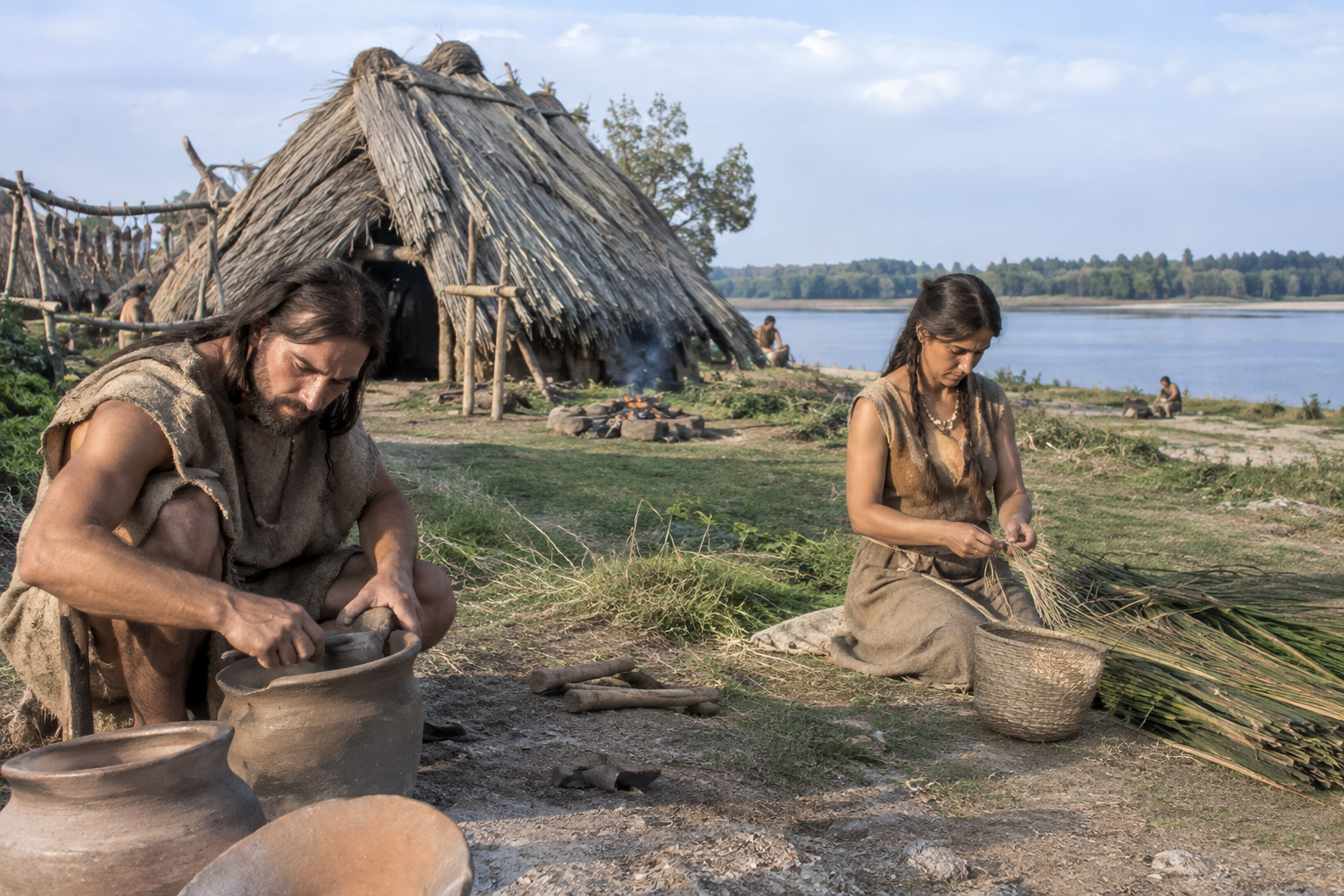
At Szigetszentmiklós in Hungary, two men buried around 2350 BC - sample IDs I7041 and I7043 - give us one of the clearest early archaeological footholds for the Y-DNA branch R1b1a1b1a1a4. That may sound forbiddingly technical, but the setting is anything but abstract: this is the Copper Age in the Carpathian Basin, a landscape already dense with movement, exchange, and social change.
What makes these burials so interesting is not that they let us tell a grand, simple story. Quite the opposite. They show how a very specific paternal line appears within a real prehistoric community at a moment when central and eastern Europe were being reshaped by new mixtures of ancestry, new burial customs, and new regional networks. Y-DNA tracks only one direct male line, not a person's whole ancestry, but that single line can still anchor a remarkably vivid historical question.
Szigetszentmiklós lies in the Hungarian Plain near the Danube, a region that has long been one of Europe's great corridors. By the later third millennium BC, this was already a meeting ground: the river connected communities, raw materials, and ideas across a wide zone stretching into central Europe and the Balkans. Burials from places like this matter because they show us actual individuals living through that transformation.
For haplogroup R1b1a1b1a1a4, the significance of I7041 and I7043 is straightforward. They place this paternal branch, or at least an assignment associated with it, in Copper Age Hungary at about 2350 BC. Even with only limited site detail in hand here, that is already historically valuable: it ties the branch to the Carpathian Basin during a period when male-line turnover and population restructuring were becoming major features of European prehistory.
An ancient DNA study of prehistoric Europe, published in Nature, helped establish just how important this era was for the spread and reshaping of steppe-derived ancestry and associated paternal lines. That broader context does not mean every R1b branch behaved in the same way, or that every man carrying one of them had the same identity. But it does explain why two men from one Hungarian site deserve close attention.
The label R1b1a1b1a1a4 is a narrow twig on the much larger R1b tree. That distinction matters. R1b as a whole has a vast and complicated history across Eurasia and later Europe, but one should not simply pour the entire history of R1b into this one subclade and call the matter settled.
What we can say, cautiously, is that the branch represented by these Szigetszentmiklós burials belongs to a paternal landscape that was becoming very prominent in later prehistoric Europe. In many regions during the later Copper Age and Early Bronze Age, archaeogenetics shows strong shifts in Y-chromosome patterns, often with a relatively small number of paternal lines becoming more visible in the burial record. That does not automatically tell us about language, status, or ethnicity. It tells us that direct male descent was part of the demographic story.
So if you carry R1b1a1b1a1a4 today, the useful historical point is not a fantasy of tracing yourself to one named "tribe." It is that your paternal line fits into a very old process visible in the Carpathian Basin and surrounding regions: one in which male-line continuity, migration, and local integration all seem to have mattered.
Ancient DNA can sometimes tempt us into thinking that a single sample is enough. Usually it is not. That is why having two individuals - I7041 and I7043 - from the same place and period is so helpful. Even without claiming they were close relatives, their presence reduces the chance that we are looking at a complete outlier with no local relevance.
Instead, the pattern suggests that this paternal branch had some foothold in the Szigetszentmiklós community or in the population from which that community drew its male lines. That is a more modest claim than saying there was a "dynasty" there, but it is also a more defensible and more interesting one. Archaeology is full of places where repetition matters: the second find often tells you that the first was not just an accident.
The date is important too. Around 2350 BC, the Carpathian Basin sat in a zone of overlap between older Copper Age traditions and the beginnings of Bronze Age social formations. Communities were not frozen units. They were absorbing newcomers, maintaining local practices, and participating in broad regional changes. A repeated Y-line in this setting hints at continuity within change.
Hungary's prehistoric importance is not an accident of modern sampling. The Carpathian Basin has repeatedly emerged in archaeology as a hinge region between worlds: the Balkans to the south, the central European plains to the west and north, and the steppe-connected zones further east. In periods of major population change, such places tend to preserve especially revealing mixtures of continuity and disruption.
That wider setting helps make sense of why an R1b branch appears here at all. By the later third millennium BC, lineages related to broader R1b expansions were becoming increasingly visible across large parts of Europe. But local histories were never uniform. In one valley or cemetery, an incoming paternal line might become established rapidly; elsewhere it might remain rare, or mix into older populations in ways that only genome-wide data can untangle.
Szigetszentmiklós therefore matters not because it gives us a neat origin myth, but because it provides a fixed point on the map. It tells us that men associated with R1b1a1b1a1a4 were present in Copper Age Hungary, in a region where archaeology and genetics both show intense interaction. For family historians, that is often how real deep ancestry works: not as a single heroic migration, but as a series of anchored appearances in historically busy places.
Central Europe Continuity and Change
One of the enduring lessons of ancient DNA is that paternal lineages can persist through huge cultural changes. A branch seen in the Copper Age may survive into the Bronze Age, Iron Age, medieval period, and modern populations - while everything around it changes: languages, political structures, burial customs, even the genetic makeup of the rest of a person's ancestry.
That is why it is wise to resist overclaiming. We should not turn I7041 or I7043 into representatives of all Hungary, still less of all later Europeans carrying related R1b branches. But neither should we miss the force of the evidence. These men show that the paternal history behind R1b1a1b1a1a4 was already part of the human landscape of the middle Danube in the late Copper Age.
In that sense, this haplogroup belongs to one of the most consequential chapters in European prehistory: the remaking of populations in the centuries around the end of the third millennium BC. The branch is narrow; the historical backdrop is enormous.
The best current ancient evidence here places R1b1a1b1a1a4 at Szigetszentmiklós in Hungary around 2350 BC, with two men - I7041 and I7043 - showing that this was not just a one-off trace. That makes the haplogroup historically meaningful in a very specific way: it links a modern paternal line to the Carpathian Basin during a period of major demographic change, when new male-line patterns were becoming established across parts of Europe. If this is your branch, the strongest supported picture is not a legend of a single ancestor, but a deep connection to the prehistoric societies of the Danube frontier as Europe moved from Copper Age worlds into the Bronze Age.
Comments