Haplogroup R1b1a1b1a1a2c1a5c3

– 4 min read


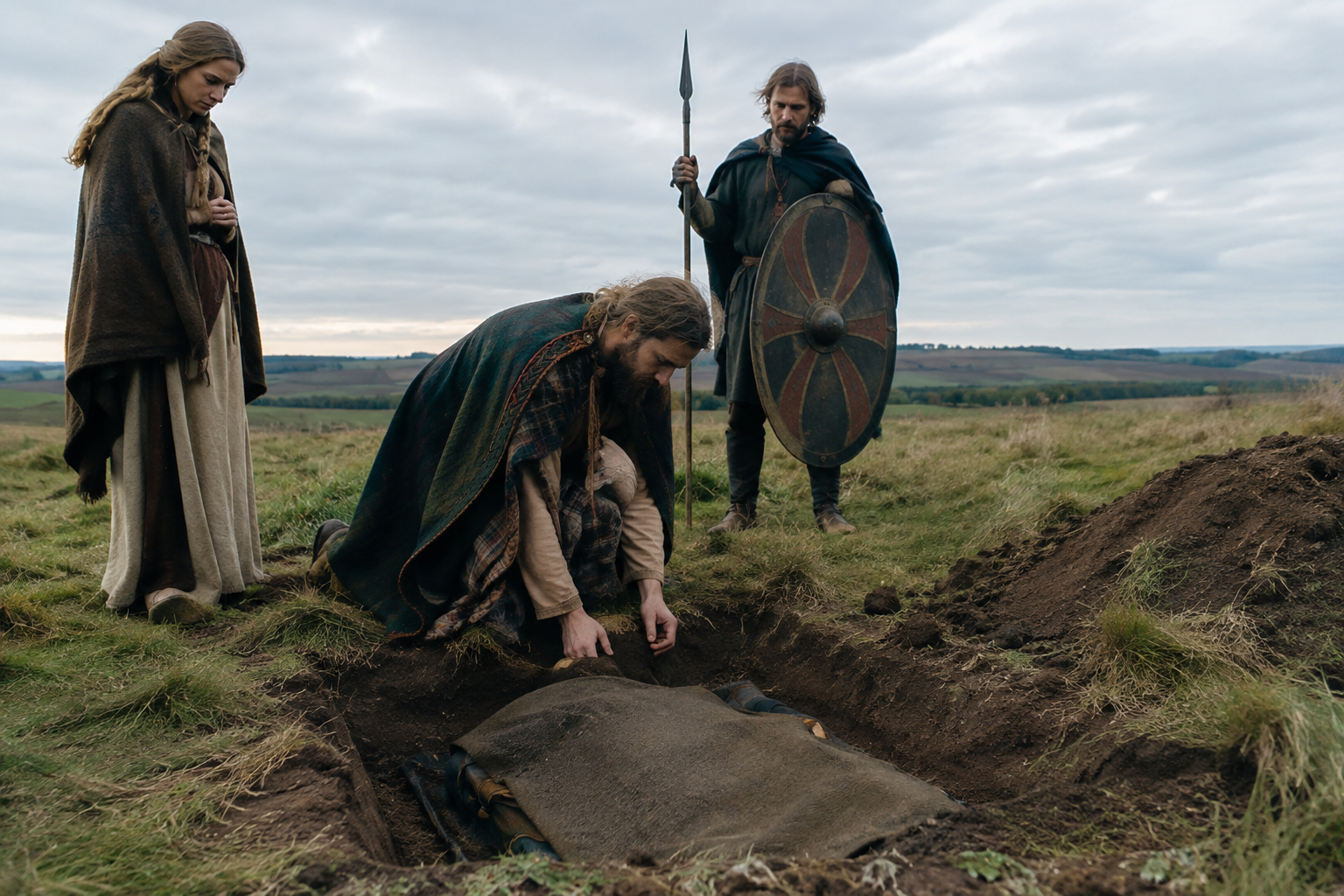
At Wetwang Slack in East Yorkshire, archaeologists uncovered one of the most closely studied Iron Age burial landscapes in Britain. Among the individuals from this cemetery is sample I37324, identified as a member of the Celtic Parisi and dated to around 225 BC. For anyone carrying the Y-DNA haplogroup R1b1a1b1a1a2c1a5c3, that is a striking point of contact: not a vague "Celtic" label, but a specific man from a known Iron Age community in northern England.
The interest here lies in scale as much as identity. Wetwang Slack is not a legendary battlefield or a royal mausoleum. It is better than that for genetic history: a real cemetery used by a real community, where archaeology and ancient DNA can be brought together carefully. In this case, the paternal line attached to R1b1a1b1a1a2c1a5c3 appears in an Iron Age Yorkshire setting associated with the Parisi, a group known from later classical references and from the distinctive archaeological record of the Arras Culture.
Wetwang Slack sits in the Yorkshire Wolds, a landscape of chalk uplands that has produced some of the most important Iron Age burials in Britain. The cemetery belongs to the broader Arras Culture tradition, famous for square barrows and, in some cases, chariot burials. That does not mean every excavated person was buried with spectacular equipment, and it would be wrong to invent such details for I37324. What matters is that this burial ground places him in a socially and archaeologically distinctive regional tradition.
The Parisi of East Yorkshire have long fascinated historians because they seem, at least in later Roman-era writing, to preserve a tribal name with possible Continental parallels. Archaeology, though, is more reliable than old ethnographic guesswork. What we can say with confidence is that East Yorkshire in the middle Iron Age was neither isolated nor culturally blank. Communities here buried their dead in ways that marked status, identity, and local custom, while remaining part of a wider British and northwestern European world.
R1b1a1b1a1a2c1a5c3 is a very narrow paternal branch. That matters because Y-DNA tracks only one line of descent: father to son, back through time. It is not the same thing as a person's whole ancestry, still less a shortcut to ethnicity. An Iron Age man in Yorkshire could belong to a paternal line with deeper roots elsewhere in Europe, while the rest of his family tree would already have been far more mixed and local.
It is also important not to load too much onto the long name of the haplogroup itself. The broader parent haplogroup R1b is widespread in western Europe and deeply entangled with major prehistoric changes, but that does not automatically tell us the specific history of the far narrower branch R1b1a1b1a1a2c1a5c3. What the Wetwang Slack evidence gives us is something more modest and more useful: proof that this paternal line, or a lineage classified into this branch in the reporting framework used here, was present among Iron Age people of East Yorkshire.
There is a persistent temptation, when discussing Iron Age Britain, to turn every individual into a druid, warrior, or tribal chief. Wetwang Slack resists that sort of theatre. Cemeteries like this are powerful precisely because they let us study communities rather than heroic caricatures. Sample I37324 belongs in that quieter but more revealing frame: a man buried within the lived social structure of Iron Age Yorkshire.
This is where archaeology and genetics make a useful pair. The burial ground shows us a community with recognizable local customs. The Y-DNA result adds one thread of biological continuity within that world. Together they suggest that paternal lines like this one were part of established populations in Britain before the Roman conquest, not merely later arrivals retroactively projected into the Iron Age.
A research preprint examining ancient populations relevant to these British findings is available at https://www.biorxiv.org/content/10.64898/2026.08.03.742615v2. Without overstating what one paper can settle, this kind of work is steadily improving the resolution with which we can place ancient British individuals into both local archaeological settings and wider population history.
The most interesting historical question is not whether one Y-chromosome can define "the Celts" - it cannot - but how local British groups fit into broader patterns of movement and contact. East Yorkshire in the centuries before Rome was tied into networks of exchange and ideas stretching across Britain and into the Continent. Objects, burial fashions, and perhaps people moved through those networks, though not always in simple waves or one-off migrations.
That makes I37324 especially valuable. He anchors this haplogroup in a place where archaeology already hints at both local continuity and long-distance connection. If your paternal line falls under R1b1a1b1a1a2c1a5c3, the lesson is not that you descend from a named tribal founder. It is that your direct male line is compatible with a world of Iron Age communities in Britain whose identities were regional, dynamic, and connected rather than neatly boxed.
One ancient individual is never the whole story, but sometimes one is enough to make the story tangible. I37324 turns an abstract haplogroup label into a man from a known cemetery, in a known region, at a known historical moment just before the Roman age reshaped Britain. That is already a great deal more informative than a bare frequency map or a generalized claim about western European ancestry.
For genealogists, this sort of evidence works best when treated as a well-placed historical marker. It shows that the paternal branch represented here had reached, or was present within, Iron Age East Yorkshire by around the third century BC. It does not prove descent from the Parisi as a tribe in any exclusive sense, but it does place the lineage in one of the clearest archaeological settings for pre-Roman Britain.
Roman and Early Medieval Britain
The distinctive point about R1b1a1b1a1a2c1a5c3 in this evidence is not grandeur but clarity. It is tied here to an identifiable Iron Age burial from Wetwang Slack, sample I37324, in the Parisi landscape of East Yorkshire around 225 BC. For someone exploring a paternal line today, that suggests a lineage with roots that can at least be placed within the lived communities of pre-Roman Britain, where local burial traditions and wider Celtic-world connections met on the Yorkshire Wolds.
Comments