Haplogroup R1b1a1b1a1a2c1a4b2c1b1

– 5 min read


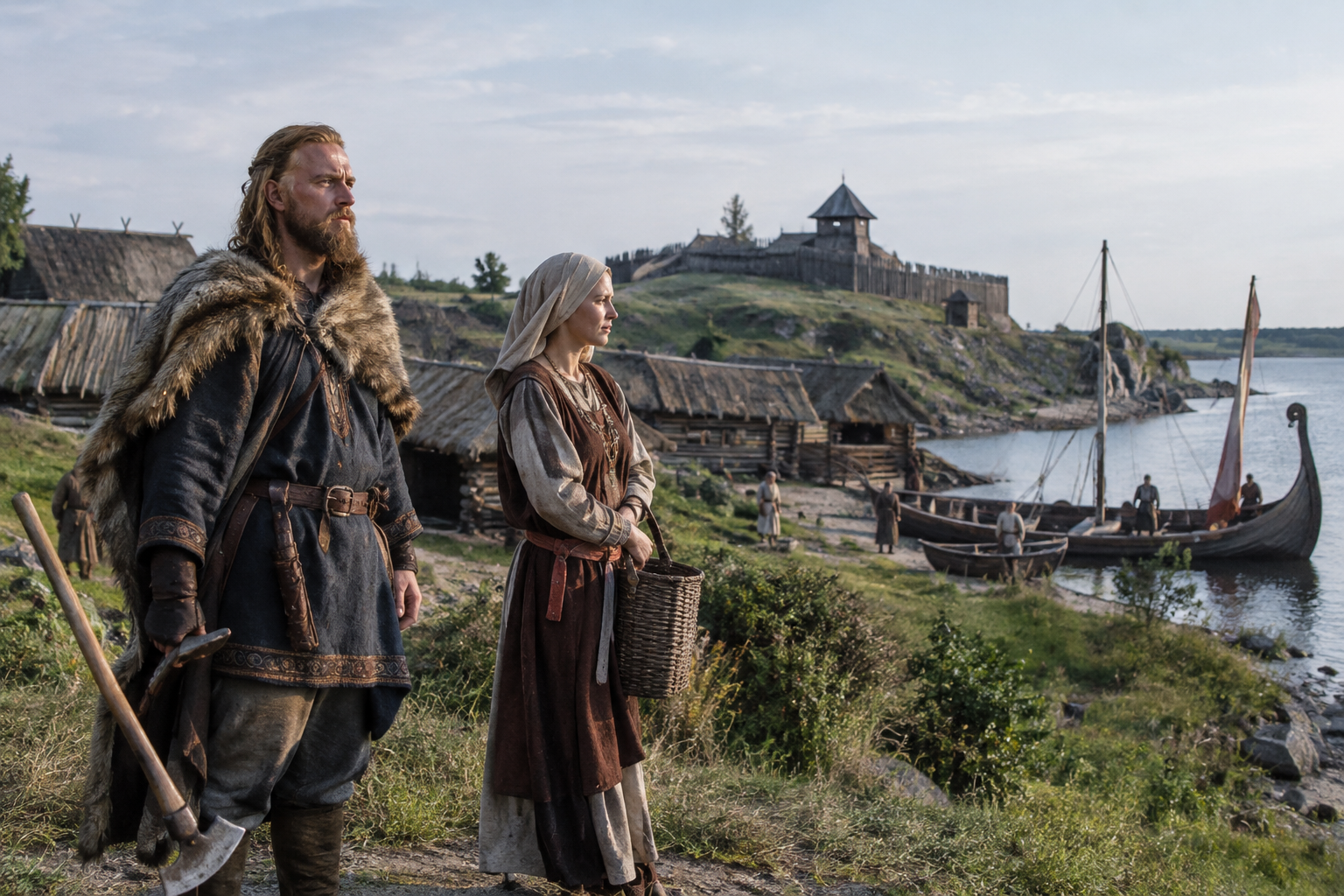
At Staraya Ladoga, on the Volkhov River in northwestern Russia, archaeologists are looking at one of the most important meeting points of the Viking Age world. This was not some romantic outpost on the edge of nowhere. By around AD 1000, it sat on a major route linking the Baltic to the river systems of eastern Europe and beyond. Among the ancient individuals associated with this place is sample VK218, reported here in connection with the Y-DNA haplogroup R1b1a1b1a1a2c1a4b2c1b1.
That makes Staraya Ladoga a useful place to begin, because the site captures a larger historical truth about Y-DNA. A paternal haplogroup follows one direct male line only, not a person's whole ancestry, language, or identity. Even so, when a branch appears in a Viking Age centre like Ladoga, the setting matters: we are dealing with a world of traders, settlers, raiders, craftspeople, and families moving between Scandinavia, the eastern Baltic, and the river highways leading south and east.
Staraya Ladoga has long been central to discussions of early Rus and Viking Age mobility. Its significance lies less in any single glamorous burial than in the town's position within a network. Goods, people, and ideas passed through here, and ancient DNA has become one more way of seeing how mixed and mobile that world could be.
For sample VK218, the secure facts supplied here are limited: Viking Age Staraya Ladoga, around AD 1000. That is already enough to place him in a historically charged landscape. By this date, Ladoga belonged to a zone where Norse-linked activity overlapped with Finnic, Slavic, and steppe-facing connections. A man carrying a branch reported as R1b1a1b1a1a2c1a4b2c1b1 at such a site is a reminder that paternal lines found in Viking Age contexts were not all the same, and that the eastern Viking world was never genetically or culturally uniform.
A genetic study of Viking Age populations that includes eastern networks and movement patterns is available here: https://www.biorxiv.org/content/10.1101/703405v1. Since the article here is built from a sparse sample record, it is better to be careful: the site is highly informative, but one should not load onto VK218 details that have not actually been provided.
The haplogroup label here is extremely specific: R1b1a1b1a1a2c1a4b2c1b1. That matters because readers are often more familiar with the broad parent haplogroup R1b, which has a very wide distribution in western Eurasia and a deep, complicated history. A narrow terminal branch, however, is not the same thing as the whole parent lineage. It represents one twig on a very large tree.
So what can responsibly be said? First, this branch belongs within that broader R1b paternal framework. Second, the presence of such a branch in a Viking Age individual from Staraya Ladoga shows that lineages often associated in modern discussions with western or central European paternal histories can also appear in the eastern Scandinavian world of movement and contact. What it does not do is prove a single migration story, a fixed ethnicity, or a direct connection to any named medieval dynasty.
This is where archaeology helps keep genetics honest. Ladoga was a crossroads. Crossroads produce mixed evidence. A Y-chromosome branch there might reflect recent family movement, older regional ancestry, or wider population processes stretching back centuries before the burial itself.
Popular imagination still likes tidy categories: Vikings over here, Slavs over there, steppe peoples somewhere beyond the horizon. The archaeology of eastern Europe is much messier, and much more interesting. River towns such as Staraya Ladoga connected the Baltic to Novgorod, the Dnieper, the Volga, Byzantium, and the Islamic world. That is a setting where paternal diversity is exactly what one should expect.
In that sense, VK218 matters less as a solitary emblem of one haplogroup than as evidence for the human texture of the route itself. Men bearing different Y-lineages could end up in the same communities because those communities were built by exchange. Some arrived through long-distance movement; others may have descended from families already established in the region for generations.
That broader eastern-European story sits well alongside recent MyTrueAncestry discussions of mobility around the Baltic and far north.
There is also a linguistic angle worth handling with care. Movements associated with Norse expansion, Slavic settlement, and Finnic-speaking populations all touched this region, but language and Y-DNA do not map neatly onto one another. A paternal branch can travel into a new speech community quite quickly, especially in trading centres, military retinues, and frontier towns.
It is perfectly fair to ask what we can do with a single ancient individual. The answer is: not everything, but not nothing either. One sample cannot define a whole population. Yet when that sample comes from a major archaeological site and a well-known historical corridor, it can anchor a discussion in real ground rather than in abstract haplogroup maps.
VK218 gives a dated instance of this paternal line in a place of first-rate historical importance. That is valuable for anyone researching direct male ancestry because it shows that the branch had reached, or was present within, the eastern Viking sphere by around AD 1000. For genealogical interpretation, that is a stronger statement than vague claims about "Viking blood" or simplistic national labels.
It also fits a wider pattern seen in early medieval Europe, where ancient DNA keeps undermining old ideas of sealed-off peoples. Communities on major frontiers and trade routes were rarely homogeneous. The Rhineland, early medieval Germany, and the lower Rhine frontier all show this in different ways.
For modern testers, a lineage like R1b1a1b1a1a2c1a4b2c1b1 can be tempting precisely because it is so precise. It feels as if the longer the label, the sharper the story should become. In practice, the opposite is often true. The finer the branch, the more important it is to separate what is securely documented from what is merely plausible.
In this case, the secure point is a Viking Age man at Staraya Ladoga, sample VK218, associated here with this branch. The historically meaningful context is a river-port world linking northern Europe to eastern Europe and beyond. The responsible interpretation is that this paternal line participated in, or at least was present within, that connected world. That is already a vivid and worthwhile finding.
If you are interested in how ancient genomics is being used to think about language spread and mobile early medieval populations, this related article is a useful companion.
The most distinctive thing about this haplogroup, in the evidence here, is not a royal claim or a grand founding myth. It is its appearance in VK218 at Staraya Ladoga, a place where the Viking Age was lived as contact, commerce, and movement across regions. For someone exploring the paternal line R1b1a1b1a1a2c1a4b2c1b1, that suggests a history which may intersect with the eastern Baltic and Rus world of around AD 1000, while remaining part of the much broader and older story of R1b in Eurasia.
Comments