Haplogroup R1b1a1b1a1a2b2b~
– 5 min read


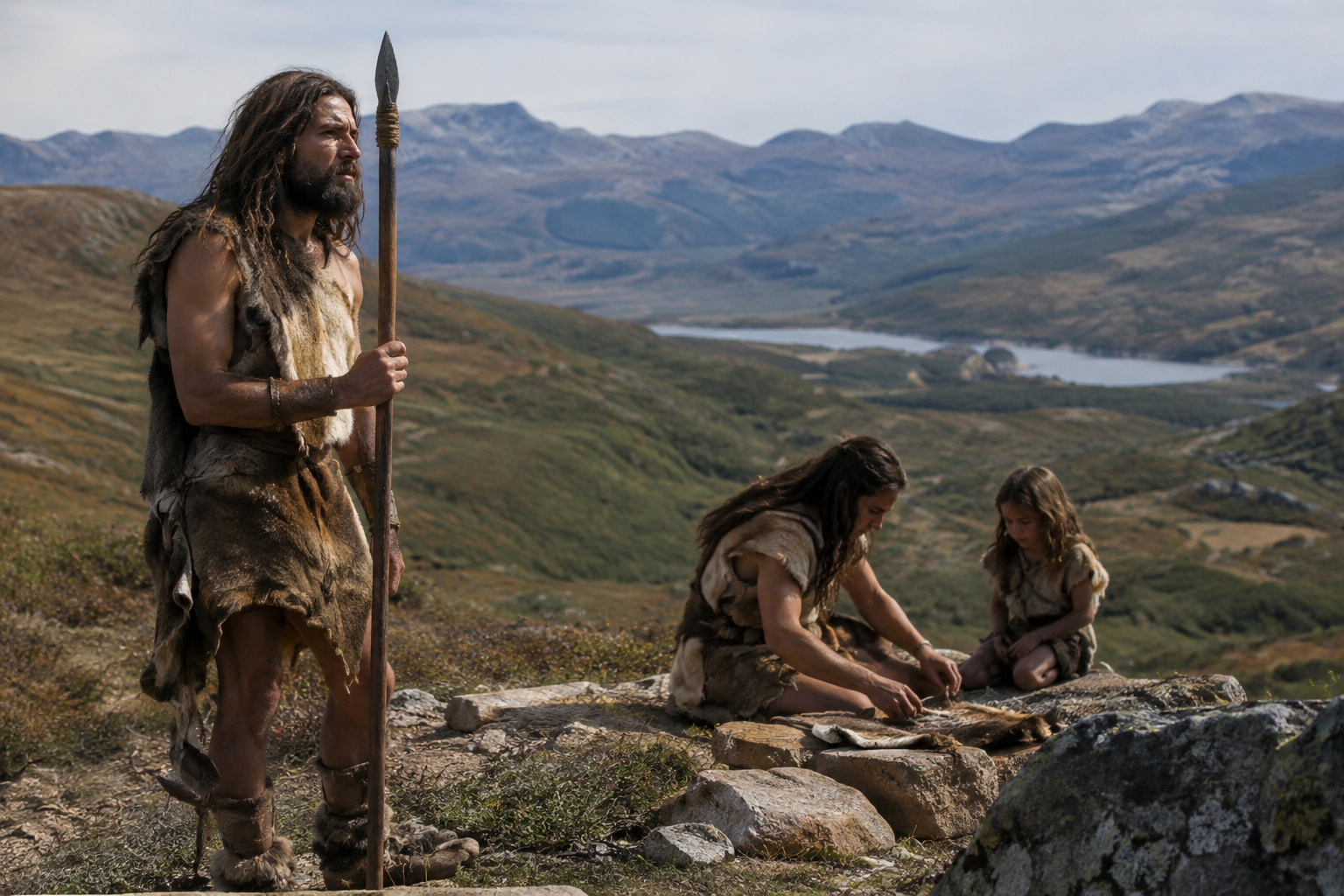
At Valdescusa in northern Spain, one Bronze Age man dated to around 1560 BC has become a small but telling witness to deep Iberian paternal history. He appears in the record simply as VAD001, yet even that sparse label is enough to place the haplogroup R1b1a1b1a1a2b2b~ in a concrete archaeological landscape: inland Iberia during the middle of the Bronze Age, long after the first farmers arrived and after major shifts in male lineages had already transformed much of western Europe.
That matters because a Y-DNA haplogroup follows only one line of descent, from father to son, not a person's whole ancestry. In this case, the branch is a very specific offshoot within the broader R1b family, and the tilde matters too: it suggests an approximate or associated placement rather than an absolutely final, fully resolved terminal call. So the interest here is not in making grand claims from one skeleton, but in asking a sharper question: what does a Bronze Age man from northern Spain tell us about the paternal landscape taking shape in Iberia?
VAD001 comes from Valdescusa, in northern Spain, and is dated to roughly 1560 BC. That places him in a period when Iberia was no longer the world of early Neolithic pioneers, but neither was it yet the Iron Age world of historically named peoples. Communities were living through long regional developments in farming, herding, metal use, settlement, and exchange, while ancestry patterns were still being reshaped by earlier Bronze Age movements.
The value of a sample like VAD001 lies precisely in its modesty. He is not a king with a genealogy, not a literary hero, and not the founder of a documented dynasty. He is better than that, in a way: an ordinary ancient individual whose Y chromosome helps show what kinds of paternal lines were present in inland Iberia after the great population turnovers associated with the later third and early second millennia BC.
A major ancient DNA study of prehistoric Iberia, published in Science, helped establish just how dramatic those earlier shifts were. One of its central conclusions was that Bronze Age Iberia saw substantial changes in ancestry and especially in Y-chromosome composition, with lineages from the wider R1b family becoming much more prominent than they had been among earlier Iberian males.
To understand R1b1a1b1a1a2b2b~, we have to be careful. It is part of a larger R1b family that became widespread across western Europe, but the history of that broad parent lineage cannot simply be pasted onto every narrower twig. Still, the larger picture gives context: by the Bronze Age, many parts of Iberia show male lines that differ strikingly from those seen in the preceding Neolithic and Copper Age.
That does not mean every community changed in the same way or at the same speed. Iberia is famous in archaeology for regional variety, and its ancient DNA confirms the point. Some places show strong continuity in parts of the genome, even while paternal lines shift sharply. Others reveal mixing among populations with different ancestries and local traditions.
So when VAD001 is associated with R1b1a1b1a1a2b2b~, the safest interpretation is this: by about 1560 BC, this specific paternal branch, or a lineage very close to it, was part of the male population of northern Spain. That is a real and useful data point, but it is not a license to claim that everyone in Bronze Age Spain shared the same descent, language, or identity.
The real drama of Iberian archaeogenetics is not hidden in a single grave; it lies in the contrast between periods. Earlier Iberian populations included a wide range of paternal lineages. By the Bronze Age, however, many sampled males belong to R1b branches. This is one of the clearest examples in Europe of how male-line descent can change more sharply than overall ancestry.
That pattern has prompted plenty of discussion about migration, social structure, and inheritance. The genetic evidence strongly supports large-scale demographic change connected to steppe-derived ancestry entering Iberia in the late third millennium BC. But archaeology reminds us that these changes were lived locally, in settlements, burial grounds, farming districts, and exchange networks that varied from region to region.
VAD001 belongs in that local story. Northern Spain was not a blank receiving zone at the edge of Europe; it was a region with its own communities and trajectories. A man carrying an R1b-derived paternal line there around 1560 BC shows that this transformation was not a fleeting intrusion. By the middle Bronze Age, such lineages had become embedded in the social fabric.
It is tempting, of course, to leap from a Bronze Age Y chromosome to later peoples of Spain: Celtiberians, Cantabrians, Romans, Visigoths, medieval kingdoms, and modern regions. That is exactly where caution is needed. A paternal line can persist through enormous cultural change. The man at Valdescusa lived nearly a millennium before Rome entered Iberian history in force, and far earlier still than the medieval societies that shaped many family traditions today.
Yet there is still a meaningful continuity of place. Northern Spain is one of those landscapes where archaeology repeatedly shows long habitation, adaptation, and reuse of territory. The people changed, mixed, married, traded, buried their dead, and spoke different languages over time, but some paternal branches clearly remained in circulation across many centuries.
That is why later genetic studies of Iberia are so interesting when read alongside prehistoric evidence. They do not turn VAD001 into an ancestor of any named medieval house, but they do help show how deep some regional genetic patterns may run beneath later political labels. For a broader look at how later periods layered themselves onto earlier Iberian populations, the MyTrueAncestry community has also explored Roman Iberia and its long genetic aftermath.
There is another reason this branch is worth noticing in Bronze Age Spain. Iberia often appears in popular history either as dramatically separate from the rest of Europe or as simply swept along by continental trends. The truth, as usual, is messier and more interesting. Ancient DNA shows both connectedness and distinctiveness.
The broader R1b expansions that touched Iberia were part of Europe-wide processes, but once these lineages arrived, they were absorbed into specifically Iberian histories. That means a branch like R1b1a1b1a1a2b2b~ should be read at two levels at once: as part of a western European paternal story, and as part of a local Bronze Age Spanish one.
This is where archaeology saves us from over-simplifying genetics. Haplogroups can suggest lines of descent, but the people carrying them lived in communities defined by land use, kinship, craft, and custom. Northern Spain in the Bronze Age was not merely a stopping point on a migration map. It was home.
If your paternal line falls under R1b1a1b1a1a2b2b~, VAD001 offers a useful kind of evidence: not a fantasy pedigree, but a real ancient foothold. It places this branch, or a very close related line, in northern Spain by the middle Bronze Age. That suggests a paternal history rooted in the deep reshaping of Iberia after the great third-millennium transitions, and possibly in lineages that endured through many later historical eras.
For family historians, that is often the most valuable insight of all. A haplogroup like this does not tell you the surname of a Bronze Age man or the language he spoke at home. What it can do is anchor your direct paternal line in a documented prehistoric setting, where archaeology and ancient DNA meet on solid ground.
Comments