Haplogroup R1b1a1b1a1a2b2a1

– 5 min read


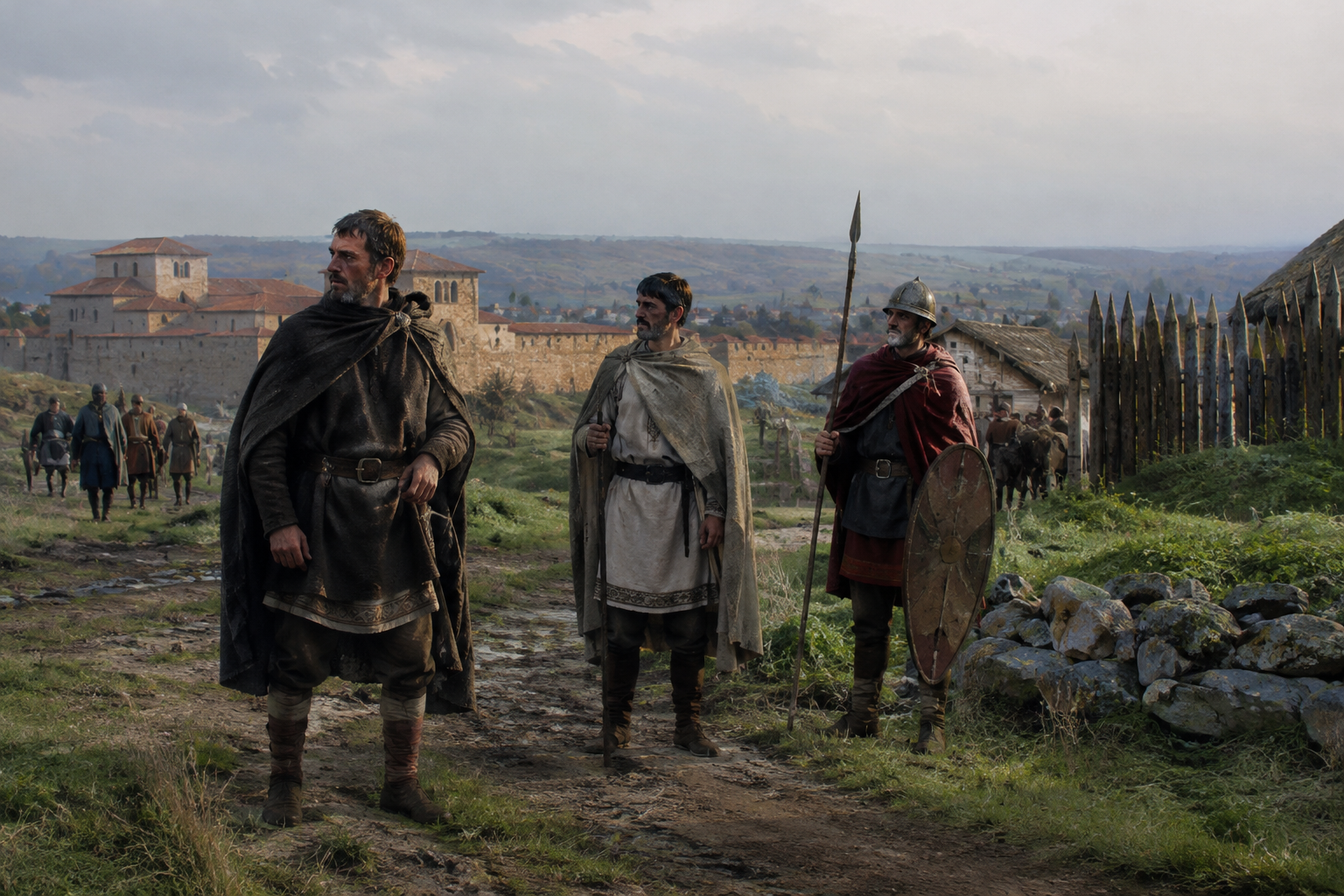
At Savaria in western Hungary, a man buried in the Dark Ages and catalogued as SZL029 offers a particularly sharp glimpse of paternal ancestry in a frontier world that had already outlived Rome. Dated to around AD 525 at Szeleste in the Barbaricum zone beyond the old imperial line, he is one of the ancient individuals associated here with the Y-DNA haplogroup R1b1a1b1a1a2b2a1.
That matters because this is not just any branch of R1b, the large and widespread West Eurasian paternal haplogroup. It is a much narrower downstream lineage, and the evidence in hand places it not in some vague prehistoric haze but in a very specific historical landscape: late and post-Roman Pannonia, where old Roman towns, military corridors, incoming groups, and local communities overlapped in ways that archaeology is only now beginning to disentangle. Y-DNA tracks one direct paternal line, not a person's whole ancestry, but even that single thread can be revealing when it turns up in the right place at the right moment.
Savaria, near modern Szombathely, had been an important Roman centre for centuries. By the early 6th century, however, the political map had changed dramatically. Imperial administration had faded, the Hunnic episode was over, and the region sat within the shifting post-Roman world of former provinces, mobile warbands, local survivors, and new powers trying to control the Danube basin.
Within that setting, SZL029 is interesting precisely because he was not excavated from a famous royal tomb or a celebrated battlefield. He comes from the ordinary, stubbornly real terrain of post-Roman life in Pannonia, where identities were being renegotiated on the ground. A lineage such as R1b1a1b1a1a2b2a1 appearing here suggests that some paternal lines associated with broader western Eurasian populations were present in this mixed frontier society well after the formal end of Roman rule.
The broader importance of this region has been highlighted by an ancient DNA study of post-Roman communities in the Carpathian Basin, published in Science. Even without turning every grave into a grand migration story, the genetic evidence makes one point very clearly: the populations living in and around former Roman Pannonia were not simple, isolated blocks. They were varied, and that variation shows up both in genome-wide ancestry and in paternal lineages.
The second ancient individual linked here, GYS055, comes from Arrabona, excavated at Széchenyi Square in modern Győr, and dated to around AD 425. This was an even earlier moment in the unravelling of Roman power in the region. Arrabona had been a Roman settlement on the Little Hungarian Plain, close to important road and river routes, and therefore especially exposed to the political and demographic shocks of the 5th century.
Placed beside SZL029, GYS055 gives us a small but suggestive pattern. We are not looking at a single isolated paternal lineage appearing once by chance in one cemetery; we are looking at the same narrow haplogroup appearing in two individuals from western Hungarian sites in late antique and early medieval contexts, separated by roughly a century. That does not prove a dynasty or close kinship. It does, however, indicate that this paternal branch was part of the human landscape of the region during a period of severe historical disruption.
That continuity through disruption is one of the most interesting things about the Carpathian Basin. Empires fell, military coalitions shifted, and labels in the written sources changed rapidly, but people did not simply vanish and get replaced in one clean sweep. Archaeology and genetics together keep forcing us back to a messier and more convincing picture: local continuity mixed with incoming ancestry, old towns reused by new populations, and family lines that outlasted political regimes.
There is a temptation with a lineage as specific as R1b1a1b1a1a2b2a1 to jump immediately from genetics to ethnicity: Roman, Goth, Hun, local Pannonian, or something else. That is exactly the leap good archaeology resists. The two individuals here lived in a world where material culture, language, political loyalty, and biological ancestry did not always line up neatly.
What can be said more securely is that this branch belonged to men living in western Hungary during the transition from late Roman to early medieval society. The labels attached to their burial settings, such as Late Antique Pannonia or Barbaricum Hungary, describe historical and archaeological contexts rather than fixed ethnic identities. A man buried beyond the former Roman frontier could carry a paternal lineage also found in populations shaped by long histories of movement across Europe.
That point has become increasingly familiar across late antique archaeology. Communities once treated in older history books as sharply separate, Roman on one side and barbarian on the other, often look far more entangled when ancient DNA is added to the picture. For a good parallel discussion of that wider phenomenon, see the MyTrueAncestry piece on Roman and frontier mixing:
Western Hungary in the 4th to 6th centuries was never a backwater. It was a corridor linking the Danube frontier, the Alps, the Balkans, and the plains further east. Troops, traders, refugees, raiders, and settlers all passed through or settled there. A paternal lineage turning up in this zone may reflect local descent, mobility across former Roman provinces, or integration into mixed post-imperial communities. The evidence we have does not choose only one of those explanations.
That is precisely why these two samples are valuable. They do not belong to a legendary founder or a named ruling house; they belong to the archaeologically documented population of a contested region. In public history, there is always a pull toward crowns and famous surnames. But most genetic history is built from places like Savaria and Arrabona, from men whose names are lost but whose chromosomes still register the social realities of their age.
The wider story of movement and mixture in this same historical horizon can also be seen elsewhere in the region and beyond it, including communities associated with Gothic and frontier settings. The comparison is useful not because it turns SZL029 or GYS055 into Goths, but because it shows how varied these late antique populations could be.
Gothic Communities in Bulgaria
For someone researching the haplogroup R1b1a1b1a1a2b2a1 today, the distinctive lesson is not that this branch can be pinned to one tribe or one migrating people. It is that the branch is archaeologically visible in western Hungary during the collapse and reassembly of the Roman world. SZL029 and GYS055 place this paternal line in a real historical environment shaped by continuity, mobility, and frontier mixing. That is a modest claim, but a strong one.
In other words, this haplogroup's ancient record here points toward participation in the human history of late antique Pannonia rather than toward a single neat origin myth. And in archaeology, that is often the more interesting answer.


Comments