Haplogroup R1b1a1b1a1a2b1c2b1a1

– 5 min read


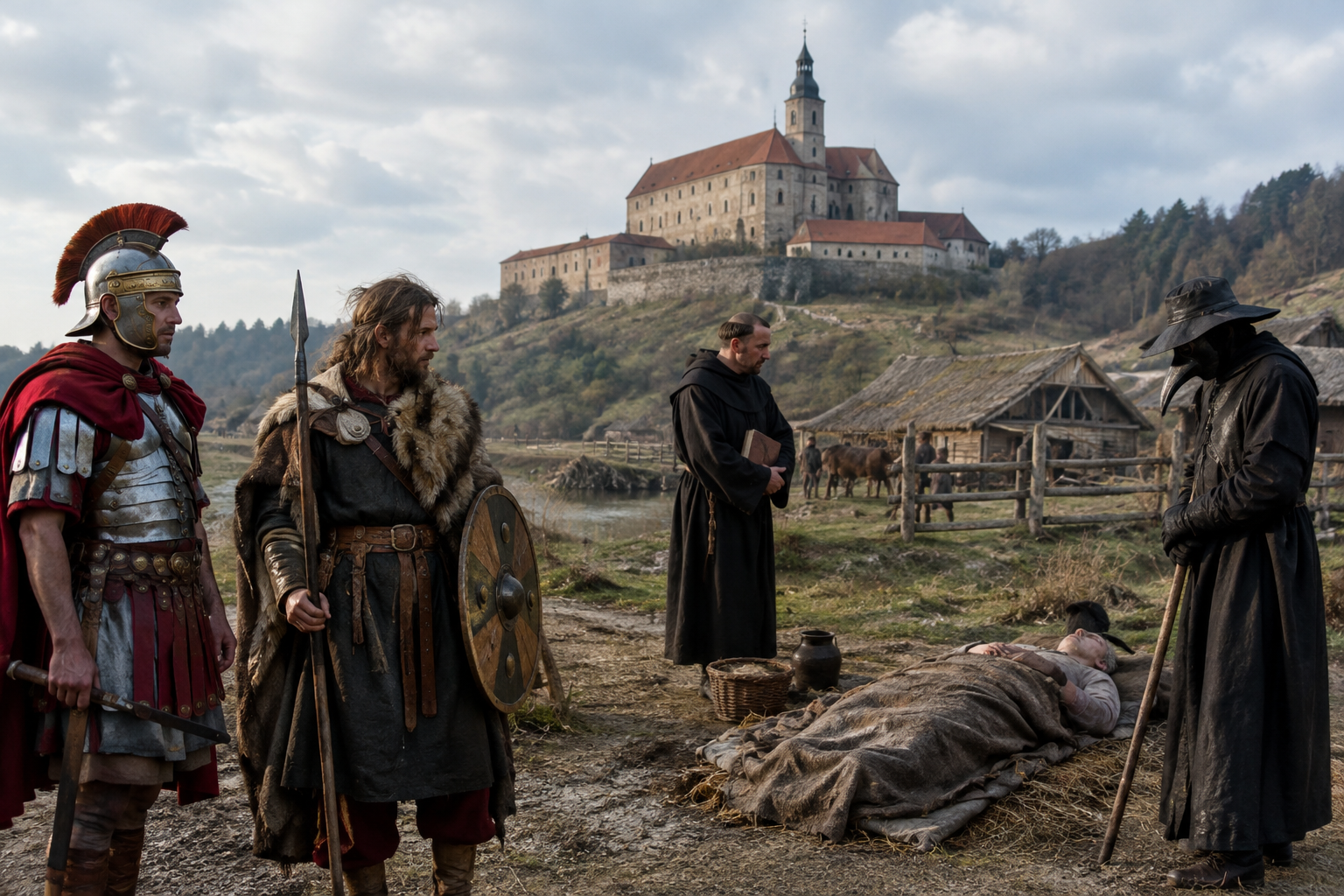
In 1315 AD, at the Benedictine monastery of Abasár in Hungary, one burial linked to the royal house of Aba adds an unusually concrete human point of entry into the long and rather technical story of Y-DNA haplogroup R1b1a1b1a1a2b1c2b1a1. The individual identified as HUAS450F belongs to a medieval setting where genealogy, power, burial place, and written history begin to overlap with ancient DNA in ways that are rare for most paternal lines.
That matters because this haplogroup is not being glimpsed here in a single isolated prehistoric grave. In the material tied to this branch, we can follow appearances from the late Roman world through post-Roman northern Europe and into medieval Central Europe, ending even in an early modern plague burial. Y-DNA tracks one direct paternal line only, not a person's full ancestry, but that narrow line can still reveal striking continuity across very different historical worlds.
The most historically resonant sample in this group is HUAS450F, dated to about 1315 AD, from the Bolt-teto Benedictine Monastary at Abasár. The site is associated with the Hungarian Royal House of Aba, a lineage important in the politics of medieval Hungary. That alone does not make every genetic detail simple, but it does place this paternal line in a documented elite context rather than in an anonymous cemetery horizon.
What makes Abasár especially interesting is that it stands in the shadow of the older Hungarian kingdom, where royal and aristocratic families were formed in a landscape shaped by conquest, Christianization, and regional power struggles. A recent ancient DNA study of Hungarian elite burials has helped clarify how complex those lineages could be, especially when archaeology, historical identity, and genetics do not map neatly onto one another in a one-to-one way; see this research on medieval Hungary's elite. In that sense, HUAS450F is valuable not because it proves a sweeping dynastic myth, but because it anchors this branch in a real medieval institution, at a real named place, within a historically legible ruling milieu.
Much earlier, another appearance comes from CGG107394, dated to about 375 AD, from Tappernøje Broskov in southern Sjælland, Denmark. The sample is described in connection with a Germanic tribe, which is a useful historical shorthand for the late Iron Age world of southern Scandinavia, though one should be careful not to turn that label into an exact ethnic badge. This was a period of mobility, shifting alliances, and growing contact across the Baltic and the Roman frontier.
The significance here is geographical as much as chronological. Southern Zealand was part of a connected northern zone feeding people, objects, and styles into the wider migration-period world. A paternal line associated with R1b1a1b1a1a2b1c2b1a1 in this region suggests that the branch was present in the Scandinavian-Germanic sphere centuries before the Abasár burial, and not only in a later medieval Central European context.
That does not mean a straight, provable father-to-son line from Denmark to Hungary. It does mean that this haplogroup turns up in historical zones deeply involved in the remaking of Europe between the late Roman Empire and the early Middle Ages. A broader ancient DNA study of post-Roman and frontier-era populations in this part of Europe has shown just how mixed and mobile these communities could be; one relevant example is this work on Roman and post-Roman population history in Central Europe.
The sample R10670, dated to about 345 AD, comes from Wels in Austria, a town known in Roman times as Ovilava. This is an important change of setting. We are no longer in a medieval monastery or a Scandinavian late Iron Age context, but in the provincial Roman world of the Danube region, where soldiers, traders, local families, and migrants could all end up in the same urban orbit.
Wels was no obscure backwater. In the Roman period it was an established settlement within Noricum, tied into roads, administration, and military movement. A Y-line associated with this haplogroup in Roman-era Austria reminds us that paternal branches do not belong to single peoples in the old textbook sense. The same lineage may appear in an imperial town, in a northern Germanic context, and later in a Hungarian monastic burial, without requiring that all three men thought of themselves in the same way or spoke the same language.
This is where the archaeology becomes more interesting than any tidy origin story. The branch's documented appearances cluster in zones of contact: the Middle Danube, the Roman frontier world, southern Scandinavia, and medieval Hungary. That pattern fits a lineage moving through the historical arteries of Europe rather than sitting still inside one neatly bounded population.
The latest sample in this small but evocative set is ELW012, identified as a post-medieval plague victim from Ellwangen, Germany, dated to about 1550 AD. By this point, the historical frame has shifted again. We are no longer looking at the Roman frontier or medieval aristocratic burial, but at the demographic shocks of early modern Europe, when epidemic disease left mass mortality in its wake.
There is a useful sobriety in this sample. Not every genetic trace of the past comes to us through kings, warriors, or famous cemeteries. Sometimes a paternal line survives into the record through catastrophe. ELW012 shows this branch still present in the German-speaking lands well after the Middle Ages, embedded in ordinary historical populations whose lives were shaped as much by disease and local community as by grand politics.
The Ellwangen burial also helps counter a common misunderstanding. Haplogroups are often imagined as if they mark one dramatic migration and then stop. In reality, what we usually see is persistence: a branch appears in one region, then another, then another again, across many centuries and social settings, carried by men whose lives had very different historical meanings.
With a haplogroup as specific as R1b1a1b1a1a2b1c2b1a1, caution matters. The deeper parent clade R1b is widespread and ancient across large parts of Europe, but that broad history should not simply be poured into this exact terminal branch. What the present evidence actually gives us is narrower and more useful: this lineage is attested in historically connected parts of Europe from the fourth century AD to the sixteenth century, with samples in Roman Austria, late Roman or migration-era Denmark, medieval Hungary, and early modern Germany.
That spread suggests a paternal line at home in the broad Central and northern European historical zone, especially around the Danubian and Germanic worlds. It may have moved through military service, local family continuity, elite politics, trade routes, or all of these at different times. The evidence is strongest not for a single dramatic origin tale, but for long-term presence across several of Europe's busiest cultural crossroads.
The most distinctive thing about R1b1a1b1a1a2b1c2b1a1 is not that it belongs to one famous people, but that it turns up in several different historical settings that mattered enormously to European history: a Roman town in Austria, a late antique Danish context, a medieval Hungarian royal-house burial, and an early modern plague cemetery in Germany. For someone researching this paternal line today, that is a meaningful clue. It points toward a branch with roots in the long, entangled history of Central and northern Europe, where empire, migration, aristocratic power, and ordinary survival all left their mark.

Comments