Haplogroup R1b1a1b1a1a2b1c1a1a1
– 4 min read


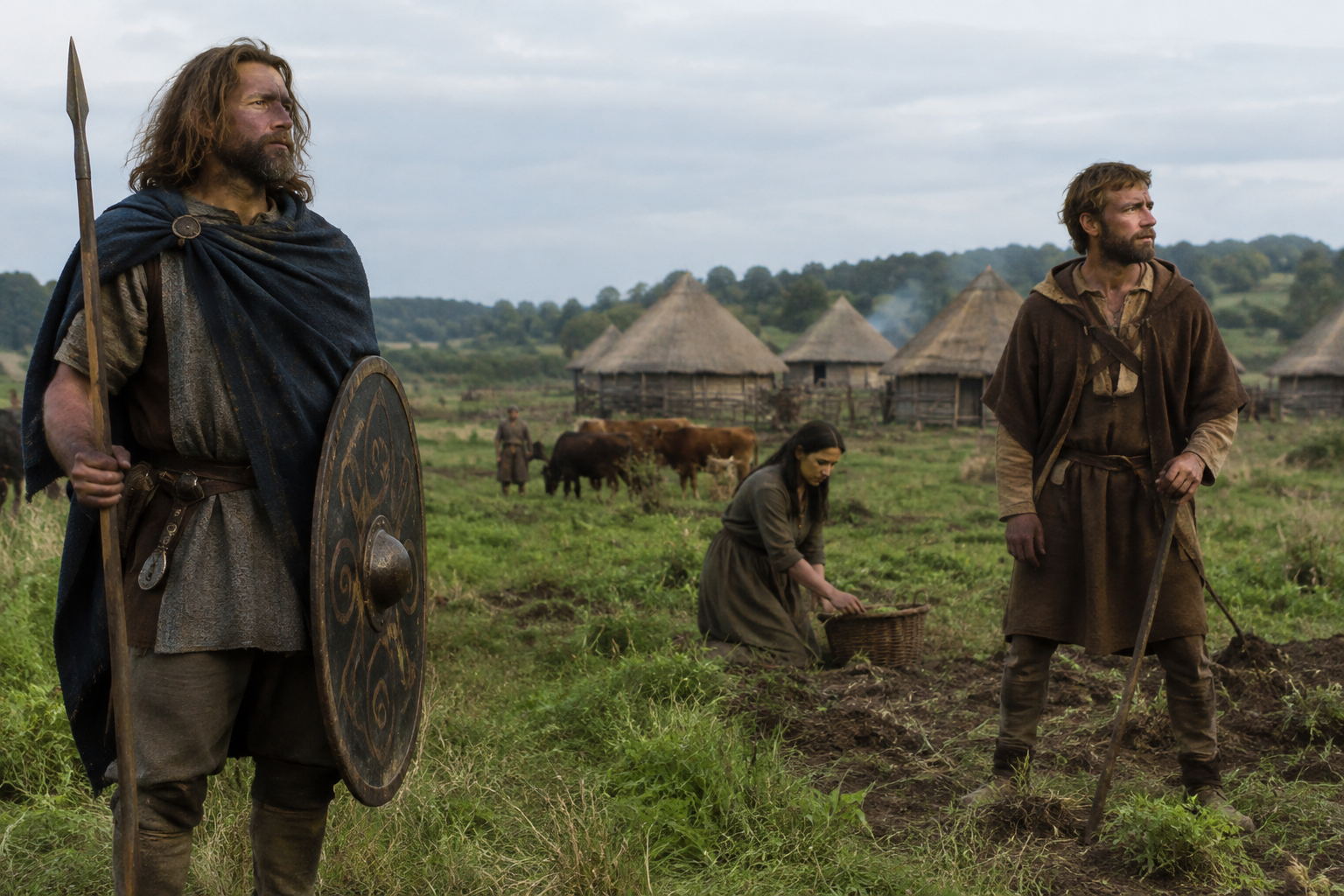
At Yarnton in Oxfordshire, archaeologists and geneticists recovered an Iron Age male dated to around 300 BC, identified as I20589. On its own, that may sound like just one more useful ancient genome from Britain. But when a paternal line as specific as R1b1a1b1a1a2b1c1a1a1 appears in a British Iron Age context and is also reported in an Iron Age individual from eastern France, it becomes a small but telling clue about how closely connected parts of northwestern Europe already were before Rome had fully remade the map.
The second reported match is CGG023706, dated around 455 BC and associated with the Sequani region in what is now France. That pairing matters. It does not mean the two men were closely related, and it certainly does not turn a haplogroup into an ethnicity. Y-DNA tracks one direct paternal line only. But taken carefully, these finds place this branch of the wider R1b family in two classic Iron Age worlds: one in southern Britain, the other in eastern Gaul.
I20589 comes from Yarnton, Oxfordshire, a site that belongs to the long and complicated pre-Roman history of southern Britain. By 300 BC, this was not an isolated countryside in any simple sense. Communities in the Thames region were tied into exchange networks that carried metalwork, ideas, and probably people across considerable distances.
That is why a paternal lineage like R1b1a1b1a1a2b1c1a1a1 is interesting here. Not because one man can stand for all of Iron Age Britain, but because he belongs to the period when local continuity and cross-Channel contact coexisted. Ancient DNA has steadily shown that later prehistoric Britain was neither sealed off nor endlessly replaced; it was a place where older lineages persisted while new social and biological connections formed around them.
A major ancient DNA study of Britain published in Nature helped clarify just how much demographic change and regional variation sat behind the familiar label "Iron Age Britain." The important point for this haplogroup is modest but solid: its presence at Yarnton fits a broader picture in which paternal lines within the larger R1b world remained prominent in southern Britain after the great Bronze Age transformations, while local communities continued to interact with continental Europe.
The French sample, CGG023706, is dated to around 455 BC and described as coming from a Germanic-Gallic France Sequani context at Parancot. That wording should be handled with care. The Sequani are historically known as a Gallic people of eastern France, in the region of the upper Saone and Jura, but labels attached to ancient individuals can sometimes reflect broad regional or interpretive frameworks rather than a perfectly precise self-identity. The safer point is geographical and chronological: this is an eastern Gaulish Iron Age male from the mid-1st millennium BC.
That alone makes him valuable. Eastern France in this period sat in a zone of movement and entanglement, linked to the Rhine, Alpine corridors, and the interior of Gaul. A paternal line reported here and also seen in Iron Age England suggests that the deeper history of this branch belongs in that northwest European conversation rather than in any narrowly bounded national story.
We should resist the temptation to overread one sample. CGG023706 does not prove that this exact subclade was "the lineage of the Sequani," still less that everyone carrying it today descends from a tribal elite in Gaul. What it does offer is a real anchor point: this branch was present in Iron Age eastern France, in a region famous for cultural traffic long before Caesar arrived to write everyone into Roman history.
The awkwardly long label R1b1a1b1a1a2b1c1a1a1 sits far down inside one of western Europe's most widespread Y-chromosome families. That wider R1b background has a long prehistoric history and many branches, but one of the common mistakes in public discussion is to let the fame of the parent lineage swallow the evidence for the smaller branch. We should not do that here.
What can be said responsibly is that this exact branch appears, in the material provided here, in Iron Age contexts on both sides of the Channel. That places it within the human geography of late prehistoric northwestern Europe: a world of regional communities, river valleys, upland routes, marriage exchange, seasonal movement, and occasional long-distance mobility. It may have been one of many paternal lines circulating through populations that archaeologists describe with labels such as British Iron Age or Gaulish, but those labels are archaeological and historical shorthand, not biological tribes.
In practical terms for family historians, this means that a present-day match to R1b1a1b1a1a2b1c1a1a1 is most usefully read as evidence of one paternal thread that was already established in Iron Age northwestern Europe. It is not, by itself, a certificate of being "Celtic," "British," "French," or "Sequani." Ancient DNA is better at locating lineages in real past populations than at confirming modern identities.
The real historical interest of these two samples lies in their pairing. Britain and Gaul in the 5th to 3rd centuries BC were not mirror images, but neither were they strangers. Archaeology has long shown connections in art styles, metallurgy, trade, and elite display. Ancient DNA adds another layer: some paternal lines were shared across this maritime zone as well.
That does not require dramatic migration stories. People did cross the Channel, of course, but lineages can spread through many small processes over generations: a family moving, a marriage alliance, incorporation into a new settlement, the growth of an existing local line, or repeated contact over centuries. The presence of this haplogroup in both Oxfordshire and eastern France sits comfortably within that quieter, more realistic picture.
Research on later prehistoric and Iron Age population structure in continental Europe is still developing quickly, and one of the supplied studies, available as a bioRxiv preprint, reflects how active that field remains. Even without leaning on unverified details from that paper, the broader lesson is clear enough: Iron Age Europe was full of local continuity, but it was also full of connection.
I20589 and CGG023706 are useful not because they solve everything, but because they put this lineage in recognizable historical landscapes. One belonged to Iron Age Oxfordshire, the other to Iron Age eastern France. Together they suggest that R1b1a1b1a1a2b1c1a1a1 was part of the paternal map of northwestern Europe before the Roman period, in communities that were distinct, local, and yet connected.
For someone researching this haplogroup today, that is the most worthwhile takeaway. Your direct paternal line may belong to a branch with confirmed ancient footholds in both Britain and Gaul during the Iron Age. That is not a grandiose claim of tribal descent; it is something better: a small, firm connection to the real human landscape of later prehistoric Europe.

Comments