Haplogroup R1b1a1b1a1a1d1

– 5 min read


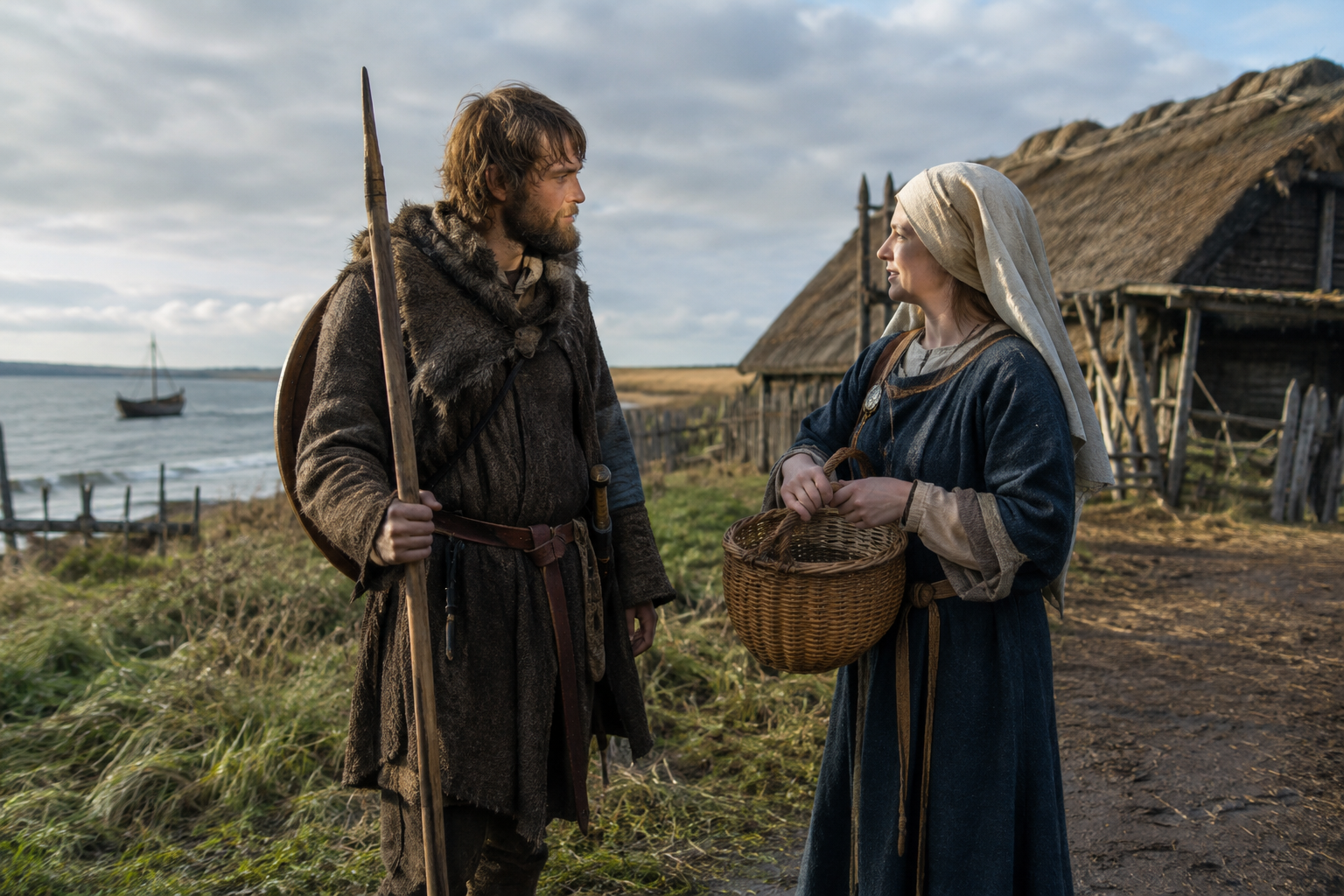
At Ahlgade in Holbaek on Zealand, one medieval male dated to around AD 1325, sample CGG101838, carries the Y-DNA haplogroup R1b1a1b1a1a1d1. That is already enough to make him interesting, not because one skeleton can stand in for medieval Denmark, but because he gives this very specific paternal line a firmly dated place in a real town of the Danish Middle Ages.
The second clue comes from a much earlier Danish context: sample CGG106485 from Jutland, dated here to around 200 BC and described as "Nordic Bronze Age Denmark Jutland Skole Samling." The period label and date do not sit neatly together, and that matters. Around 200 BC is in the later Pre-Roman Iron Age rather than the Nordic Bronze Age proper, so the safest reading is not to force a cultural identity, but to notice the broader pattern: this branch is represented in Denmark in both later prehistoric and medieval settings.
R1b1a1b1a1a1d1 is a fine-grained branch within the much larger R1b family, one of the major Y-chromosome groupings in western Eurasia. Y-DNA tracks one direct paternal line only - father to father to father - so it is not a summary of a person's whole ancestry, language, or identity. Still, when a rare or specific branch appears in ancient remains, it can anchor that paternal line in time and place.
With this haplogroup, the evidence in hand is not a sweeping migration story spread across dozens of excavated cemeteries. It is something more compact, and in its way more appealing: a Danish signal seen at two widely separated moments, one in later prehistory and one in the late medieval period. That does not prove uninterrupted descent from one man to another, but it does suggest that the branch belonged to the long-term paternal landscape of southern Scandinavia.
Denmark's Deep Genetic Background
Holbaek was not an isolated farmstead at the edge of nowhere. Medieval Zealand was tied into the political and commercial life of the Danish kingdom, and towns like Holbaek sat within a landscape shaped by crown power, church institutions, seaborne traffic, and regional markets. A male from Ahlgade dated to about AD 1325 belongs to that settled and connected world.
What makes CGG101838 so useful is its clarity of context. We are not dealing here with a legendary king or a saga hero, but with an actual man from an actual medieval Danish site. His assignment to R1b1a1b1a1a1d1 places this paternal line squarely in eastern Denmark during a period when Scandinavian society was already thoroughly Christian, urban networks were established, and local populations had long histories of mixture, continuity, and movement.
That is worth stressing because popular imagination often treats Scandinavian paternal history as if it ought to resolve into a single "Viking" signature. Ancient DNA keeps refusing that simplification. Medieval Denmark contained multiple paternal lines, some with deeper regional roots and some reflecting older or newer population movements around the Baltic and North Sea. A lineage like R1b1a1b1a1a1d1 is part of that more realistic picture.
An ancient DNA study on medieval and earlier Scandinavian material is linked through this research preprint, which is relevant here because it situates such individual assignments within a wider archaeological and genetic investigation rather than leaving them as isolated curiosities.
The earlier sample, CGG106485, is the more awkward one and therefore the more instructive. It is listed as coming from Jutland, from the Skole Samling, with a date of around 200 BC, yet described as "Nordic Bronze Age." Archaeologists and genetic historians have to live with this kind of untidiness. Museum collections, legacy labels, and later database conventions do not always align perfectly with one another.
The sensible approach is to treat the date as the strongest guide unless firmer contextual evidence says otherwise. Around 200 BC places this man in the late prehistoric north, after the classic Nordic Bronze Age and before Roman political power reached the region directly. In other words, he belongs to the world out of which later Iron Age Scandinavian societies developed.
That makes him a valuable counterpart to the medieval Holbaek man. If both assignments are sound at the reported resolution, then this paternal branch was present in Denmark many centuries apart and in different archaeological settings. We should not turn that into a dynastic fairy tale, but neither should we miss the simple historical point: some male lines persisted locally across very long spans of time, even as material culture, trade contacts, religion, and political structures changed around them.
Early Christian Scandinavia DNA
Denmark is a particularly good setting for thinking about paternal continuity because it sits at a historical crossroads that was also, repeatedly, a place of local continuity. Jutland opens toward the Continent; Zealand faces the Baltic routes; the islands and peninsulas together were never sealed off. Yet ancient DNA from Scandinavia often shows that mobility did not erase local population structure overnight. New influences arrived, but they entered societies that already had deep roots.
For a branch like R1b1a1b1a1a1d1, the Danish evidence presently looks less like a tale of a sudden appearance and more like a line embedded in northern European history. That does not tell us its ultimate place of origin, and it certainly does not allow us to assign it to a tribe, language, or social rank. But it does place the branch in a meaningful historical corridor: southern Scandinavia, across the transition from later prehistory to the medieval kingdom.
That wider Scandinavian and North Sea context matters for family historians today. Many paternal lines moved repeatedly among Denmark, northern Germany, southern Sweden, Norway, the Low Countries, and the British Isles over the last two millennia. A Danish ancient match therefore may point not to a single national story in the modern sense, but to a connected northern European zone.
North Sea Migrations to Britain
There is a temptation in genetic history to think that only grand sample sets count. In fact, a pair of well-placed finds can be revealing if they sharpen the right question. Here, the question is not whether R1b in general was present in Europe - that is old news - but whether this much narrower branch can be glimpsed in specific historical landscapes. The answer, on present evidence, is yes: in Jutland in later prehistory, and in Zealand in the medieval town world.
That sort of evidence is especially valuable because it is concrete. We can name the places. We can preserve the sample IDs. We can distinguish what is secure from what is uncertain. And we can resist the usual bad habit of collapsing every R1b lineage into one enormous undifferentiated "Celtic," "Germanic," or "Viking" category.
If you want a broader comparison for how ancient DNA keeps complicating simple regional labels, MyTrueAncestry has also covered early medieval Finland and its Baltic connections, another case where movement and continuity coexist rather than cancel each other out.
What stands out most about haplogroup R1b1a1b1a1a1d1 from the evidence here is its Danish anchoring across very different eras. One man lived in the world of medieval Holbaek; another belongs to much earlier Denmark in Jutland. Between them lies a long stretch of northern history - changing burial customs, shifting trade systems, the rise of kingdoms, Christianization, and the remaking of everyday life - yet the same direct paternal branch appears at both ends.
For someone researching this haplogroup today, that is the useful takeaway. Not a promise of royal descent, not a made-for-television migration saga, but a solid archaeological hint that this paternal line belongs within the historical population history of Denmark and the wider Scandinavian-North Sea zone.
Comments